
Amet-Khan Sultan’s career spanned two demanding periods of aviation history: the aerial battles of the Second World War and the experimental flight programmes of the early jet age. Twice awarded the title Hero of the Soviet Union, he later participated in aircraft development, aerial-refuelling trials and the testing of a piloted cruise-missile analogue.
His life also reflects a painful historical contradiction. While he served as a Soviet fighter pilot, the Soviet authorities deported the Crimean Tatar people with whom he identified. His achievements and his attachment to his community make his biography significant beyond military aviation.


Amet-Han Sultan, image source: wikimedia
Early Life in Crimea
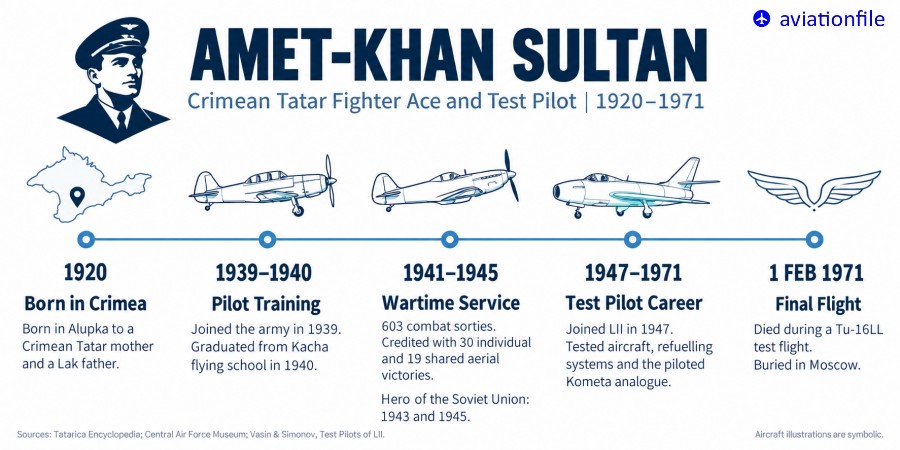
Amet-Khan Sultan was born in Alupka, on Crimea’s southern coast, in October 1920. His mother was Crimean Tatar, while his father belonged to the Lak people of Dagestan. Both the Central Air Force Museum and the Ukrainian presidential representation in Crimea describe his identification with the Crimean Tatar community. His first occupation was connected with railway maintenance. After vocational training, he worked repairing locomotives at a depot in Simferopol. Flying-club training provided his introduction to aviation. He joined the army in 1939 and graduated from the Kacha military flying school in 1940.
His exact birthday remains inconsistent across published sources. Tatarica and the Central Air Force Museum give 20 October 1920, while the Ukrainian presidential representation and MiG Test Pilots give 25 October 1920. This article therefore uses October 1920 without treating either day as conclusively established.

Wartime Service and Recognition
Amet-Khan flew combat missions from the opening period of Germany’s invasion of the Soviet Union in 1941. His wartime service included the fighting around Stalingrad, Rostov, Crimea and Berlin. He advanced from operational flying to squadron leadership and served in the 9th Guards Fighter Aviation Regiment. One of his best-known encounters occurred near Yaroslavl on 31 May 1942. Flying a Hurricane, he rammed a German Junkers Ju 88 bomber and subsequently escaped by parachute. This hazardous encounter became a prominent episode in accounts of his wartime career.
He received the title Hero of the Soviet Union on 24 August 1943, followed by a second award on 29 June 1945.
The commonly cited wartime record credits him with 603 combat sorties, 30 individual aerial victories, and 19 shared victories. These figures agree across several institutional and biographical accounts. They should nevertheless be understood as credited wartime totals, rather than a new, independent reconstruction of German aircraft losses. Shared victories also need to remain separate from his individual score.
The Deportation of the Crimean Tatars
In May 1944, following the recapture of Crimea from German occupation, Amet-Khan visited his family in Alupka. His visit coincided with the Soviet deportation of the Crimean Tatars. The experience placed the persecution of his own community alongside his continuing service in the Soviet armed forces. Accounts differ over the circumstances that allowed his immediate family to avoid deportation. Their exemption should therefore not be attributed solely to his military decorations without stronger documentary evidence.
In later years, Amet-Khan supported efforts to restore the rights of the Crimean Tatars and secure their return to their homeland. This involvement helps explain his enduring importance in Crimean Tatar historical memory.
From Fighter Pilot to Test Pilot
After the war, Amet-Khan attended the Air Force Academy in 1945–1946 and entered the reserve in 1946. In February 1947, he began flight-test work at the Flight Research Institute, or LII, in Zhukovsky near Moscow.
His postwar assignments extended across several research programmes. He participated in aerial-refuelling experiments and the testing of the I-320 experimental interceptor. He also worked with Tu-16 flying laboratories used for jet-engine development. These activities connected his operational flying experience with the practical evaluation of new aviation technology.
Another notable assignment was the NM-1 experimental aircraft, whose first flight he performed on 7 April 1959, according to the biography in Test Pilots of the Flight Research Institute.
Recommended: Wilhelm Kress: The Austrian Aviation Pioneer
The Kometa Programme and Its Connection to Crimea
A particularly distinctive part of his test career involved the piloted analogue of the KS cruise missile, developed for the Kometa anti-ship weapon system. This was an experimental aircraft used to evaluate the missile’s behaviour and systems, rather than an operational missile carrying a pilot. The Central Air Force Museum confirms that Amet-Khan performed the analogue’s first flight on 4 January 1951. It also credits him with its first airborne launch from a Tu-4 carrier aircraft in May 1951. These dates agree with the account in MiG Test Pilots.
The museum records that testing subsequently moved to an air-force range in Crimea. The peninsula therefore formed part of his experimental aviation career as well as his childhood and wartime experience. Amet-Khan received the Stalin Prize in 1953 and the title Honoured Test Pilot of the USSR in 1961. Tatarica states that he mastered approximately 100 types of flying machines. This is an approximate career figure and should not be presented as an exact count of aircraft that he personally tested.
His Final Flight
On 1 February 1971, Amet-Khan Sultan died during a test flight aboard a Tu-16LL flying laboratory. He was 50 years old and was buried at Novodevichy Cemetery in Moscow.
The reviewed sources agree on the date, aircraft and flight-test context. However, this research did not locate a publicly accessible accident-investigation report establishing the definitive technical cause. A specific mechanical failure—or an allegation of sabotage—should therefore not be presented as a confirmed explanation.
An Enduring Legacy
On 14 May 2015, Ukraine’s parliament adopted a resolution naming Simferopol International Airport after Amet-Khan Sultan. This is a documented parliamentary decision, rather than a statement about the name used by the airport’s de facto administration. Amet-Khan Sultan’s aviation legacy rests on both wartime combat flying and postwar experimental research. His career illustrates the transition from piston-engine aerial warfare to increasingly complex flight-test programmes. His Crimean Tatar identity and support for his people give that career a lasting human and historical significance.
References and Further Reading
- Representation of the President of Ukraine in Crimea — Memorial biography prepared with the Ukrainian Institute of National Memory.
- V. P. Vasin and A. A. Simonov, Test Pilots of the Flight Research Institute — Amet-Khan Sultan.
- Tatarica: Tatar Encyclopedia — Amet-Khan Sultan.
- I. B. Balakov and A. A. Simonov, MiG Test Pilots — Amet-Khan Sultan.
- Verkhovna Rada of Ukraine — Resolution naming Simferopol International Airport after Amet-Khan Sultan, 14 May 2015.