
In February 1945, as World War II was approaching its final months in Europe, U.S. President Franklin D. Roosevelt undertook a remarkable journey to Crimea. His destination was the Yalta Conference, where he would meet British Prime Minister Winston Churchill and Soviet leader Joseph Stalin to discuss the final stages of the war and important questions concerning the postwar international order.
Although the Yalta Conference is primarily remembered for its diplomatic significance, Roosevelt’s journey also represents an interesting chapter in aviation history. Traveling at a time when Europe was still at war, the American president crossed the Atlantic aboard a naval warship before continuing from Malta to Crimea in a specially modified Douglas VC-54C Skymaster, known as the Sacred Cow. The flight involved military coordination, fighter escorts, and arrangements designed to accommodate Roosevelt’s physical needs.
The details of this journey are preserved in official U.S. government records, particularly the Foreign Relations of the United States (FRUS) series published by the Department of State and historical material maintained by the National Museum of the United States Air Force.


Source
Preparing for the Journey to Crimea
By the beginning of 1945, Allied forces were advancing against Nazi Germany, and discussions about Europe’s future were becoming increasingly important. Roosevelt, Churchill, and Stalin were preparing to meet in Crimea between February 4 and 11 to discuss military operations and political arrangements that would influence the postwar period. Among the principal subjects were the future of Germany, Poland’s political situation, the establishment of the United Nations, and Soviet participation in the war against Japan.
For Roosevelt, reaching the conference required careful planning. His health and the operational limitations of contemporary aircraft were important considerations, particularly because the journey involved flying over regions where weather, terrain, and wartime conditions could complicate transportation.
A message Roosevelt sent to Churchill on December 31, 1944, provides valuable insight into these preparations. In the correspondence, Roosevelt explained that his medical and other advisers considered it inadvisable for him to fly at high altitudes over the mountainous areas between Italy and Crimea. Admiral H. Kent Hewitt had suggested an alternative route that would allow the president to travel by sea to Malta before continuing by aircraft to Crimea. This arrangement would reduce the need for high-altitude flight and was eventually adopted.
The correspondence illustrates how Roosevelt’s personal circumstances influenced the planning of an international journey. It also reflects the challenges of presidential transportation during a period when long-distance aviation was still developing and most military transport aircraft operated without pressurized cabins.

Crossing the Atlantic Aboard USS Quincy
Roosevelt began the main overseas portion of his journey aboard USS Quincy (CA-71), a Baltimore-class heavy cruiser of the United States Navy. Rather than making the entire journey by air, the president traveled across the Atlantic to Malta, which served as an important staging point for the Allied delegations.
According to the official presidential travel log, USS Quincy entered Grand Harbour at Valletta on the morning of February 2, 1945. The vessel was moored at 10:01 a.m., having traveled approximately 4,883 miles (7,858 kilometers) from Newport News, Virginia. Roosevelt’s arrival in Malta was followed by meetings with Churchill and senior American and British military officials, who were preparing for the discussions with Stalin.
Malta was particularly important to the transportation arrangements because it provided an established Allied base from which the delegations could continue to Crimea by air. The movement involved several aircraft carrying officials, personnel, and equipment. Roosevelt’s aircraft was part of this wider military transportation operation, which required coordination between American and British authorities and the Soviet officials responsible for receiving the delegations.
The Sacred Cow: A Special Aircraft for the American President
The aircraft selected for Roosevelt’s flight to Crimea was the Douglas VC-54C Skymaster, commonly known as the Sacred Cow. Based on the Douglas C-54 military transport, it was specially modified to meet the requirements of presidential travel. According to the National Museum of the United States Air Force, the VC-54C was the first aircraft specifically built to transport a U.S. president, and only one example of this version was produced.
The Sacred Cow combined the fuselage of a C-54A with the wings of a C-54B, providing additional fuel capacity. Powered by four Pratt & Whitney R-2000 engines, each producing approximately 1,450 horsepower, the aircraft had a published maximum speed of around 300 mph (483 km/h) and a range of approximately 3,900 miles (6,276 kilometers). Its service ceiling was listed as 22,300 feet (6,797 meters), although these figures represent the aircraft’s published technical specifications rather than its actual performance during the Yalta flight.
The aircraft’s interior was significantly different from that of a standard military transport. It included a conference area with a large desk, a private lavatory, a folding bed, and an electric refrigerator. One of its most distinctive features was a battery-powered elevator installed at the rear of the fuselage. Because Roosevelt used a wheelchair, this system allowed him to board and leave the aircraft more easily. A special rectangular bulletproof window was also incorporated into the aircraft.
These modifications demonstrate how presidential transportation was beginning to develop beyond the use of conventional military aircraft. The Sacred Cow was not simply intended to carry passengers over long distances; it was adapted to provide a suitable working and traveling environment for the American president. Its unpressurized cabin also made the selection of an appropriate flight altitude particularly relevant to Roosevelt’s journey.
February 3, 1945: The Flight from Malta to Crimea
On February 3, 1945, Roosevelt continued his journey from Malta to the Crimean Peninsula aboard the Sacred Cow. The aircraft departed from Luqa Airfield as part of a coordinated movement of American and British delegations. The flight crossed the Mediterranean region before continuing toward the Black Sea and Crimea, where Soviet authorities had made arrangements to receive the Allied leaders.
One of the most interesting details of the journey was the fighter escort assigned to Roosevelt’s aircraft. According to the official presidential travel log, six Lockheed P-38 Lightning fighters joined the aircraft near Athens. One of these fighters subsequently developed engine trouble and returned to Athens, while the remaining five continued with the presidential aircraft to Saki Airfield.
The P-38 Lightning was a twin-engine fighter widely used by the United States Army Air Forces during World War II. Its participation in Roosevelt’s journey illustrates the military support involved in transporting a head of state through a region affected by an ongoing war.
Roosevelt’s aircraft arrived at Saki Airfield at 12:10 p.m. on February 3, accompanied by the five remaining P-38 fighters. The official travel log records the distance between Malta and Saki as approximately 1,375 miles (2,213 kilometers). Although the surviving records provide useful information about the flight and its arrival, they do not constitute a complete technical account of every stage of the operation.
Arrival in Crimea and the Journey to Livadia Palace
Upon arriving at Saki Airfield, Roosevelt was welcomed by Soviet Foreign Affairs Commissar Vyacheslav Molotov, U.S. Secretary of State Edward Stettinius, and U.S. Ambassador Averell Harriman. The president initially remained aboard his aircraft while waiting for Churchill, whose aircraft arrived from Malta approximately twenty minutes later, also accompanied by fighter escorts.
After Churchill’s arrival, Roosevelt left the Sacred Cow and entered a jeep for the official welcoming ceremony. The event included military honors and the national anthems of the United States, the United Kingdom, and the Soviet Union. Roosevelt reviewed the assembled troops while seated in the jeep, an arrangement consistent with his mobility requirements.
The arrival ceremony marked the end of the flight, but the American delegation still faced a considerable road journey to reach its destination. At approximately 1:06 p.m., Roosevelt and his party departed Saki in vehicles provided by the Soviet government. The route covered around 80 miles (129 kilometers), passing through Simferopol and Alushta before continuing along mountainous roads toward Yalta.
The official travel log provides a detailed description of the surrounding landscape. Parts of the countryside were covered in snow, while damaged buildings, destroyed tanks, and abandoned German railway equipment offered visible reminders of the fighting that had taken place in Crimea. Soviet military personnel were stationed along the route, and the delegation continued through the mountainous terrain toward the southern coast of the peninsula.
Roosevelt’s party passed through Yalta at approximately 5:50 p.m. and reached Livadia Palace at 6:00 p.m. The palace, which had previously served as a residence of the Russian imperial family, became the headquarters of the American delegation during the conference. After an Atlantic crossing, a flight across the Mediterranean and Black Sea region, and a lengthy road journey, Roosevelt had finally reached the location of the diplomatic meetings.
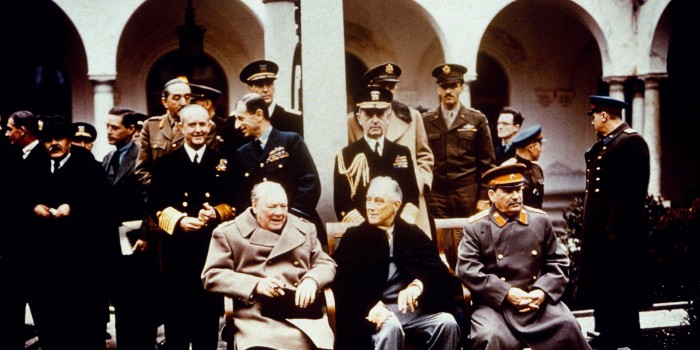
The Yalta Conference and Its Historical Significance
The first formal meeting of the Yalta Conference began at Livadia Palace on February 4, 1945. Roosevelt, Churchill, and Stalin were joined by senior diplomatic and military representatives, and their discussions continued until February 11.
The conference addressed important questions concerning the final military operations against Germany and the political organization of Europe after the war. The leaders also discussed the proposed United Nations, Poland’s future, and Soviet participation in the war against Japan. The agreements reached at Yalta and their subsequent implementation became major subjects of historical discussion during the postwar period.
From an aviation perspective, however, Roosevelt’s journey is significant for different reasons. It demonstrates the growing role of aircraft in high-level international diplomacy and the extent of the logistical preparations required for presidential transportation during wartime. The combination of naval travel, specially modified aircraft, fighter escorts, and coordinated ground transportation provides a useful example of how military resources supported diplomatic activity in the 1940s.
An Unusual Security Measure and the Sacred Cow’s Later History
Another interesting detail of Roosevelt’s Yalta journey concerns the identification of the Sacred Cow. According to the National Museum of the United States Air Force, the aircraft’s original serial number was 42-107451. During the Yalta trip, however, it displayed the number 42-72252 as a security precaution. Although the museum does not provide extensive operational details about this measure, the change reflects the special security considerations associated with presidential transportation during World War II.
Roosevelt’s journey to Yalta was his only flight aboard the Sacred Cow. He died on April 12, 1945, approximately two months after the conference, and the aircraft subsequently continued its presidential service under Harry S. Truman.
The Sacred Cow later became associated with another important event in American history. On July 26, 1947, Truman signed the National Security Act of 1947 aboard the aircraft. The legislation provided the legal foundation for establishing the United States Air Force as an independent military service.
After its presidential service, the aircraft continued to be used for military transportation before being retired in October 1961. It was eventually transferred to the National Museum of the United States Air Force in 1983, where it underwent an extensive restoration process. According to the museum, the restoration required more than 34,000 hours of work over approximately ten years.
Today, the Sacred Cow is preserved as an important example of early presidential aviation and the transition toward aircraft specifically designed for transporting national leaders.
Recommended: Amet-Khan Sultan: The Crimean Tatar Fighter Ace and Test Pilot
Conclusion
Franklin D. Roosevelt’s journey to the Yalta Conference in February 1945 offers an interesting connection between aviation history and international diplomacy. At a time when World War II was still underway, the American president traveled across the Atlantic aboard USS Quincy before continuing to Crimea in the specially modified Douglas VC-54C Sacred Cow.
The journey required careful consideration of Roosevelt’s health, aircraft capabilities, flight routing, military security, and ground transportation. The documented participation of P-38 Lightning fighters, the arrangements at Saki Airfield, and the final journey to Livadia Palace illustrate the coordination involved in transporting a national leader during wartime.
Although the Yalta Conference is remembered mainly for its political and diplomatic consequences, Roosevelt’s flight deserves recognition as part of the early development of presidential air transportation. The Sacred Cow’s special modifications and subsequent service under President Truman also demonstrate how dedicated presidential aircraft gradually became an established element of modern government operations.
Supported by official historical records, the journey remains a valuable example of the relationship between aviation technology, military logistics, and diplomacy during the final months of World War II.
References and Further Reading:
- U.S. Department of State, Office of the Historian. (1945). Foreign Relations of the United States: Diplomatic Papers, Conferences at Malta and Yalta, 1945. Presidential travel log, February 3–12, 1945.
https://history.state.gov/historicaldocuments/frus1945Malta/d322 - U.S. Department of State, Office of the Historian. (1944). President Roosevelt to Prime Minister Churchill, December 31, 1944. In Foreign Relations of the United States: Conferences at Malta and Yalta, 1945.
https://history.state.gov/historicaldocuments/frus1945Malta/d36 - U.S. Department of State, Office of the Historian. (1945). Foreign Relations of the United States: Diplomatic Papers, Conferences at Malta and Yalta, 1945. Presidential travel log, February 2, 1945.
https://history.state.gov/historicaldocuments/frus1945Malta/d290 - U.S. Department of State, Office of the Historian. Foreign Relations of the United States: Conferences at Malta and Yalta, 1945 – Introduction.
https://history.state.gov/historicaldocuments/frus1945Malta/introduction - National Museum of the United States Air Force. Douglas VC-54C “Sacred Cow”. Official aircraft history and technical specifications.
https://www.nationalmuseum.af.mil/Visit/Museum-Exhibits/Fact-Sheets/Display/Article/195813/www.youtube.com/USAFmuseum/www.youtube.com/douglas-vc-54c-sacred-cow/