
Artificial intelligence is already transforming aviation, from predictive maintenance to flight planning and airport operations. However, a new development is attracting increasing attention: AI agents (2026). Unlike traditional AI systems that primarily analyze information or generate predictions, AI agents can perform multiple connected tasks to achieve a specific goal. They can gather information, interact with software systems, evaluate alternatives, and execute authorized actions. In aviation, where operational efficiency, coordination, and safety are essential, this technology could become an important part of future digital operations.
What Is an AI Agent?
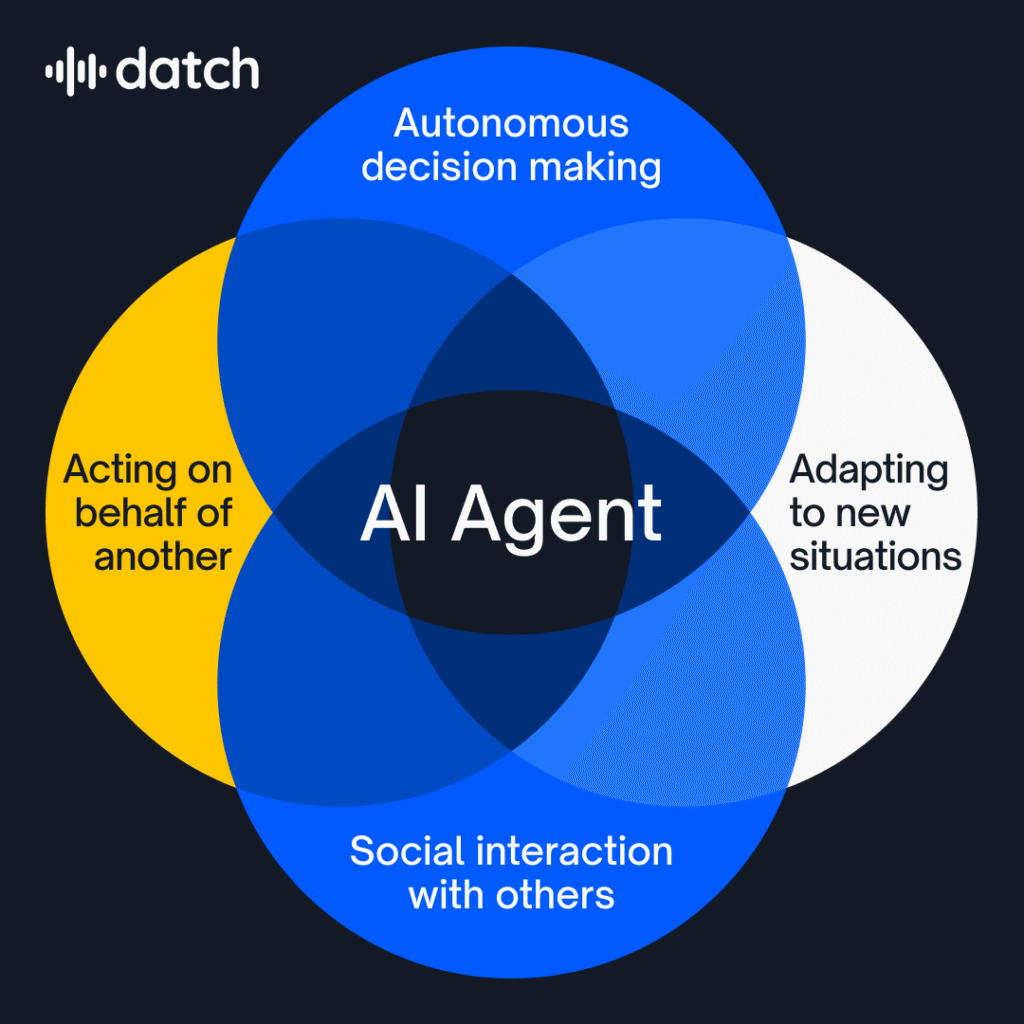
An AI agent is a software system that uses artificial intelligence to pursue defined objectives through a sequence of actions. For example, a conventional AI system might predict that a flight will be delayed. An AI agent could go further by checking connecting flights, reviewing available resources, identifying alternative arrangements, and preparing recommendations for an operations team.
AI agents generally combine several capabilities:
- Information gathering: Accessing relevant data from connected systems.
- Reasoning and planning: Identifying the steps needed to complete a task.
- Tool interaction: Using software applications, databases, or authorized interfaces.
- Task execution: Performing permitted actions or requesting human approval.
- Monitoring: Checking results and adjusting subsequent actions.
Not every AI-powered application is an AI agent. A prediction model or chatbot does not automatically qualify as an agent unless it can coordinate actions toward a defined objective.
Importantly, autonomy does not necessarily mean operating without human supervision. AI agents can be designed with approval requirements, operational restrictions, and human oversight.
Real-World Examples of AI Agents in Aviation
Although agentic AI is still an emerging technology by 2026, several aviation organizations have already introduced products, research projects, or implementation initiatives.
1. Turkish Technology – ResAI
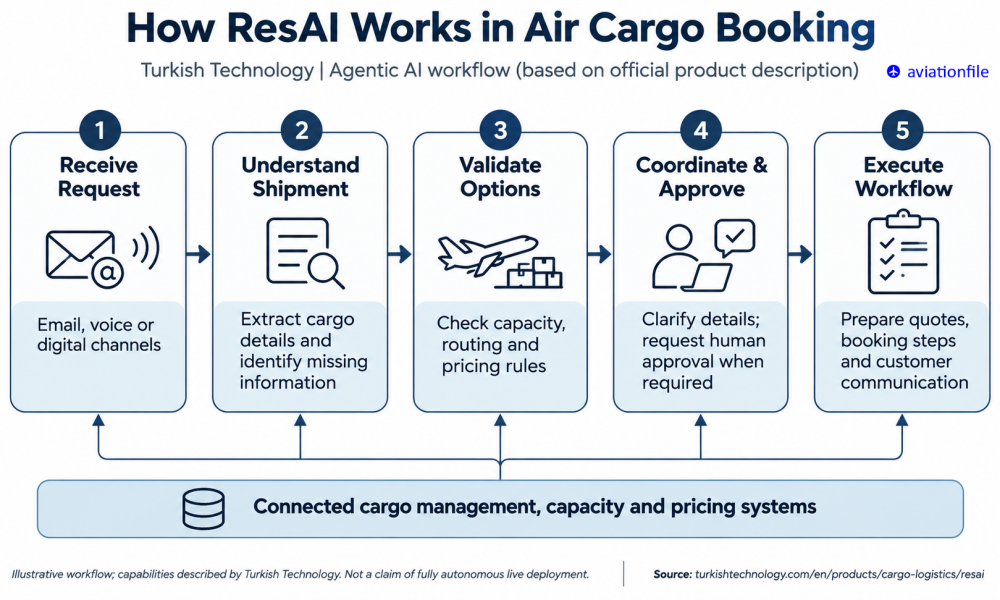
Turkish Technology has introduced ResAI, an agentic AI platform designed to support air cargo booking and logistics sales operations. According to the company’s official product documentation, ResAI can interpret incoming booking requests, extract shipment information, check capacity and pricing rules, request missing details, and coordinate booking workflows.
The platform is designed to interact with existing cargo management systems while maintaining human approval for decisions that require additional authorization. ResAI illustrates how AI agents can move beyond providing information and participate in multi-step commercial processes. However, the publicly available product description does not independently establish the scale of its operational deployment or measured performance.
2. IATA – Project Carina
The International Air Transport Association (IATA) has developed Project Carina (source), a proof-of-concept initiative investigating cooperation between AI agents across different airline systems. The project focuses on interline air cargo operations, where airlines frequently need to exchange information about bookings, capacity, agreements, and disruptions. According to IATA’s 2026 technical report, the project demonstrated communication between AI agents representing four simulated airlines, each implemented by a different technology partner.
The system explored three main scenarios: initial cargo booking, disruption management, and cancellation.
A particularly important feature is that participating organizations can retain their existing IT systems while AI agents coordinate selected workflows between them. Project Carina remains a proof of concept rather than evidence of widespread operational deployment. Nevertheless, it provides a documented example of multi-agent cooperation in aviation.
3. Ryanair and Google Cloud – Enterprise AI Agents
In August 2026, Ryanair announced a five-year data and AI partnership with Google Cloud (source). The agreement includes the deployment of Gemini Enterprise, Google’s agentic AI platform, as part of a broader technology rollout supporting approximately 35,000 Ryanair employees. According to Ryanair’s official announcement, the platform is intended to help automate workflows, support decision-making, improve flight crew logistics, and increase organizational productivity. This initiative demonstrates growing airline interest in integrating AI agents into enterprise operations.
However, the announcement describes a deployment program and its intended benefits; it does not establish that all proposed agent-based functions are already operational.
Recommended: Calibrated Trust in Information Systems: Why Decision Support Should Be Trusted—but Not Blindly
The Future of AI Agents in Aviation
The potential applications of AI agents extend well beyond cargo bookings and administrative workflows.
Air Traffic Management (ATM)
Future AI agents could integrate traffic predictions, weather information, airspace restrictions, and airport capacity data to support air traffic controllers and flow management personnel. For example, an agent might identify developing congestion, evaluate alternative traffic management strategies, and present recommendations to human operators. Such systems would require rigorous validation, cybersecurity protection, and appropriate regulatory approval before performing safety-critical functions.
Aircraft Maintenance
AI agents could combine aircraft health monitoring information, maintenance records, technical documentation, and spare-part availability to support maintenance planning. Rather than simply predicting a component failure, an agent could help coordinate the subsequent maintenance workflow.
Airport Operations
Airports could use AI agents to coordinate aircraft stands, ground handling resources, turnaround activities, and operational disruptions. These systems may help different airport stakeholders share information and respond more efficiently to changing conditions.
Airline Operations
AI agents could support operations control centers by evaluating schedule disruptions, aircraft availability, crew constraints, and passenger connections. Their main advantage may be the ability to coordinate information and actions across systems that currently require substantial manual interaction.
Challenges: Safety, Trust, and Human Oversight
Despite their potential, AI agents introduce important challenges. Aviation organizations must consider the reliability of information, cybersecurity, system integration, traceability, and accountability for automated decisions. AI-generated recommendations may also be incorrect, incomplete, or based on outdated information. In safety-critical environments, particularly air traffic control and flight operations, human oversight and clearly defined operational authority remain essential. The distinction between decision support and autonomous operational control is therefore fundamental.
Types of AI Agents
AI agents can be classified into different types depending on how they process information, make decisions, and respond to their environment. Five commonly recognized types are:
- Simple Reflex Agents: Respond to specific conditions using predefined rules, without considering previous events. For example, a basic monitoring system may trigger an alert when a predefined threshold is exceeded.
- Model-Based Reflex Agents: Maintain information about their environment and use previous observations to make more informed decisions.
- Goal-Based Agents: Plan and select actions to achieve a particular objective, such as finding an efficient route or completing a booking process.
- Utility-Based Agents: Compare different alternatives and select the most beneficial option based on defined criteria, such as time, cost, or efficiency.
- Learning Agents: Improve their performance over time by learning from experience, new information, and feedback.
These categories are not necessarily mutually exclusive. For example, an agent may pursue specific goals while also learning from previous experiences. In aviation, understanding these basic differences helps explain how AI agents could support tasks ranging from simple operational monitoring to complex planning and decision support.
Conclusion
AI agents represent a potential next step in aviation’s digital transformation. Unlike traditional AI applications, they can coordinate multiple tasks, interact with operational systems, and support complex workflows. Projects such as Turkish Technology’s ResAI, IATA’s Project Carina, and Ryanair’s Google Cloud initiative demonstrate growing interest in agentic AI across the aviation industry. However, these examples represent different stages of maturity, from commercially presented products to research prototypes and enterprise deployment initiatives. The most realistic near-term opportunity is not replacing aviation professionals, but improving coordination, reducing repetitive work, and supporting better-informed decisions. As the technology develops, its long-term success in aviation will depend not only on technical capabilities but also on reliability, transparency, human oversight, and safety.
References
- Turkish Technology. (2026). ResAI – Your Agentic AI Booking Workforce for Air Cargo and Logistics Sales Operations. https://turkishtechnology.com/en/products/cargo-logistics/resai
- International Air Transport Association (IATA). (2026). Data and Technology Proof of Concept – Cycle 2: Project Carina, AI Agent Multilateral Interoperability. https://www.iata.org/contentassets/a46387f9bc6b42368c0a72664f6f930f/cycle2-data-tech-poc-position-paper.pdf
- IATA. (March 11, 2026). IATA Advances AI Initiatives to Support Air Cargo Operations. https://www.iata.org/en/pressroom/2026-releases/2026-03-11-01/
- Ryanair. (August 12, 2026). Ryanair & Google Cloud Announce Five-Year Data and AI Partnership. https://corporate.ryanair.com/news/ryanair-google-cloud-announce-five-year-data-and-ai-partnership/
- https://web.stanford.edu/class/cs224g/lectures/CS%20224G%202026%20Lecture%207%20-%20Agent%20Orchestration%20%26%20Workflow%20Design.pdf