
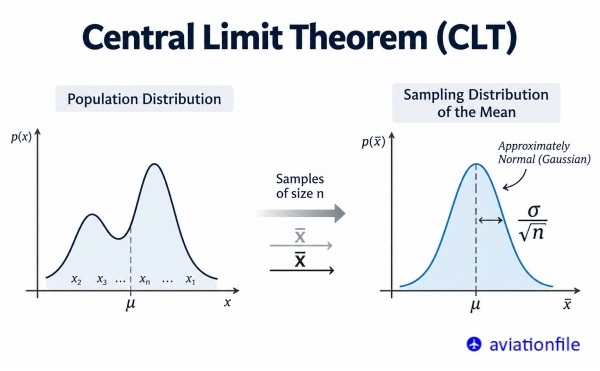
The Central Limit Theorem (CLT) is a cornerstone of statistics. It states that the sampling distribution of the sample mean approaches a normal distribution as the sample size increases, regardless of the population’s distribution. This powerful concept plays a crucial role in air traffic management (ATM), where accurate decision-making relies heavily on data analysis and prediction.
Importance of CLT in Air Traffic Management
Air traffic management involves handling vast amounts of data, such as flight delays, aircraft movements, and weather patterns. These datasets often have varied and complex distributions. The CLT enables air traffic controllers and planners to make accurate inferences by assuming normality in large datasets.
- Flight Delay Predictions: Using the CLT, analysts can calculate the average flight delay with confidence, even if individual delays follow a non-normal distribution. For instance, major airports like Atlanta’s Hartsfield-Jackson use historical delay data to optimize daily schedules and minimize congestion.
- Traffic Flow Optimization: The CLT supports models that predict peak air traffic periods by averaging data from various sources. For example, European air traffic management utilizes CLT-based tools to predict traffic surges during holidays and manage sector workloads effectively.
- Weather Impact Analysis: Weather conditions affect flight schedules and safety. The CLT allows aggregation of meteorological data, simplifying the analysis of its impact on flights. For instance, New York’s JFK airport uses aggregated weather data to anticipate storm-related delays and prepare contingency plans.
Understanding the Role of the CLT in Air Traffic Management
It is important to clarify that the Central Limit Theorem (CLT) is not an operational air traffic management tool by itself. Air traffic controllers do not directly apply the CLT when managing aircraft, nor does the theorem imply that air traffic, delay, or weather data automatically follow a normal distribution.
Instead, the CLT provides a mathematical foundation for certain statistical analyses used in aviation research, forecasting, performance assessment, and decision support. Under appropriate conditions, the distribution of sample means or sums tends toward a normal distribution as the sample size increases, even when the underlying observations are not normally distributed.
In an ATM context, this principle can support statistical inference when analysts estimate quantities such as average delays, traffic demand, sector workload, or other operational performance indicators from sufficiently large samples. Its importance therefore lies primarily in supporting the statistical methods used to understand uncertainty and draw conclusions from complex aviation data, rather than in directly controlling or predicting air traffic.
Other Statistical Methods in Air Traffic Management
In addition to the CLT, several other statistical methods enhance decision-making in air traffic management:
- Regression Analysis:
- Example: Airports like Chicago O’Hare use regression models to predict delays caused by variables such as weather, aircraft maintenance, and runway conditions. This helps optimize gate assignments and reduce turnaround times (Stanford University).
- Time Series Analysis:
- Example: London Heathrow analyzes historical hourly air traffic volumes to identify recurring patterns and forecast demand for airspace, aiding in crew scheduling and resource allocation (Heathrow)
- Monte Carlo Simulations:
- Example: Air traffic control systems in Dubai simulate various traffic scenarios, such as emergency diversions or heavy fog, to determine optimal runway usage and ensure minimal disruption (arxiv)
- Bayesian Statistics:
- Example: The FAA applies Bayesian methods to assess the probability of rare events, such as mid-air collisions, incorporating real-time updates from radar data to refine safety measures (catsr)
- Hypothesis Testing:
- Example: Airports test the effectiveness of new procedures, such as single-engine taxiing, to validate assumptions about fuel savings and emissions reduction without compromising operational efficiency.
Applications in Real-World Air Traffic Management
- Runway Capacity Management: Statistical methods help determine how many aircraft can land or take off in a given time without delays. For instance, Los Angeles International Airport uses statistical modeling to assess runway occupancy times during peak hours (aviationsystems.arc.nasa.gov)
- Safety Assessments: Data-driven models predict potential safety risks, ensuring compliance with aviation standards. For example, EUROCONTROL uses statistical methods to evaluate collision risks in European airspace (EUROCONTROL).
- Efficiency Improvements: By analyzing traffic patterns, airports can optimize schedules and reduce passenger wait times. Singapore Changi Airport uses predictive analytics to improve baggage handling and reduce transfer times (straitstimes).
Why Statistical Methods Matter
The aviation industry operates in a high-stakes environment. Statistical methods, including the CLT, allow for data-driven decisions that enhance safety, efficiency, and passenger satisfaction. These tools also enable proactive problem-solving, minimizing disruptions and maximizing resource utilization.
Key Takeaways for Air Traffic Managers
- Leverage the Central Limit Theorem: Simplify complex datasets for actionable insights.
- Use complementary methods: Combine CLT with regression, time series, and simulations for robust analysis.
- Focus on continuous improvement: Regularly analyze and refine ATM processes using statistical insights.
Conclusion
Statistical methods form the backbone of effective air traffic management. From ensuring safety to optimizing efficiency, tools like the Central Limit Theorem, regression analysis, and Monte Carlo simulations enable data-driven decisions in an industry where precision is critical. By embracing these methods, air traffic managers can confidently tackle challenges, streamline operations, and maintain the highest standards of safety and service. Leveraging the power of statistics ensures that the aviation industry remains prepared for current demands and future innovations.
References and Further Reading:
References
- National Institute of Standards and Technology (NIST). Central Limit Theorem. NIST Computer Security Resource Center. NIST – Central Limit Theorem
- International Civil Aviation Organization (ICAO). Global Air Navigation Plan (GANP) – Performance Management and Data Analytics. ICAO GANP Portal. ICAO GANP – Performance Management
- EUROCONTROL. On the Validation Practices at the EUROCONTROL Experimental Centre. EUROCONTROL. EUROCONTROL – Validation Practices
- EUROCONTROL. Validating Probabilistic Network Traffic Forecast. EUROCONTROL/SESAR. EUROCONTROL – Probabilistic Network Traffic Forecast
- National Aeronautics and Space Administration (NASA). Validating an Air Traffic Management Concept of Operation Using Statistical Modeling. NASA Technical Reports Server (NTRS). NASA NTRS – Statistical Modeling in ATM
- Federal Aviation Administration (FAA). Performance Data and Analysis. Federal Aviation Administration. FAA – Performance Databases