
Fata Morgana is one of nature’s most fascinating optical illusions—an atmospheric mirage so dramatic that it can make ships float, islands rise like skyscrapers, or coastlines appear where none exist. While it feels like something out of maritime folklore, this phenomenon is rooted in complex atmospheric physics and holds real operational importance for aviation. Understanding how and why Fata Morgana occurs helps pilots, air traffic controllers, and even search-and-rescue teams make safer decisions in visually challenging environments.
What Is Fata Morgana?
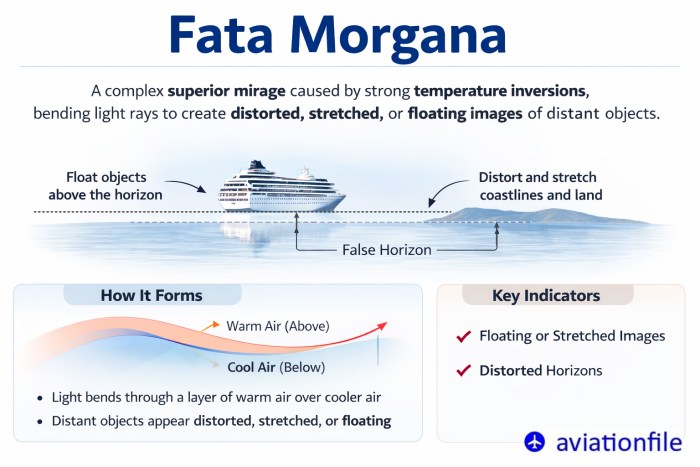
Fata Morgana is a type of superior mirage caused by a strong temperature inversion, where a layer of warm air sits above colder, denser air near the surface. This temperature structure bends light downward toward the observer, allowing you to see distant objects that would normally be hidden by Earth’s curvature—or making real objects look elevated, stretched, or distorted.
In simple terms, Fata Morgana tricks the human eye by refracting light in extreme ways. This can produce images that appear stacked, floating, flipped upside down, or stretched vertically. The name “Fata Morgana” comes from the sorceress Morgan le Fay in Arthurian legend, highlighting its almost magical appearance.
How Does a Temperature Inversion Create the Illusion?
Under normal conditions, light travels in straight lines through layers of air with gradual temperature changes.
But when a temperature inversion forms—cold air trapped under warmer air—light bends toward the denser layer. This bending (refraction) creates visual distortions such as:
- Elevated images of distant objects
- Multiple layers appearing like “stacks”
- Floating ships, lifted horizons, and stretched coastlines
- Rapidly changing shapes as the atmospheric layers shift
Fata Morgana is commonly observed over sea surfaces, ice sheets, deserts, and long flat landscapes, where sharp temperature contrasts occur.
Fata Morgana and Aviation: Why It Matters
Although often associated with maritime navigation, Fata Morgana can create visual challenges for pilots, especially during low-altitude operations or when flying over bodies of water.
1. False Horizons and Visual Illusions
The phenomenon can distort the horizon line, making it appear higher, lower, or curved. For pilots relying on visual cues—particularly during VFR flights—this can create spatial disorientation or misjudgment of aircraft attitude.
2. Misinterpretation of Terrain and Objects
Fata Morgana can make distant ships, mountains, buildings, or even coastlines appear closer or higher than they really are. In visually demanding phases of flight such as search and rescue, coastline patrolling, or helicopter operations, this illusion may complicate decision-making.
3. Impact on Search and Rescue (SAR)
Mirages can create false targets, causing crews to interpret visual cues incorrectly. A floating ship that appears much larger or closer can easily be a distorted mirage. For SAR missions over the sea, recognizing Fata Morgana is essential.
4. Pilots in Cold Regions Are More Exposed
Fata Morgana occurs frequently in polar regions, winter coastal environments, and icy surfaces—areas where aviation operations already face heightened risks. Pilots flying in the Arctic, North Atlantic, or Antarctic regions often report dramatic mirage effects.
Where Is Fata Morgana Most Common?
You’re most likely to encounter this phenomenon:
- Over cold seas on sunny days
- Near polar regions (Greenland, Antarctica, Northern Canada)
- Above desert surfaces
- Along coastlines with rapid temperature transitions
- Over ice-covered lakes or snow-covered ground
These areas produce the strong, stratified air layers needed for extreme refraction.
Historical Connections and Misreported Sightings
Throughout history, Fata Morgana has been responsible for many misinterpretations—from sailors reporting mythical islands to explorers believing they spotted land during polar missions. Even today, viral images of “floating ships” along coastlines often turn out to be classic examples of this atmospheric illusion.
Why Pilots Should Recognize This Illusion
For aviation professionals, the key to handling Fata Morgana lies in awareness. Pilots trained to identify atmospheric illusions are less likely to rely on misleading visual cues. Instrument proficiency provides the biggest protection: when the eyes deceive, the instruments do not.
In ATC and pilot communication, unusual visual reports—“ships appear floating,” “coastline seems elevated,” or “horizon looks curved”—should be evaluated with knowledge of the local weather conditions, especially temperature inversions.
Recommended Article: Loss of Situational Awareness for Air Traffic Controllers: A Safety Threat
Conclusion
Fata Morgana is a visually stunning yet operationally significant atmospheric illusion. For aviation, it represents another reminder that visual perception can easily be distorted under certain atmospheric conditions. Understanding how this phenomenon works not only enriches our knowledge of flight and weather but also supports safer operational awareness.
References
- National Weather Service. (n.d.). Mirages and optical phenomena.
https://www.nesdis.noaa.gov/our-environment/optical-phenomena - Britannica. (2024). Fata Morgana (optical phenomenon).
https://www.britannica.com/topic/Fata-Morgana-mirage