
Article by – Dimitri Ursulin Guest Writer of aviationfile
While air travel is undoubtedly the fastest way to go from place to place, it sometimes appears that slowing down is required in order to maintain safety. To regulate air traffic, some tools are used daily as a helping hand towards that objective. Among them, two similar yet different procedures constitute the backbone of traffic regulation: holding patterns and hacetrack patterns. Since they represent such an important part of aviation, let’s dive into their differences and applications into everyday operations.
Holding patterns: When slower means safer
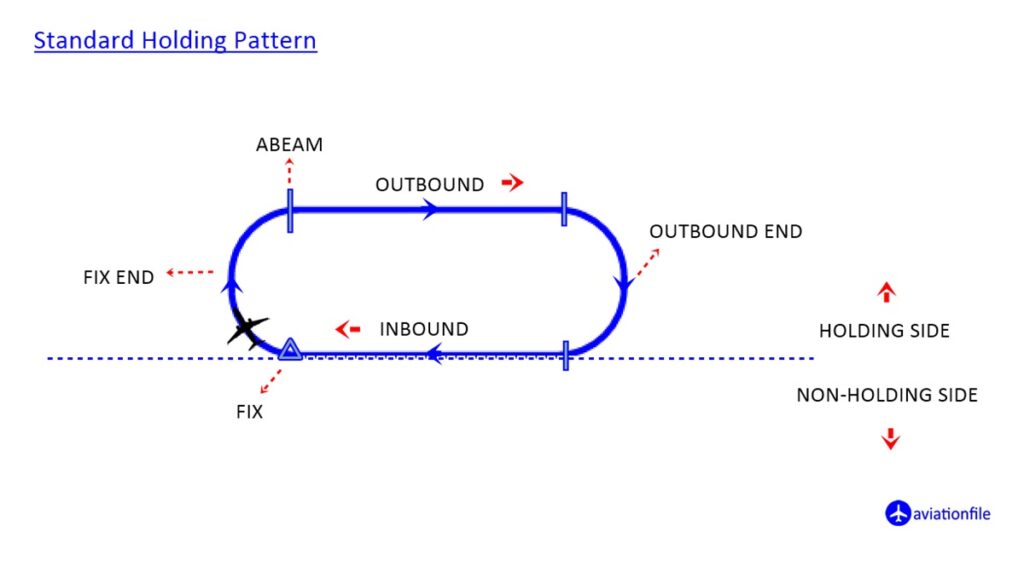
A holding pattern, also referred to as “holding procedure” or simply “a hold”, is a procedure in which aircraft are placed on a specific track in order to regulate traffic. The construction and use of holding patterns are regulated so as to maintain a certain level of safety in all applications. As such, some limits are designed into the procedure itself, as explained below.
Firstly, the holding track itself is built in a way that lets aircraft manoeuvre safely. As depicted below, the track is made up of two parallel staight lines connected by two half circles positioned at each end. The exact dimensions of the holding are either limited by time (1 min per “sector” for a total of 4 min all around) or by distance (distance between the holding fix and the end of the outbound leg).
Secondly, the “general area” of the holding is said to be “protected”. This means that the aircraft is guaranteed safe operation within a certain range, calculated by taking into account several parameters such as wind, speed, altitude, terrain, or even temperature.
In order to build a protected area of resonable size, the speeds and altitudes along the track are limited as shown below.

Lastly, aircraft in holdings are protected by a segregation of allowed altitudes inside the pattern. This means that only a specific selection of altitudes (often odd or even) is available for use. The allocation of these remains the sole responsibility of the Air Traffic Controller.
In a nutshell, holding patterns are the main components of air traffic regulation when simple route alterations are no longer possible. They are well protected inside an area designed to envelop every flight path. We can consider them as the aviation equivalent of a polite queue at 8,000 feet.
Racetracks: The blunt yet useful twin
The racetrack is a procedure, built similarly to a hold, that lacks the level of protection offered by a dedicated holding procedure. Racetracks are most commonly used in close proximity to airports, in a way that eases the transition between arrival and final approach phases.
While being less strict on speed and altitude constraints, racetracks are usually “protected” by the airport’s own protection area. However, the racetrack makes up for the lack of protection by suggesting speeds and altitudes, often related to the actual approach procedure they are linked to. These suggestions are presented as a speed/outbound time chart where a designated speed corresponds to a set timing on the outbound leg.
Racetracks help ease the transition between arrival and approach phases. This is done by allowing aircraft to enter the track from any angle, while also guiding them towards the final approach segment. This ensures a safe arrival without high-bank turns, which could jeopardise safety.
In a nutshell, racetracks are not to be confused with holding patterns, for they lack the level of protection offered by the latter. However, they constitute an important asset used in critical terminal phases of flight and improve safety, almost as much as their stricter brother.
The small but powerful family
In conclusion, while it is true that holdings and racetracks are close siblings, each one serves its own purpose in regard to safety. Holding procedures are established anywhere suitable, and are available when needed to regulate traffic. As they are requiredto maintain a certain level of accuracy, some limits are implemented into the design and regulation itself. Racetracks, on the other hand, are a bit more permissive, while remaining safe and useful. They serve a more discreet, yet important objective: guiding each aircraft safely towards its destination.
In short, holdings and racetracks are aviation’s way of saying, “Please wait, we’ll be right with you”—but with a few thousand horsepower and impeccable precision.
Recommended article: Aeroplane vs. Airplane vs. Aircraft vs. Flight: Understanding the Key Differences
Sources
- FAA ENR 1.5 : https://www.faa.gov/air_traffic/publications/atpubs/aip_html/part2_enr_section_1.5.html
- ICAO Doc 8168 PANS-OPS : https://www2023.icao.int/NACC/Documents/Meetings/2021/DSMW/eCharts-P04-EN.pdf
- FAA Instrument Procedures Handbook: https://www.faa.gov/regulations_policies/handbooks_manuals/aviation/instrument_procedures_handbook