
Mutual Assured Destruction (MAD) is one of the most influential military doctrines of the nuclear age. Developed during the Cold War, it shaped global security strategy and remains relevant to discussions of nuclear deterrence today. The concept argues that when two opposing states possess enough nuclear weapons to completely destroy each other, neither side will initiate a nuclear attack because doing so would guarantee its own annihilation.
This strategic equilibrium helped prevent direct military confrontation between nuclear superpowers for decades. In this article, we examine the origins of MAD, how it works, its role during the Cold War, and why it still matters in modern military and aviation strategy.
What Is Mutual Assured Destruction?
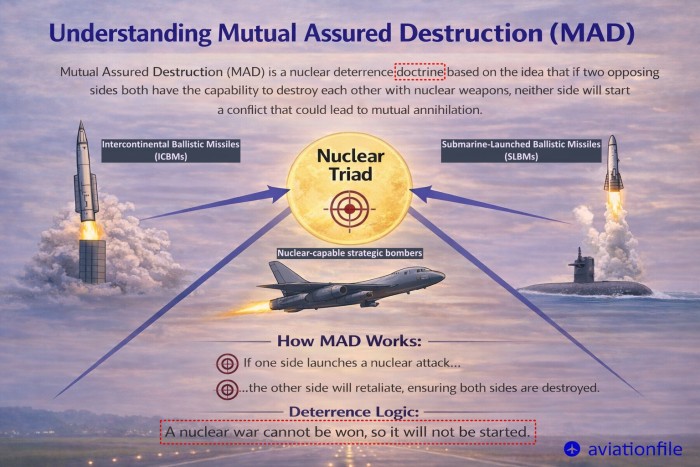
Mutual Assured Destruction (MAD) is a military strategy based on nuclear deterrence. It assumes that if one nuclear-armed state launches a full-scale nuclear strike against another nuclear power, the attacked country will retaliate with its own nuclear weapons. The resulting exchange would destroy both nations, leaving no winner.
The doctrine relies on a critical requirement: second-strike capability. This means that even after suffering a nuclear attack, a nation must retain enough surviving nuclear forces to launch a devastating counterattack.
Because both sides understand this outcome, the logic of MAD discourages either side from initiating nuclear war.
Origins of the MAD Doctrine
The concept of Mutual Assured Destruction emerged during the early Cold War as the United States and the Soviet Union rapidly expanded their nuclear arsenals. By the 1950s and 1960s, both superpowers possessed thermonuclear weapons capable of destroying entire cities and regions.
The term “Mutually Assured Destruction” (MAD) was coined in 1962 by strategist Donald Brennan at the Hudson Institute. The acronym intentionally formed the word “mad,” highlighting the paradox of maintaining peace through the threat of total annihilation.
During this period, nuclear strategy shifted from winning wars to deterring them entirely. The presence of massive nuclear arsenals made traditional military victory meaningless because any nuclear exchange would result in catastrophic destruction on both sides.
The Nuclear Triad: Foundations of MAD
For MAD to function effectively, countries must maintain a secure and survivable nuclear arsenal. This led to the development of the nuclear triad, which includes three delivery systems:
1. Land-Based Intercontinental Ballistic Missiles (ICBMs)
These missiles are launched from underground silos or mobile platforms and can strike targets thousands of kilometers away within minutes.
2. Submarine-Launched Ballistic Missiles (SLBMs)
Nuclear submarines can remain hidden underwater for extended periods, ensuring a retaliatory capability even if land-based forces are destroyed.
3. Strategic Bombers
Long-range bombers carry nuclear weapons and provide flexible response options during crises.
Together, these systems ensure redundancy and survivability, making it nearly impossible for an adversary to eliminate all nuclear forces in a single attack.
MAD During the Cold War
The doctrine of MAD heavily influenced Cold War geopolitics. Both the United States and the Soviet Union maintained massive nuclear arsenals capable of destroying each other many times over.
Several historical events highlighted the importance of nuclear deterrence:
- The Cuban Missile Crisis (1962) brought the world close to nuclear war, reinforcing the dangers of escalation.
- Arms control agreements such as the Strategic Arms Limitation Talks (SALT) attempted to stabilize the nuclear balance.
- The concept of Pax Atomica, or nuclear peace, suggested that the fear of mutual destruction prevented large-scale wars between superpowers.
Although tensions were extremely high, the existence of MAD arguably prevented a direct military conflict between the United States and the Soviet Union.
Criticism and Risks of MAD
Despite its role in maintaining strategic stability, the MAD doctrine has faced significant criticism.
1. Accidental Nuclear War
Technical failures, misinterpretation of radar signals, or human error could trigger an unintended nuclear exchange.
2. Nuclear Proliferation
As more countries acquire nuclear weapons, maintaining stable deterrence becomes more complex.
3. Non-State Actors
MAD relies on rational state actors. Terrorist groups or rogue actors with nuclear capabilities would not necessarily be deterred by retaliation.
4. Ethical Concerns
The strategy depends on the willingness to destroy entire cities and populations, raising profound moral and humanitarian issues.
MAD in the Modern Era
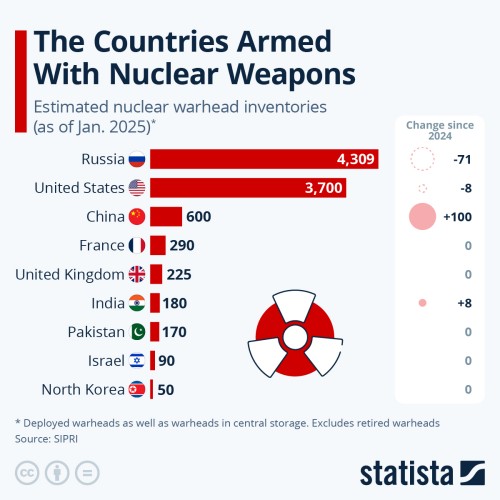
Although the Cold War ended in 1991, the principles of nuclear deterrence remain relevant. Today, several countries maintain nuclear arsenals, including the United States, Russia, China, France, the United Kingdom, India, Pakistan, and North Korea.
Modern deterrence strategies still rely on the core logic of MAD: the certainty of retaliation prevents nuclear conflict.
However, emerging technologies such as missile defense systems, cyber warfare, and hypersonic weapons may alter the balance of nuclear deterrence in the future.
Aviation and Strategic Deterrence
Aviation has played a crucial role in nuclear deterrence strategy. Strategic bombers such as the B-52, B-2 Spirit, and Tu-95 have historically served as airborne nuclear delivery platforms.
Unlike missiles, bombers provide flexibility because they can be recalled after launch, allowing political leaders more time to manage crises. This makes them an important component of modern deterrence doctrines.
In addition, nuclear-capable aircraft and airborne command systems remain vital to maintaining credible deterrence and ensuring communication during extreme scenarios.
Recommended
Soaring Above the Fray: The Lockheed U-2’s Reign as the Cold War’s Spy Plane
Conclusion
Mutual Assured Destruction remains one of the most controversial yet influential doctrines in military history. By ensuring that any nuclear attack would result in the annihilation of both sides, MAD created a strategic balance that discouraged nuclear war between superpowers.
While the global security environment has evolved since the Cold War, the fundamental logic of nuclear deterrence still shapes international relations. Understanding the principles behind MAD is essential for analyzing modern military strategy, nuclear policy, and the role of aviation in global security.