
Cabin crew members work in an environment unlike most conventional workplaces. Their duties combine safety responsibilities, irregular schedules, night work, changing time zones, prolonged standing and walking, manual handling, repetitive movements, passenger interaction and periods of high psychological demand.
Although pilots and cabin crew share many aviation-related occupational exposures, their physical workloads can be substantially different. Pilots spend much of a flight seated in a constrained cockpit environment, whereas cabin crew repeatedly stand, walk, bend, reach, lift, push and pull while performing safety and service duties.
Understanding these differences is important because cabin crew health is not simply a matter of personal fitness. It is also an occupational health issue involving fatigue, sleep, ergonomics, mental well-being and the organization of work.
The U.S. National Institute for Occupational Safety and Health (NIOSH) identifies several health concerns relevant to aircrew, including circadian disruption, job stress, musculoskeletal disorders, noise, cosmic ionizing radiation, reproductive health and respiratory exposures. CDC
The Cabin Crew Working Environment
A normal duty period may require a flight attendant to alternate between physically demanding tasks and periods of relatively lower activity. Cabin crew may walk repeatedly through narrow aisles, work in restricted galley spaces, push or pull service carts, reach overhead, handle equipment or baggage, and maintain balance while the aircraft is moving.
NIOSH specifically identifies lifting, pushing, pulling, reaching, prolonged standing, awkward or constrained postures and repetitive movements as factors that can cause or aggravate work-related musculoskeletal disorders among aircrew. Turbulence and sudden aircraft movements can introduce an additional risk by causing loss of balance and injury. CDC
This makes the cabin a distinctive ergonomic environment: the worker is physically active, but that activity should not automatically be interpreted as healthy exercise. Repeated occupational movements may load the same muscles and joints without providing the balanced strengthening and recovery associated with structured physical activity.
Physical Health Challenges for Cabin Crew
Musculoskeletal Problems
Musculoskeletal disorders are among the most intuitive occupational concerns for cabin crew because many routine tasks involve physical loading.
The lower back may be stressed by repeated bending, lifting and working in confined spaces. Shoulders and the upper back may be loaded during overhead reaching and handling. Legs and feet may become fatigued after prolonged standing and walking, while pushing and pulling carts can place additional demands on the upper and lower body.
NIOSH notes that work-related musculoskeletal symptoms can include pain, stiffness, swelling, numbness and tingling. Importantly, such problems can develop acutely or gradually over time. CDC
This does not mean that every flight attendant will develop a musculoskeletal disorder. Individual fitness, aircraft type, route structure, workload, age, previous injuries, ergonomics and many other factors influence risk.
Fatigue and Sleep Disruption
One of the most important health challenges in commercial aviation is fatigue.
ICAO defines fatigue as a physiological state of reduced mental or physical performance capability resulting from factors including sleep loss, extended wakefulness, circadian phase and workload. Critically, fatigue can reduce alertness and the ability of crew members to perform safety-related duties. ICAO’s fatigue-management provisions apply to both flight crew and cabin crew. ICAO
For cabin crew, the problem can be amplified by early starts, late finishes, overnight duties, changing schedules and crossing multiple time zones.
A scoping review examining 27 studies of airline cabin crew reported evidence of substantial fatigue and sleepiness, unsatisfactory sleep quality and susceptibility to sleep disorders within the populations studied. The authors also emphasized that the evidence base remains comparatively limited and that many studies focused on international or long-haul operations. PubMed Central (PMC)
Circadian disruption is therefore more than simply “feeling tired after a long flight.” The body’s internal timing system regulates sleep and wakefulness, and changing sleep schedules and time zones can disturb that rhythm. NIOSH specifically recognizes work-related circadian disruption and jet lag as occupational concerns for aircrew. CDC
Mental Health and Psychological Demands
The cabin crew role also contains a significant psychological component.
Flight attendants must maintain professional communication while simultaneously remaining prepared for abnormal and emergency situations. They may have to manage disruptive passengers, medical events, turbulence, schedule disruptions, interpersonal conflicts and extended periods away from home.
NIOSH identifies several potential aircrew job stressors, including heavy job demands, long or irregular working hours, sleep disruption, unpredictable schedule changes, difficult interactions with passengers or colleagues, time away from family and exposure to traumatic events such as in-flight emergencies. CDC
These factors do not mean that working as cabin crew inevitably causes a mental health disorder. The relationship is more complex.
However, a systematic review of aircrew occupational health research identified high work demand, long working hours and night work among recurrent organizational risk factors. Across the studies reviewed, commonly reported health outcomes included sleep disturbances, fatigue, musculoskeletal disorders and mental health problems. The authors also cautioned that much of the underlying literature was of moderate or low methodological quality. PubMed Central (PMC)
That limitation matters: occupational-health associations should not be interpreted as proof that a particular roster or flight directly caused an individual’s symptoms.
Mental Health Protection Is More Than “Managing Stress”
Mental well-being should not be treated solely as an individual’s responsibility.
WHO guidance on mental health at work emphasizes addressing workplace conditions themselves. Organizational interventions can include modifying excessive workloads or work schedules, improving communication, addressing violence and harassment, training managers and improving workers’ understanding of mental health. WHO
The International Labour Organization similarly identifies long or unsocial hours, shift work, workload, lack of control, poor organizational communication, inadequate support, violence and harassment, and conflict between work and home life as potential psychosocial hazards. International Labour Organization
For airlines, this means that protecting cabin crew mental health cannot realistically depend only on telling employees to sleep better, exercise or become more resilient. Roster design, adequate recovery, fatigue reporting, organizational culture, workload management and access to support are also important parts of prevention.
Pilot vs Cabin Crew: Different Physical Demands in the Same Aircraft
Pilots and cabin crew share several occupational exposures. Both may experience irregular working hours, night duties, circadian disruption, fatigue, noise, cosmic radiation and psychological demands associated with safety-critical aviation operations. CDC
Their physical working conditions, however, differ substantially.
| Occupational factor | Pilots | Cabin crew |
|---|---|---|
| Typical posture | Predominantly seated | Predominantly standing/walking during active service periods |
| Movement during flight | Relatively restricted | Frequent movement through cabin and galley |
| Lower-back demand | Prolonged/static sitting and constrained posture | Bending, lifting, twisting and prolonged standing |
| Upper-body demand | Static cockpit posture and repeated control/interface interaction | Reaching, lifting, pushing and pulling |
| Leg activity | Long periods of relative inactivity | Repeated standing and walking |
| Manual handling | Generally limited | More frequent handling of carts, equipment and other items |
| Shared exposures | Fatigue, circadian disruption, noise, radiation, psychological demands | Fatigue, circadian disruption, noise, radiation, psychological demands |
The distinction can be summarized as static versus dynamic occupational loading, although real operations are more complicated than that simple description.
A pilot may experience prolonged low-movement static loading, particularly involving the back, neck, shoulders and lower limbs. Cabin crew typically experience a more dynamic and repetitive physical workload involving standing, walking, bending, reaching and manual handling.
Neither pattern is automatically “healthier.” They represent different ergonomic risk profiles.
How Can Cabin Crew Reduce Physical Health Risks?
Prevention should begin with the working environment rather than exercise alone.
NIOSH recommends ergonomics programs that identify musculoskeletal risk factors, involve workers and management, provide appropriate training and support recovery. At the individual task level, NIOSH advises limiting awkward postures, repetitive movements, heavy or overhead lifting and forceful pushing or pulling when reasonably possible. CDC
Equipment maintenance also matters. A service cart with poorly functioning wheels, for example, can substantially change the force required to move it. NIOSH specifically recommends reporting or correcting defective equipment that increases physical demands. CDC
Exercise for Cabin Crew
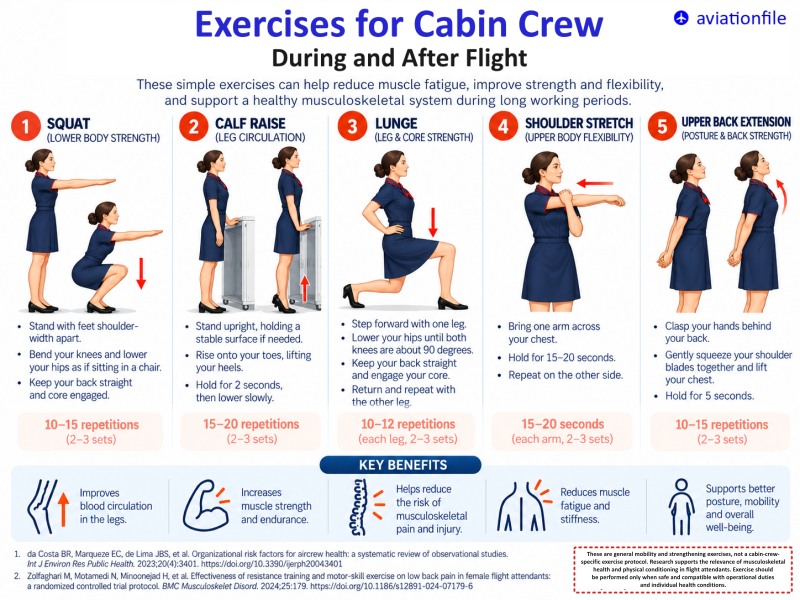
Exercise cannot eliminate occupational hazards, but maintaining adequate strength, mobility and general physical conditioning can help prepare the body for physically demanding work.
A sensible cabin-crew fitness programme can therefore focus on several complementary areas:
- Lower-body strength: squats, controlled lunges and similar exercises can strengthen muscles used during standing, walking, lifting and changing body position.
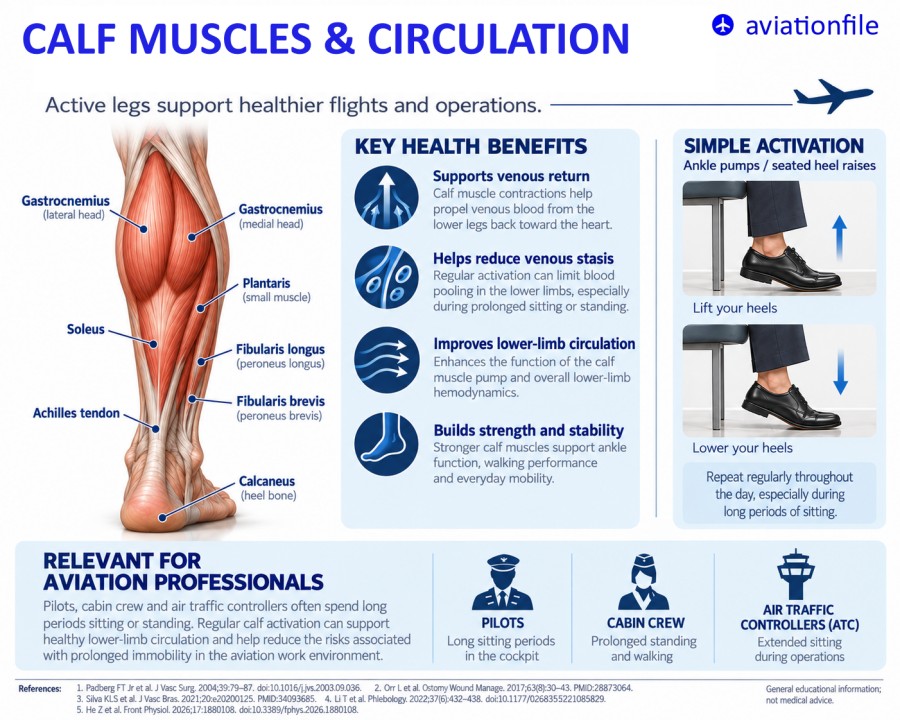
- Calf raises: these activate the calf muscles and can be incorporated into general lower-leg conditioning, particularly for workers who spend substantial time standing.
- Core and trunk conditioning: appropriate exercises targeting the abdominal, spinal and hip musculature can support overall trunk strength and movement control.
- Upper-back and shoulder conditioning: strengthening and mobility exercises may be useful given the reaching and manual-handling demands of cabin work.
- General aerobic exercise: walking, cycling, swimming or other appropriate cardiovascular activities can contribute to overall cardiovascular fitness.
- Mobility and flexibility work: controlled movements for the hips, shoulders and thoracic region may complement strengthening, particularly where occupational tasks repeatedly use restricted postures.
There is an important evidence distinction here. These are general conditioning principles, not a scientifically established universal “cabin crew exercise protocol.” The optimal programme will differ according to health status, previous injury, age, physical capacity and occupational demands.
This distinction is particularly important because research specifically testing exercise programmes in flight attendants remains much smaller than the general exercise and occupational-health literature.
Rest and Recovery Are Part of the Solution
Physical fitness cannot compensate for insufficient sleep.
ICAO treats fatigue as an operational safety issue and recognizes both prescriptive flight/duty/rest limits and Fatigue Risk Management Systems (FRMS) as approaches for managing fatigue risk. ICAO
For individual crew members, sleep opportunities, recovery between duties and recognition of fatigue symptoms remain important. But the structure of duty periods and rosters means fatigue prevention also requires action at organizational and regulatory levels.
This is a crucial distinction: exercise can improve physical conditioning, but it cannot “train away” circadian disruption or chronic sleep restriction.
Other Occupational Health Considerations
Cabin crew health extends beyond musculoskeletal problems and fatigue.
Noise
Aircrew encounter noise from engines, aerodynamic airflow, aircraft systems, ground operations, announcements and service activities. NIOSH recommends controlling occupational noise exposure below the equivalent of 85 dBA over eight hours to reduce the risk of occupational noise-induced hearing loss. Actual exposure varies considerably by aircraft and operating conditions. CDC
Cosmic Radiation
At aviation altitudes, aircrew are exposed to more cosmic ionizing radiation than people at ground level. Exposure varies with altitude, latitude, flight duration and solar activity. This issue is particularly relevant to occupational exposure management and pregnancy. CDC
Reproductive Health and Pregnancy
NIOSH identifies cosmic radiation, circadian disruption, long working hours and physical demands such as prolonged standing, lifting and bending as relevant considerations for pregnant aircrew. The agency recommends reducing heavy physical demands during pregnancy where appropriate. CDC
These findings should not be interpreted to mean that flying itself will cause a reproductive problem in a particular person; NIOSH explicitly notes the difficulty of attributing individual outcomes to a specific occupational exposure. CDC
A Combined Approach to Cabin Crew Health
The most effective approach to cabin crew health is therefore unlikely to be a single exercise, supplement or lifestyle intervention.
It requires several layers of prevention working together: safe work organization, fatigue management, ergonomics, appropriate physical conditioning, adequate recovery, psychological support and occupational-health surveillance.
For airlines, this means examining rosters, workloads, equipment, cabin ergonomics, reporting systems and organizational culture.
For cabin crew, it means recognizing that physical fitness, sleep, recovery and mental well-being are interconnected. Persistent pain, severe fatigue, sleep problems or psychological symptoms should not simply be accepted as an unavoidable part of aviation employment.
Conclusion: Healthy Crew Support Safe Operations
Cabin crew are often seen primarily through their passenger-service role, but their primary aviation function includes important safety responsibilities performed in a physically and psychologically demanding environment.
Their occupational health profile is also different from that of pilots. Pilots generally experience more prolonged sitting and static postural loading, while cabin crew encounter more standing, walking, reaching, bending, lifting and repetitive physical activity. At the same time, both groups share important exposures including fatigue, circadian disruption, noise and the psychological demands of aviation work.
The goal should therefore not be to determine which profession has the “harder” working environment. The more useful approach is to recognize that pilots and cabin crew have different physical risk profiles but share several important occupational-health challenges.
Good ergonomics, scientifically based fatigue management, appropriate exercise, adequate recovery and supportive organizational practices can all contribute to healthier aircrew — and healthy, alert crew members are an important component of safe aviation.
References and Further Reading
- ICAO — Cabin Crew Fatigue Management — official ICAO guidance on fatigue and FRMS.
- CDC/NIOSH — Aircrew and Musculoskeletal Disorders — particularly strong source for lifting, reaching, prolonged standing, awkward posture and repetitive-motion risks.
- CDC/NIOSH — Job Stress in Aircrew — aircrew-specific psychological and occupational stressors.
- CDC/NIOSH — Aircrew and Workplace Exposures — overview of major occupational exposures affecting pilots and flight attendants.
- CDC/NIOSH — Aircrew and Jet Lag — circadian disruption and aircrew.
- WHO — Guidelines on Mental Health at Work — evidence-based organizational and individual mental-health interventions.
- International Labour Organization — Psychosocial Risks and Stress at Work — workplace-level psychosocial risk framework.