
Digital transformation is reshaping air traffic management (ATM). Electronic flight strips, advanced controller working positions, remote towers, data-link applications, and increasingly sophisticated decision-support systems have changed how air traffic controllers interact with information. Artificial intelligence is likely to accelerate this transformation further. Yet the digitalization of ATM raises a question that receives considerably less attention: does access to advanced technology necessarily mean that users are equally capable of working with it?
This question connects ATM with the broader concept of the digital divide. Traditionally, the digital divide referred mainly to unequal access to computers, telecommunications and the Internet. More recent approaches developed by organisations such as the OECD and ITU treat the issue more broadly, incorporating digital skills, quality of use and the ability to obtain meaningful outcomes from technology. In other words, having access to a digital system is only the first step.
Recommended: The Digital Divide and Its Impact on Global Air Traffic Management
For ATM, this distinction is particularly important. Two air navigation service providers may operate modern surveillance systems, electronic flight strips and automated decision-support tools, yet the operational value obtained from these technologies may differ considerably. Interface design, controller training, familiarity with automation, organisational experience and the ability to operate during system degradation can all influence the outcome.
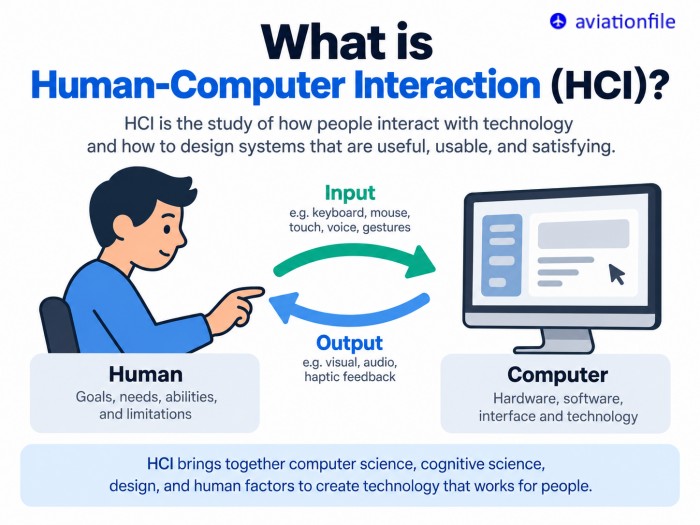
This suggests that the digital divide in ATM should also be examined through the perspective of Human–Computer Interaction (HCI).
From Technology Access to an HCI Divide
Human–Computer Interaction concerns how people perceive, understand and use technological systems. In ATM, however, HCI is more than a usability issue. The controller–system relationship directly affects workload, situation awareness, decision making and ultimately operational safety.
EUROCONTROL has long studied this relationship through its human–automation research and controller working-position programmes (EUROCONTROL source). Its work emphasises that introducing automation changes not only what controllers do but also how they understand the traffic situation. ICAO similarly warns that highly reliable automation can lead to over-reliance and skill degradation if humans gradually move from active control toward passive supervision. (ICAO source)
This creates what might be described as an HCI dimension of the digital divide.
The term is useful because an organisation can close its technological gap while still retaining a human–technology gap. Installing an advanced ATM system does not guarantee that controllers understand its logic, trust it appropriately or remain capable of intervening effectively when it behaves unexpectedly.
The difference can be expressed simply:
Technology access → Effective interaction → Operational outcome
Digital maturity in ATM therefore depends not only on the sophistication of the technology but also on the ability of humans to work effectively with it.
Automation, Trust and Situation Awareness
Trust provides a good example.
Controllers need sufficient confidence in automation to use it effectively. Too little trust can result in useful tools being ignored; too much trust can lead to excessive reliance on automated recommendations. Human-factors research generally describes the desirable condition as calibrated trust — confidence that reflects the actual reliability and limitations of the system.
This issue becomes increasingly important as automation moves beyond displaying information and begins supporting operational decisions.
SESAR’s long-term ATM automation vision anticipates progressively higher levels of human–machine cooperation. Controllers may increasingly supervise, validate or intervene in tasks partly performed by automated systems. EASA’s Artificial Intelligence Roadmap similarly adopts a human-centric approach in which human oversight remains central to the safe introduction of AI into aviation (EASA source).
The challenge is that successful automation can change the controller’s cognitive role.
A controller traditionally involved in detecting a developing conflict, analysing it and deciding on a solution may increasingly receive an automatically generated alert or resolution proposal. This can reduce routine workload, but it can also reduce active involvement in building the traffic picture.
The problem is well established in human-factors research as the out-of-the-loop performance problem. When operators spend long periods supervising reliable automation, their awareness of the underlying process may weaken. If the automation suddenly fails, the human must rapidly reconstruct the situation precisely when intervention is most urgently required.
In ATM, the consequences are particularly relevant. Automation may make normal operations easier while making unusual situations cognitively more demanding.
This leads to an important principle:
The effectiveness of ATM automation should not be evaluated only by how much workload it removes during normal operations, but also by how effectively controllers can understand and recover from the system when normal automation is unavailable.
Digital Competence in the Controller Working Position
The changing technological environment also changes what “digital competence” means for an air traffic controller.
Generic computer literacy is clearly insufficient. Controllers increasingly need some understanding of what automated systems are doing, which information they use, where their limitations lie and under what circumstances their outputs should be questioned.
This does not mean that controllers need to become software engineers. It means that operational competence increasingly includes automation literacy.
A useful distinction can therefore be made between an automation-literate controller and an automation-dependent controller.
An automation-literate controller uses technology effectively but understands its limitations and remains capable of operating when automation becomes degraded. An automation-dependent controller may perform extremely well while the system behaves normally but experience a larger performance decline when automated support disappears.
This distinction could become one of the most important aspects of the digital divide in future ATM.
SESAR already recognises that future competence schemes will need to evolve as AI and higher levels of automation enter ATM. Similarly, EASA’s human-centric AI approach places emphasis on human oversight and trustworthy interaction rather than simply maximising automation.
Training therefore needs to evolve alongside technology. Simulator programmes should not only teach controllers how to use new systems but also expose them to automation failures, incomplete information, misleading recommendations and degraded modes. Otherwise, highly reliable automation may gradually reduce opportunities to practise the very skills required when that automation fails.

Remote Towers Show Why HCI Matters
Remote tower operations provide a particularly clear example of this issue.
In a conventional tower, much of the controller’s information comes directly from the out-the-window view. In a remote tower, that environment is mediated through cameras, sensors, displays and communication networks.
The airport has not disappeared, but the controller’s perception of it has become digital.
Research on remote and multiple remote tower operations has therefore paid considerable attention to visual scanning, display design, workload and situation awareness. EASA’s regulatory and training material also recognises the specific human-factors characteristics of remote aerodrome operations.
This illustrates why technological access alone cannot define digital maturity.
An ANSP may possess remote tower technology, but its operational success still depends on whether the interface presents information naturally, whether controllers can distribute their attention effectively and whether training reflects the different perceptual environment.
Remote towers therefore provide a useful example of how an infrastructure divide can evolve into an interaction divide.
AI Will Make the Question More Important
Artificial intelligence is likely to deepen this challenge because future systems may do more than automate repetitive tasks. They may increasingly predict, recommend and prioritise.
SESAR research already explores adaptive digital assistants and higher levels of human–machine teaming. Some research programmes investigate systems that respond dynamically to controller workload or infer aspects of controller intent and attention.
As this develops, controllers may increasingly need to ask not simply what is the system showing me? but also why is the system recommending this?
This makes explainability and transparency operational issues.
A controller should be able to recognise when an AI recommendation is based on incomplete information, understand the limits of the system and retain sufficient authority and competence to reject an inappropriate solution.
The future digital divide in ATM could therefore involve another distinction:
AI access versus AI readiness.
An organisation may acquire AI-enabled systems without having equivalent training, human-factors expertise or organisational readiness to use them safely and effectively.
A Human-Centered View of ATM Digitalisation
The digital divide in ATM can consequently be considered across several connected layers:
Infrastructure → Interface → Competence → Human–Automation Interaction → Operational Outcome
- The first layer asks whether modern technology is available.
- The second asks whether that technology is designed in a way that supports human performance.
- The third concerns whether controllers possess the skills required to use and understand it.
- The fourth considers trust, workload, situation awareness and the ability to manage automation.
- The final layer asks whether digitalisation actually improves safety, resilience and efficiency in operational practice.
This perspective changes how ATM digital maturity might be evaluated.
A technologically advanced control centre should not automatically be considered digitally mature simply because it operates sophisticated systems. Human-centred digital maturity also depends on training quality, usability, controller involvement in system development, degraded-mode competence and the ability to maintain appropriate human oversight.
Conclusion
The next stage of ATM digitalisation will not be defined only by better computers, more data or higher levels of automation. It will also be defined by the changing relationship between the controller and the system.
Traditional digital-divide research asks who has access to technology. In ATM, another question is becoming equally important:
Who has the capability to work effectively with that technology?
This is where Human–Computer Interaction becomes part of the digital-divide discussion.
Future inequalities in ATM may not exist only between organisations operating modern and legacy technologies. They may also appear between usable and poorly designed interfaces, automation-literate and automation-dependent users, strong and weak training environments, or organisations capable and incapable of integrating human factors into technological change.
For this reason, digital transformation in ATM should not be considered complete when a new system is installed.
It is complete only when the people responsible for operating the system can understand it, use it, question it and safely continue operating when it is no longer available.
References and Further Reading:
- ICAO. Human Performance Considerations in Aviation.
- EUROCONTROL. Solutions for Human-Automation Partnerships in European ATM (SHAPE).
- EUROCONTROL. Controller Working Position / Human-Machine Interface.
- SESAR Joint Undertaking. European ATM Master Plan and Automation Roadmap.
- EASA. Artificial Intelligence Roadmap 2.0: A Human-Centric Approach to AI in Aviation.
- OECD. OECD Digital Economy Outlook 2024.
- International Telecommunication Union (ITU). Measuring Digital Development.
- Endsley, M. R., & Kiris, E. O. Research on the out-of-the-loop performance problem and automation.
- National Research Council. The Future of Air Traffic Control: Human Operators and Automation.
- FAA Civil Aerospace Medical Institute. Research on information complexity and human performance in air traffic control.