
On 6 September 2026, a SunExpress Boeing 737-800 operating flight XQ980 from İzmir to Vienna declared an emergency and returned to İzmir Adnan Menderes Airport (ADB/LTBJ) after a reported crack in a cockpit windshield.
The event was already notable as an aviation safety occurrence. However, a review of flight-tracking data and the NOTAMs applicable to İzmir that day reveals an additional operational detail: the aircraft appears to have returned during a period in which İzmir Adnan Menderes Airport was closed to normal take-off and landing traffic because of familiarization, rehearsal and demonstration flights associated with activities ahead of İzmir’s 9 September celebrations.
This creates an interesting case involving an airborne emergency, a scheduled airport traffic restriction and the operational priority afforded to an aircraft requiring an emergency return.
What Happened to SunExpress Flight XQ980?
SunExpress flight XQ980 was scheduled to operate from İzmir Adnan Menderes Airport to Vienna International Airport on 6 September 2026.
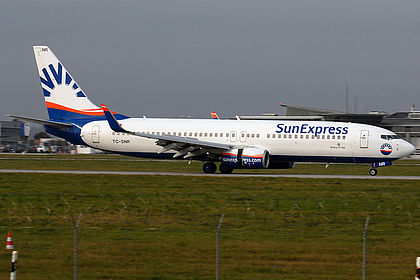
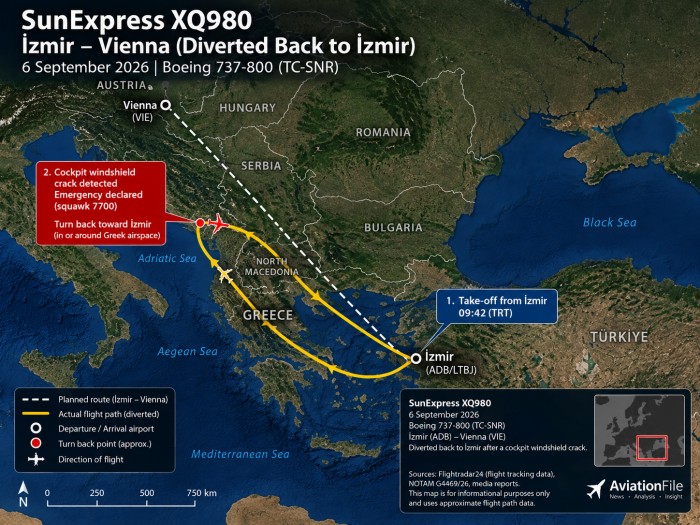
Flight-tracking records identify the aircraft as TC-SNR, a Boeing 737-800. Available flight history shows that the aircraft departed İzmir at approximately 09:42 local time before later turning back toward its departure airport.
During the return sequence, the aircraft transmitted the international emergency transponder code 7700.
Independent ADS-B tracking records identify XQ980 as a 7700 emergency event and show İzmir as the diversion airport.
Turkish aviation reports published following the event stated that the crew had detected a crack in the cockpit windshield while the aircraft was operating toward Vienna. According to these reports, the crew decided to return to İzmir while in or around Greek airspace, declared an emergency and selected squawk 7700.
The Boeing 737 subsequently landed safely at İzmir.
At the time of writing, AviationFile has not located a detailed public technical statement specifying which windshield layer was affected or establishing the exact cause of the crack. Therefore, possible causes such as windshield heating failure, thermal stress, impact damage or material fatigue should not be presented as the confirmed cause of this particular event.
NOTAM – Notice To Air Missions
The Important Detail: İzmir Airport Was Under a NOTAM Traffic Closure
The operational context becomes particularly interesting when the flight is compared with the NOTAM information applicable to İzmir Adnan Menderes Airport.
An Aerodrome PIB covering the period contains NOTAM G4469/26, which stated that İzmir Adnan Menderes Airport would be closed to take-off and landing traffic, except for traffic involved in the relevant activity.
The reason stated in the NOTAM was:
“CEVRE TANIMA, PROVA VE GOSTERI UCUSLARI NEDENIYLE”
which can be translated as:
“Due to familiarization, rehearsal and demonstration flights.”
The NOTAM was published with the following validity and schedule:
G4469/26
FROM: 06 SEP 2026 10:00
TO: 09 SEP 2026 16:00
Schedule:
06 SEP: 1000–1130 UTC and 1500–1600 UTC
07 and 09 SEP: 1500–1600 UTC
Türkiye operates on UTC+3 throughout the year. Therefore, the first restriction period on 6 September corresponded to: 13:00–14:30 local time in İzmir.
This is important because available tracking information places XQ980’s emergency return within this general time window.
Timeline of the XQ980 Emergency
Combining the available flight-tracking and NOTAM information produces the following approximate timeline:
| Event | Local Time (TRT) |
|---|---|
| XQ980 departs İzmir for Vienna | ~09:42 |
| First NOTAM restriction period begins | 13:00 |
| XQ980 emergency/7700 event recorded | During the return sequence |
| XQ980 returns to İzmir | During the NOTAM restriction window, according to available tracking data |
| First NOTAM restriction period ends | 14:30 |
The precise timestamps displayed by different flight-tracking services require some caution because platforms may present event times using different local time zones or recording methodologies. Nevertheless, the available data indicates that the emergency return overlapped with the scheduled NOTAM restriction.
This means XQ980 was returning to an airport operating under an unusual temporary traffic restriction rather than under completely normal traffic conditions.
Does Landing During an Active NOTAM Create a Problem?
Not necessarily.
An important distinction must be made between an airport or runway that is physically unavailable and an airport where normal traffic is temporarily restricted because of a planned activity.
In this case, the published restriction was associated with familiarization, rehearsal and demonstration flights. It did not, by itself, indicate that the runway was physically unusable because of construction, an obstruction, pavement damage or a similar condition.
An aircraft in distress is also operationally different from normal scheduled traffic. Under international air traffic service principles, an aircraft known or believed to be in a state of emergency is given priority over other aircraft as circumstances require.
Therefore, the fact that XQ980 landed while a NOTAM restriction was active does not by itself indicate a violation or an unsafe operation.
If necessary, the relevant authorities and air traffic services can coordinate, delay, suspend or separate the activity responsible for the temporary restriction in order to accommodate an emergency aircraft. This does not necessarily require the underlying NOTAM to be cancelled altogether.
In practical terms, an emergency aircraft may be given priority while the temporary restriction remains published and operationally relevant.
The exact coordination that occurred in the XQ980 case has not been made public. There is currently no public evidence establishing whether a rehearsal flight was actively interrupted or what specific coordination took place between ATC and the units involved in the planned activity.
Nevertheless, XQ980’s landing during the restriction period should not automatically be interpreted as an irregularity. Rather, it illustrates the flexibility required in air traffic management when a real-time emergency takes precedence over a pre-planned operational restriction.
What May Have Happened Operationally?
Without ATC recordings or an official operational report, the precise coordination sequence cannot be reconstructed with certainty.
However, an operationally plausible sequence would be:
XQ980 develops a technical problem → crew decides to return to İzmir → emergency is declared / 7700 is selected → İzmir ATC coordinates the aircraft’s return → conflicting rehearsal or demonstration activity is separated, delayed or suspended as necessary → XQ980 receives priority and lands.
This should not be interpreted as a confirmed reconstruction.
There is currently no publicly available evidence establishing exactly which rehearsal aircraft were airborne at that moment, whether demonstration activity was actively taking place during XQ980’s final approach, or whether any participating aircraft had to interrupt their operations.
Those details would require ATC communications, radar data, operational logs or an official statement from the relevant authorities.
What can be established is the unusual overlap between the emergency return and the published airport traffic restriction.
Why a 7700 Squawk Matters
Squawk 7700 is the internationally recognized transponder code used to indicate a general emergency.
However, seeing 7700 on a flight-tracking platform does not by itself reveal the severity or exact nature of the emergency.
It primarily makes the aircraft’s emergency status immediately recognizable to air traffic services and surveillance systems.
For an aircraft returning to an airport affected by unusual traffic restrictions, an emergency declaration can have significant operational consequences: ATC can give the aircraft priority and coordinate other traffic or activities around the emergency situation.
In the case of XQ980, independent tracking data confirms that the aircraft transmitted 7700 during the event.
How Serious Is a Cracked Boeing 737 Cockpit Windshield?
Aircraft cockpit windshields are very different from ordinary glass.
Transport-category aircraft windshields are constructed using multiple layers and are designed to withstand aerodynamic loads, pressurization, impacts and substantial temperature differences. They also incorporate electrical heating systems used for functions including anti-icing and maintaining appropriate windshield temperature.
A visible crack therefore does not automatically mean that the entire windshield has structurally failed or that cabin depressurization is imminent.
The significance depends on factors including the affected windshield layer, location and extent of the damage and the condition of the windshield heating system.
This is precisely why the technical details of the XQ980 occurrence should not be overstated.
Publicly available information currently establishes a reported windshield crack and an emergency return but does not establish the exact failure mechanism.
An Interesting Case for Air Traffic Management
The XQ980 incident provides a useful real-world example of the difference between a scheduled operational restriction and the management of an actual airborne emergency.
NOTAMs provide pilots, operators and air traffic services with critical advance information concerning temporary changes to normal operations. But aviation operations are dynamic, and an unexpected technical problem can rapidly change operational priorities.
When an aircraft experiences an abnormal or emergency situation, air traffic management must respond to the circumstances in real time.
The available evidence indicates that this is effectively what occurred at İzmir on 6 September 2026: a commercial Boeing 737 requiring an emergency return was accommodated during a period in which the airport was scheduled to be unavailable to normal landing and departing traffic because of rehearsal and demonstration activity.
This does not inherently represent a conflict with the NOTAM. Instead, it demonstrates how emergency priority and real-time ATC coordination can coexist with a previously published operational restriction.
Conclusion
SunExpress flight XQ980’s emergency return to İzmir on 6 September 2026 was more operationally interesting than a conventional technical diversion.
The Boeing 737-800, TC-SNR, returned after a reported cockpit windshield crack and transmitted the emergency squawk code 7700.
During the same period, İzmir Adnan Menderes Airport was subject to a published NOTAM restricting normal take-off and landing traffic because of familiarization, rehearsal and demonstration flights ahead of activities associated with İzmir’s 9 September celebrations.
The fact that an emergency aircraft landed during this period does not, by itself, indicate an operational violation. A temporary restriction established for planned aerial activity is fundamentally different from a runway being physically unusable, and emergency aircraft can be accommodated through priority handling and operational coordination when conditions permit.
The exact coordination remains unknown without official ATC or operational records. Nevertheless, the overlap between XQ980’s emergency return and the active NOTAM makes the occurrence an interesting real-world example of air traffic management, emergency priority and operational flexibility.
This article is based on publicly available flight-tracking data, NOTAM/PIB information and aviation reporting available as of 8 September 2026. It will be updated if SunExpress, DHMI, the Turkish Directorate General of Civil Aviation (SHGM) or another authoritative source releases additional technical information.