
The Roadmap Shaping the Future of Air Traffic Management
The rapid growth of global aviation has made it essential for countries to modernize their air navigation and air traffic management systems in a coordinated way. This is where the ICAO Global Air Navigation Plan (GANP) comes into play. Designed as a long-term strategic roadmap, the GANP provides a shared vision that helps states align their technological upgrades, operational improvements, and regulatory frameworks to support safer, more efficient, and globally harmonized airspace operations.
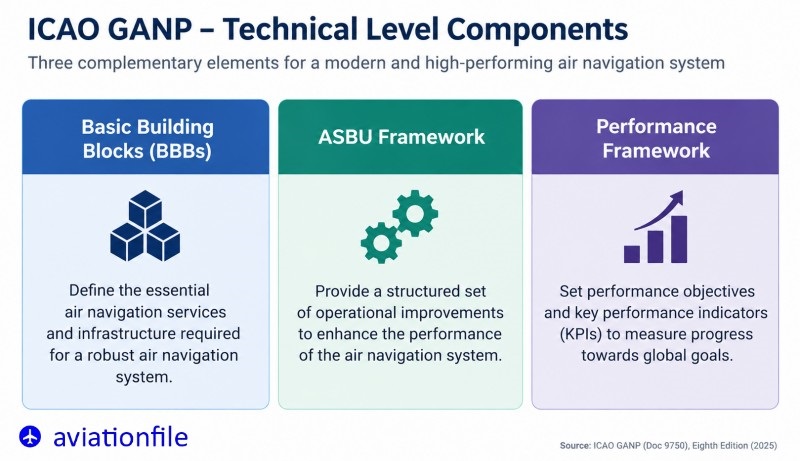
At its core, the GANP is built on the understanding that aviation is a borderless system. A technological improvement made in one region can only reach its full potential if surrounding states evolve in the same direction. To support this global alignment, ICAO developed the Aviation System Block Upgrades (ASBU) framework—one of the most recognizable elements of the GANP. The ASBU structure breaks modernization into time-sequenced blocks, allowing countries to upgrade step by step, according to their national priorities while still remaining interoperable with the global system.

The GANP also embraces a performance-based approach, focusing on measurable outcomes rather than imposing specific technologies. This ensures flexibility, especially for states with different economic, technological, or operational conditions. Whether the goal is enhancing safety, increasing airspace capacity, improving predictability, or reducing environmental impact, the GANP provides a structured guide on how to get there.
In recent years, the plan has increasingly emphasized digital transformation. Concepts such as System Wide Information Management (SWIM), Performance-Based Navigation (PBN), ADS-B surveillance, and data-driven decision support tools are part of the modernization path needed to handle future traffic demand. The GANP recognizes that tomorrow’s ATM system will rely heavily on digital connectivity, timely information sharing, and automation-supported human performance.
Another important feature of the GANP is its dual-level planning structure: global and regional. While the plan outlines universal goals, regional groups (PIRGs) adapt them to local operational needs. This ensures that the evolution of air navigation remains consistent worldwide, without ignoring regional realities such as terrain constraints, traffic patterns, or infrastructure levels. In the current GANP framework (2026), this planning architecture is further articulated through four interconnected levels: Global Strategic, Global Technical, Regional, and National. The Global Strategic Level defines the long-term direction of air navigation, while the Global Technical Level translates this vision into technical and performance frameworks, including the BBBs and ASBUs. Regional and National levels then support the adaptation and implementation of these global objectives according to regional and State-specific needs.
Ultimately, the ICAO GANP serves one essential purpose: to ensure that aviation continues to scale safely and sustainably. As airspace demand grows and technologies evolve, the GANP provides the roadmap that keeps the global system interoperable, future-ready, and aligned with the expectations of airlines, controllers, airports, and—most importantly—passengers.
GANP Eighth Edition (2025)
The Eighth Edition of the ICAO Global Air Navigation Plan (GANP) was approved by the ICAO Council on 2 July 2025 and subsequently presented to the 42nd Session of the ICAO Assembly for endorsement. Representing a major update to the previous edition, it aligns the evolution of global air navigation with ICAO’s Strategic Plan 2026–2050 and provides strategic direction toward 2050 and beyond. The updated GANP reinforces a performance-driven and globally harmonized approach to air navigation modernization while linking long-term strategic objectives with technical, regional, and national implementation.
For professionals in aviation, understanding the GANP means understanding where the industry is heading. It is more than just a planning document; it is the blueprint for the next generation of air navigation.
Recommended Article: ICAO and EUROCONTROL Launch Strategic Integration to Accelerate Search and Rescue Operations