
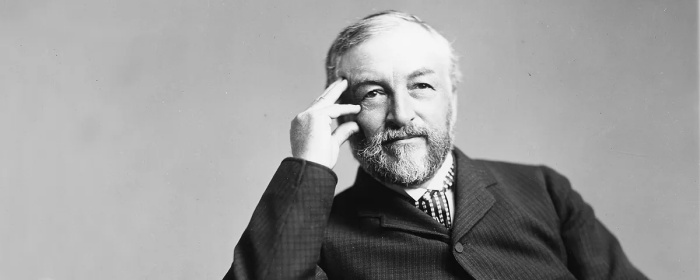
By the late 19th century, powered, controlled human flight was still one of the greatest unsolved challenges. Among the leading figures working on this problem was Samuel Pierpont Langley, then Secretary of the Smithsonian Institution.
Langley gained significant attention in 1896 after successfully flying unmanned, steam-powered models. These flights demonstrated that powered flight was technically possible, at least on a smaller scale.
Following these achievements, in 1898, the United States government decided to support his work. According to Smithsonian archival records, the U.S. War Department allocated $50,000 to Langley to develop a powered aircraft capable of carrying a human.
This is confirmed by the National Museum of the U.S. Air Force, which states that Langley received a Congressional grant to build a man-carrying flying machine. For that period, this was a significant investment and is often considered one of the earliest large-scale, government-funded aviation research projects.
The Aerodrome Project: High Expectations, Failed Attempts
With this funding, Langley developed what he called the “Aerodrome” a powered aircraft designed to carry a pilot.
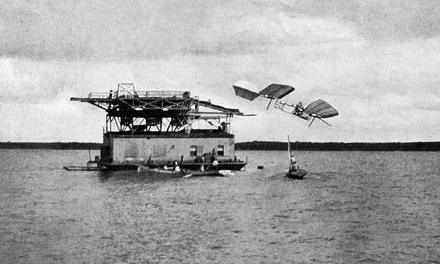
However, the project ultimately failed. In 1903, two full-scale launch attempts ended unsuccessfully, with the aircraft falling into the water immediately after launch.
Only weeks later, the Wright Brothers achieved the first successful, controlled, and sustained powered flight, marking a turning point in aviation history.
Why Langley Still Matters in Aviation
Despite the failure of the project Aerodrome, Langley’s work remains important for several reasons:
- It represents one of the first major government-funded aviation projects
- It contributed to early understanding of powered flight principles
- It shows the engineering challenges faced before practical flight was achieved
Samuel Pierpont Langley – Short Biography
Samuel Pierpont Langley (1834–1906) was an American astrophysicist, astronomer, and aviation pioneer. He served as the third Secretary of the Smithsonian Institution and made significant contributions to solar physics, including the invention of the bolometer.
Langley began studying the principles of flight in the late 19th century and published Experiments in Aerodynamics (1881), which laid the groundwork for his later aircraft designs. In 1896, his powered, unmanned models achieved sustained flight, demonstrating the feasibility of heavier-than-air machines.
With financial support from the U.S. government in 1898, he developed a full-scale “Aerodrome” intended for human flight, but his attempts in 1903 ended in failure. Despite this, Langley remains an important figure in early aviation research, bridging the gap between theoretical science and practical flight.
Operational Limitations of the Aerodrome
From an operational aviation perspective, Langley’s Aerodrome had several critical limitations that help explain its failure. The aircraft was launched using a catapult system from a houseboat, rather than taking off under its own power, which already introduced additional complexity and risk at the moment of departure. It also lacked conventional landing gear, as it was intended to be recovered from the water after flight—meaning it was never designed for a standard takeoff–landing cycle as we understand today.
More importantly, the Aerodrome suffered from a lack of effective flight control systems. Unlike later successful aircraft, it did not provide the pilot with sufficient means to control pitch, roll, and stability during flight. From a modern aviation standpoint, this is a fundamental limitation; without controlled, sustained flight capability, even a powered aircraft cannot be considered operationally viable.
Source: wikimedia

Conclusion
In 1898, the person funded by the U.S. government to develop a powered, manned aircraft was Samuel Pierpont Langley.
This fact is clearly supported by primary sources such as Smithsonian archives and the U.S. Air Force Museum, making it historically reliable and well-documented.
References and Further Reading:
- https://siarchives.si.edu/collections/siris_sic_151
- https://www.nationalmuseum.af.mil/Visit/Museum-Exhibits/Fact-Sheets/Display/Article/197544/the-aerodrome-samuel-pierpont-langley/
- https://www.ebsco.com/research-starters/history/samuel-pierpont-langley
- https://www.britannica.com/biography/Samuel-Pierpont-Langley
- https://www.rasc.ca/honorary-member-samuel-pierpont-langley