
An examination of the 2002 Überlingen accident, its operational and organizational causes, and the lessons it provided for modern aviation safety.
Introduction
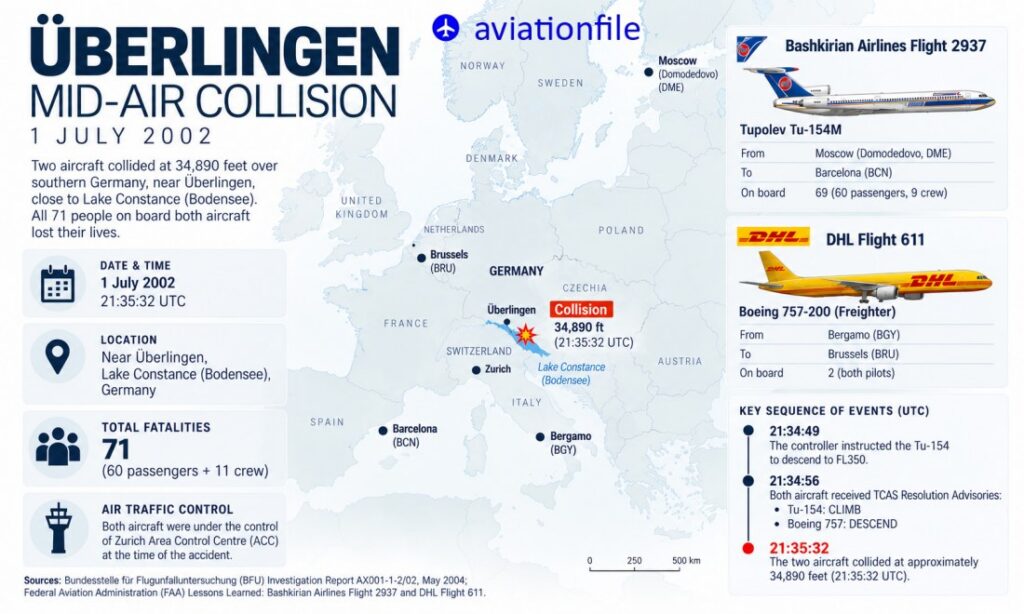
On 1 July 2002, two commercial aircraft collided at approximately 34,000 feet over southern Germany, near Lake Constance. Bashkirian Airlines Flight 2937, a Tupolev Tu-154M carrying 69 people, collided with DHL Flight 611, a Boeing 757-200 freighter carrying two pilots. All 71 occupants lost their lives.
The Überlingen disaster remains a significant case in aviation safety because it exposed critical weaknesses in the interaction between air traffic control (ATC), airborne collision avoidance systems, and organizational safety management.
The investigation conducted by the German Federal Bureau of Aircraft Accident Investigation (BFU) demonstrated that the accident resulted not from a single failure but from a combination of operational decisions, procedural inconsistencies, and systemic deficiencies.
Recommended: Swiss Cheese Model – Aviation Safety
The Sequence of Events
Both aircraft were operating under instrument flight rules (IFR) and were under the control of Zurich Area Control Centre (ACC), operated by the Swiss air navigation service provider Skyguide. Although the collision occurred over German territory, responsibility for providing ATC services in that sector had been delegated to Switzerland.
The two aircraft were approaching intersecting flight paths at flight level 340 (FL340).
During the night shift, one controller was actively managing traffic at Zurich ACC. The controller was also handling an additional aircraft approaching Friedrichshafen Airport, requiring attention to be divided between separate radar workstations.
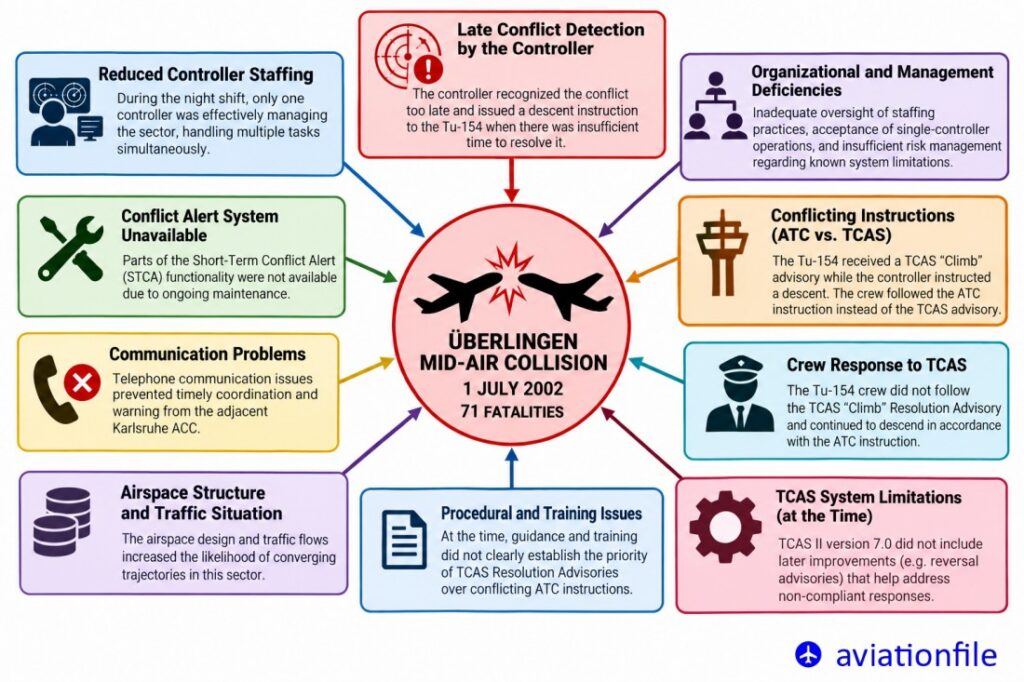
Several technical limitations further complicated the situation. Maintenance activities had affected the Short-Term Conflict Alert (STCA) functionality available to the controller, while telephone communication problems prevented controllers at Karlsruhe ACC from successfully relaying their conflict warnings.
As the aircraft converged, the Zurich controller recognized the developing conflict and instructed the Tupolev crew to descend. However, this instruction was issued too late to maintain the required separation.
At approximately the same time, the aircraft’s Traffic Collision Avoidance Systems (TCAS) generated coordinated but opposite Resolution Advisories (RAs):
- DHL Boeing 757: Descend.
- Bashkirian Tupolev Tu-154M: Climb.
The DHL crew followed its TCAS instruction and initiated a descent. The Tupolev crew, however, continued descending in accordance with the controller’s instruction, despite receiving a TCAS advisory to climb.
Consequently, both aircraft descended toward the same altitude. At 21:35:32 UTC, they collided in mid-air.
Why Did the Safety Barriers Fail?
1. Air Traffic Control and Operational Workload
The BFU investigation identified the late recognition of the developing separation infringement as an immediate cause of the accident. The controller’s working environment contributed to the situation. The combination of reduced staffing, simultaneous traffic responsibilities, unavailable conflict-alert functionality, and communication difficulties weakened the ATC system’s ability to detect and resolve the conflict.
Importantly, the investigation highlighted organizational deficiencies in staffing arrangements and supervisory practices. The established practice of allowing one controller to work alone during low-traffic nighttime periods had been tolerated by management.
This demonstrates how organizational decisions can influence operational safety long before an accident occurs.
2. Conflicting TCAS and ATC Instructions
The most critical cockpit-level factor was the conflict between the controller’s descent clearance and the Tupolev’s TCAS climb advisory. TCAS II is designed as an independent airborne safety barrier that provides collision avoidance guidance when normal separation mechanisms have failed. When both aircraft are suitably equipped, their systems coordinate complementary Resolution Advisories through Mode S communication.
At the time of the accident, however, international regulations, operator procedures, and training materials did not consistently communicate the priority of TCAS RAs over conflicting ATC instructions. The BFU therefore identified the insufficient integration of ACAS/TCAS into the wider aviation system as a systemic cause.
The accident illustrated that sophisticated safety technology cannot deliver its intended protection unless procedures, training, and operational behavior are aligned with its design philosophy.
3. Human Factors and Organizational Safety
Überlingen also demonstrates the limitations of interpreting accidents exclusively through individual human error. The controller operated within a system affected by staffing practices and technical restrictions. The flight crews encountered a rapidly developing emergency involving conflicting instructions from two sources normally regarded as authoritative. These circumstances created conditions in which situational awareness, decision-making, and effective coordination became particularly challenging.
From a safety management perspective, the accident represents the simultaneous degradation of several defensive layers: strategic traffic planning, radar monitoring, ground-based conflict warning, ATC intervention, and airborne collision avoidance.
How Überlingen Changed Aviation Safety
The accident contributed to significant developments in collision avoidance procedures and technology. First, international guidance was clarified to establish that pilots must follow TCAS Resolution Advisories, even when they conflict with ATC instructions, unless doing so would endanger the aircraft.
Second, improvements were introduced to TCAS logic. TCAS II version 7.1 incorporated enhanced reversal advisory functionality to address situations in which an aircraft responds contrary to its RA. This version also introduced other improvements to reduce inappropriate pilot responses.
Third, the accident reinforced the importance of robust air traffic services, including adequate controller staffing, reliable communication systems, effective safety monitoring, and carefully managed maintenance activities.
These developments strengthened the relationship between airborne collision avoidance technology and operational procedures.
Conclusion
The Überlingen mid-air collision was not simply the consequence of a late ATC instruction or a flight crew’s decision to disregard a TCAS advisory. It revealed a deeper problem involving the coordination of human operators, automated safety systems, procedures, and organizational management.
Its enduring significance lies in demonstrating that aviation safety depends on more than the reliability of individual technologies or the competence of individual professionals.
Effective safety requires multiple independent barriers, clearly defined operational priorities, and organizations capable of recognizing and managing risks before they develop into accidents.
More than two decades later, Überlingen remains an essential case study in air traffic management, human factors, automation, and systemic aviation safety.
References
- Bundesstelle für Flugunfalluntersuchung (BFU). (2004). Investigation Report AX001-1-2/02: Mid-Air Collision near Überlingen, 1 July 2002. Official investigation report.
- Federal Aviation Administration (FAA). Lessons Learned: Bashkirian Airlines Flight 2937 and DHL Flight 611. FAA accident analysis.
- EUROCONTROL. Airborne Collision Avoidance System (ACAS/TCAS). Technical and operational guidance.
- EUROCONTROL. (2025). Airborne Collision Avoidance System (ACAS) Guide, Version 5.0. Official guide.
- Swiss Federal Council. (2004). Investigation Report on the Überlingen Aircraft Accident: Federal Council Accepts Errors Were Made and Expresses Apologies. Official statement.