
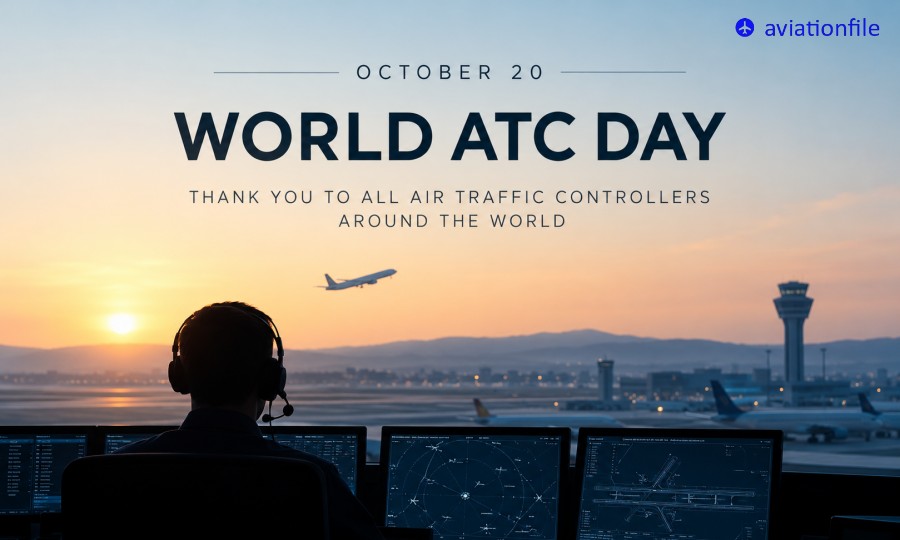
Every year on October 20, the aviation community celebrates the International Day of the Air Traffic Controller, recognizing the professionals responsible for maintaining the safety, order, and efficiency of air traffic worldwide.
Behind thousands of daily aircraft movements are air traffic controllers who continuously monitor complex operational environments, coordinate aircraft movements, and make time-critical decisions. Although their work often remains invisible to passengers, air traffic control is one of the fundamental pillars of modern aviation. The date also carries historical significance: October 20 marks the anniversary of the establishment of the International Federation of Air Traffic Controllers’ Associations (IFATCA) in 1961.
The Historical Origins of October 20
The origins of the International Day of the Air Traffic Controller are closely connected to the development of international professional cooperation in air traffic control. In 1956, Jacob Wachtel, founder and first chairman of the Israeli Air Traffic Controllers’ Association, proposed establishing an international organization representing the profession. This initiative eventually led to meetings among European air traffic controller associations, including an important gathering in Frankfurt in 1959. The decisive step occurred in Amsterdam, where representatives of 12 founding associations established IFATCA on October 20, 1961. Initially conceived as a European federation, the organization adopted an international identity to reflect the profession’s increasingly global character. The annual observance was formally designated during IFATCA’s 42nd Annual Conference in Buenos Aires in 2003, when October 20 was selected as the International Day of the Air Traffic Controller.
In 2026, the aviation community celebrates the 65th anniversary of IFATCA, which has grown from its original 12 founding associations to more than 130 member associations worldwide.
Why Air Traffic Controllers Matter
Air traffic controllers play a critical role in maintaining aviation safety by managing aircraft movements within controlled airspace and at aerodromes.
According to the International Civil Aviation Organization (ICAO), the principal objectives of air traffic control include preventing collisions between aircraft, preventing collisions between aircraft and obstructions on the manoeuvring area, and expediting and maintaining an orderly flow of air traffic.
These responsibilities are distributed across different operational environments:
- Aerodrome Control: Manages aircraft and relevant vehicle movements at airports, including runway operations and traffic in the vicinity of the aerodrome.
- Approach Control: Manages controlled arriving and departing flights, including sequencing and separation during critical phases of flight.
- Area Control: Provides air traffic control services to controlled flights during the en-route phase, often across extensive airspace sectors.
Controllers must continuously interpret surveillance information, assess potential conflicts, communicate with flight crews, coordinate with adjacent units, and respond to unexpected developments. Their decisions directly influence not only flight safety but also airspace capacity, operational efficiency, delays, and the environmental performance of aviation.
Recommended: ATC – Air Traffic Controller: The Indispensable Linchpins of Aviation Safety
A Profession Built on Human Judgment
Air traffic control is a highly specialized profession requiring technical knowledge, situational awareness, communication skills, and effective decision-making under pressure. Unlike many occupations, operational decisions in air traffic control frequently involve limited time and rapidly changing circumstances. Controllers must maintain an accurate mental picture of traffic while managing competing priorities, including aircraft separation, weather conditions, operational restrictions, and emergency situations. The profession also operates continuously. Controllers work during nights, weekends, and public holidays, ensuring that essential air navigation services remain available whenever required. These characteristics make appropriate staffing, recurrent training, fatigue management, psychological well-being, and a strong safety culture particularly important.



Technology and the Future of Air Traffic Control
Over recent decades, air traffic management has evolved from predominantly procedural methods to increasingly sophisticated systems supported by surveillance technologies, digital communications, automation, and advanced decision-support tools. Emerging developments, including artificial intelligence, trajectory-based operations, remote tower services, and the integration of unmanned aircraft, are expected to reshape parts of the operational environment. However, technological progress does not eliminate the importance of human expertise. New systems must be designed around operational requirements, human performance, transparency, and clearly defined responsibilities. Automation can support conflict detection, traffic prediction, and workload management, but its effectiveness depends on how successfully it is integrated into real-world operations.
As aviation becomes more technologically interconnected, maintaining the appropriate balance between automation and human oversight will remain a central challenge for air traffic management.
Recommended: ICAO Global Air Navigation Plan (GANP)
The Significance of International Cooperation
Air traffic does not stop at national borders. Safe and efficient operations depend on coordination between air navigation service providers, regulators, airlines, airports, and professional organizations.
Since its establishment, IFATCA has contributed to international discussions concerning aviation safety, technical standards, professional policies, and human factors. Its participation in international aviation forums helps ensure that the operational experience of controllers is considered in the development of aviation systems and procedures.
The International Day of the Air Traffic Controller therefore represents more than professional recognition. It also highlights the importance of international cooperation, continuous improvement, and the people responsible for implementing aviation safety procedures every day.
Conclusion
October 20 is an opportunity to recognize a profession whose contribution to aviation safety is essential but frequently overlooked.
From the establishment of IFATCA in 1961 to today’s increasingly complex air traffic management environment, the fundamental mission of air traffic controllers has remained consistent: to maintain the safe, orderly, and efficient movement of aircraft. As aviation continues to evolve, advanced technologies will undoubtedly transform how air traffic is managed. Nevertheless, professional competence, sound judgment, and effective human-machine cooperation will remain essential to the future of safe air navigation.
On International Day of the Air Traffic Controller, AviationFile recognizes the professionalism, dedication, and contribution of air traffic controllers worldwide.
References
- IFATCA – The History of IFATCA. Federation’s establishment and historical development. Official history.
- IFATCA – Administrative Manual (2024). Section 8, formal designation of October 20 at the 2003 Buenos Aires conference. Official manual.
- IFATCA – International Day of the Air Traffic Controller 2026. 65th anniversary and current professional priorities. 2026 statement.
- ICAO – Annex 11: Air Traffic Services. Objectives and regulatory framework of air traffic services. ICAO reference.
- FAA – Air Traffic Control, Chapter 2: General Control. Operational objectives and responsibilities of ATC. FAA reference.