
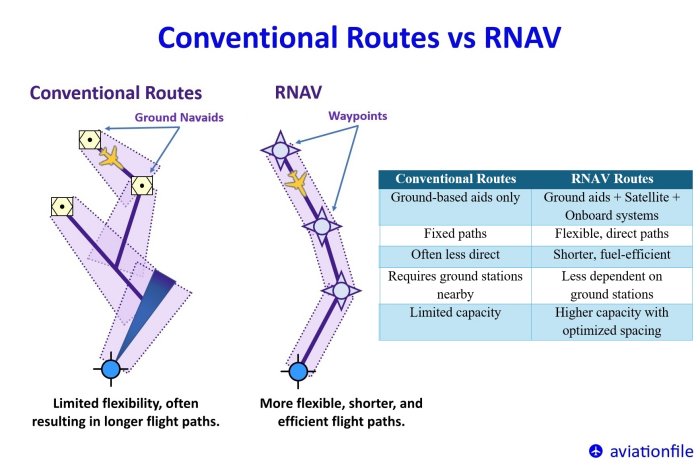
Free Route Airspace (FRA) is a specified portion of controlled airspace where airspace users can freely plan a route between defined entry and exit points, with the option to use intermediate waypoints, without following the traditional fixed ATS route network. Flights are still controlled by ATC and subject to airspace availability and restrictions.
In practice, this means that instead of flying along “airways” that resemble motorways in the sky, aircraft can choose more direct, optimised trajectories – often much closer to the great-circle route. FRA is typically implemented in upper airspace (e.g. from FL245 upwards) and is a core element of global ATM modernisation and ICAO’s Aviation System Block Upgrades (ASBU).
Europe has been a major driver of FRA, progressively deploying it across national and cross-border airspace. According to EUROCONTROL, continuing FRA implementation is a key enabler of flight efficiency and is mandated with a cross-border dimension and connectivity to TMAs by 31 December 2025.
Türkiye has just joined this trend: the Ministry of Transport and Infrastructure announced that Serbest Rota Hava Sahası (Free Route Airspace – FRA) will be applied in Turkish airspace, aimed at shortening flight times and cutting emissions.

How Does Free Route Airspace Work?
Within an FRA volume:
- Operators file a direct or optimised route from an FRA entry point to an FRA exit point.
- They may include intermediate published or unpublished points, provided they respect restricted areas, danger areas and other constraints.
- The traditional airway network may be reduced or even removed in that airspace, as long as ATS can still be provided safely and efficiently.
- Flights remain under ATC control, using the same surveillance and communication infrastructure; what changes is the flexibility of route design.
From the ATM side, FRA is closely linked to trajectory-based operations (TBO), where the planned 4D trajectory (position + time) becomes the main reference for managing traffic.
Key Benefits of Free Route Airspace
1. Flight Efficiency and Cost Savings
Multiple studies and operational reports highlight that FRA:
- Reduces flight distance and time, since aircraft can fly more direct routes.
- Leads directly to lower fuel consumption, which translates into significant cost savings for airlines.
- Provides more flexibility for dispatchers and flight planners to avoid adverse weather and congestion hot-spots while still filing an optimal plan.
EUROCONTROL assessments of FRA deployment across Europe show that it has become a major enabler of optimised flight planning, improving overall network efficiency.
2. Capacity and Network Performance
FRA can also support airspace capacity:
- Removing rigid airway structures and allowing more continuous routing offers more options for conflict resolution and can reduce bottlenecks.
- Studies of North European FRA indicate potential for capacity increases while also decreasing average flight time and fuel burn.
However, these gains depend on good network design, harmonised procedures and robust ATM tools – otherwise complexity can offset the efficiency gains (we return to this under challenges).
3. Flexibility for Airspace Users
From an airline perspective, FRA delivers:
- User-preferred trajectories (UPTs): airlines can choose routes balancing cost, time, weather and network constraints.
- Better integration with flight efficiency initiatives, such as continuous climb/descent operations and performance-based navigation.
This flexibility is particularly impactful in regions with dense traffic and complex flows, such as central Europe or busy cross-border corridors.
Environmental Impact of Free Route Airspace
One of the strongest arguments for Free Route Airspace is its environmental benefit.
1. Fuel Burn and CO₂ Emissions
Because FRA shortens distances and allows more stable, optimised trajectories:
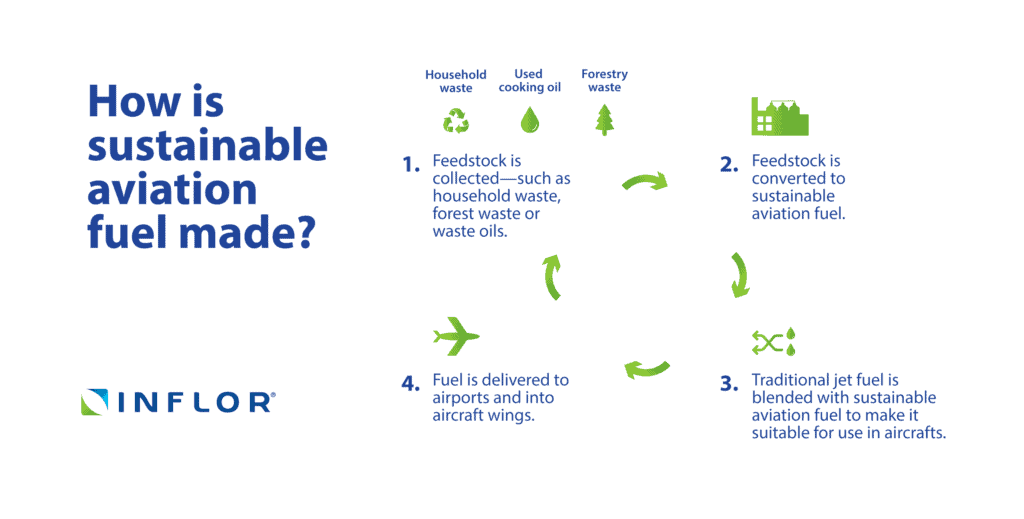
- Early Eurocontrol Free Route Airspace Project (FRAP) analysis found fuel savings and proportional CO₂, H₂O and SOx emission reductions of up to about 2% for flights in the studied upper airspace scenarios.
- The European Aviation Environmental Report notes that FRA introduction in Europe has already saved over 2.6 million tonnes of CO₂ since 2014, representing around 0.5% of total European aviation CO₂ emissions over that period.
- The industry’s Aviation Benefits initiative highlights FRA as a key infrastructure measure enabling more efficient direct routes, saving time and fuel and therefore reducing emissions per flight.
Recent academic work also supports these findings, showing that FRA and related trajectory-optimisation measures deliver tangible reductions in distance, fuel and CO₂/NOx emissions when compared with conventional routings.
2. Contribution to Climate and Sustainability Goals
By cutting fuel burn and CO₂, Free Route Airspace contributes to:
- Net-zero roadmaps for aviation, especially in regions (like Europe and the UK) where airspace modernisation is a recognized climate-action lever.
- Airline-level sustainability strategies, where operational efficiency (including optimised routings) is one of the quickest, technology-ready ways to reduce emissions before new aircraft or alternative fuels scale up.
It is important to note that FRA alone will not decarbonise aviation, but it is a relatively low-cost, high-impact measure when combined with other initiatives such as sustainable aviation fuels, fleet renewal and improved ATM tools.
Challenges of Free Route Airspace for Air Traffic Management
Despite the benefits, FRA is not “free” for the ATM system. It introduces several operational and technical challenges that must be managed carefully.
1. Increased Complexity in Conflict Detection and Resolution
Fixed airways naturally “structure” traffic flows, which can make conflict detection more predictable. In FRA:
- Traffic can be more dispersed and less predictable along many possible trajectories, increasing the complexity for both controllers and pre-tactical planning tools.
- Research and recent dispatcher-routing studies highlight that while FRA improves efficiency, it can significantly increase conflict detection complexity during flight planning, requiring better tools and closer coordination between dispatchers and ANSPs.
Therefore, FRA deployment must be supported by advanced conflict detection, trajectory prediction, and decision-support systems.
2. Mixed Operations and Transitional Phases
During the transition, many FIRs operate with mixed traffic:
- Some flights are still filed on conventional ATS routes, while others use free-route trajectories.
- Eurocontrol’s design guidelines note that this can create parallel systems that are harder to manage and require careful route structuring, sector design and clear rules for where FRA applies.
Managing these mixed operations, especially at night/day transitions or around TMAs, is a key challenge for supervisors and flow managers.
3. Fragmented Airspace and Cross-Border Harmonisation
In Europe and other multi-state regions, airspace is often fragmented across many ANSPs:
- SESAR notes that while most European countries use FRA, the benefits tend to stop at national borders if procedures and systems are not harmonised.
- Cross-border FRA seeks to overcome this by creating seamless free-route volumes across several FIRs, but this requires common standards, agreed entry/exit points, compatible systems and regulatory alignment.
Without such harmonisation, aircraft may still have to “step” through fragmented FRA segments, limiting the full fuel and emissions savings.
4. System Requirements, Data Quality and Resilience
To make FRA safe and efficient, ATM systems need:
- High-quality navigation and surveillance data, robust trajectory prediction and continuous coordination between centres.
- Adequate contingency and fallback procedures, especially if major system failures occur while many aircraft are on diverse, user-defined trajectories.
- Integration with other concepts such as Flexible Use of Airspace (FUA), so that military/segregated areas and civil FRA operations coexist without degrading safety or efficiency.
5. Human Factors and Training
Finally, controllers, supervisors and dispatchers must adapt to:
- Different traffic patterns, with more varied headings and crossing angles.
- Greater reliance on automation and decision-support tools.
- New procedures for coordinating cross-border trajectories and managing mixed operations.
This requires targeted training, simulation and human-factors assessments to ensure that FRA implementation does not inadvertently increase workload or reduce situational awareness.
Free Route Airspace and the Future of ATM
Free Route Airspace is more than just a technical tweak to flight plans; it is a cornerstone of modern, trajectory-based air traffic management:
- It directly supports flight efficiency and cost reduction.
- It delivers measurable environmental benefits in terms of fuel burn and CO₂.
- It pushes ANSPs, regulators and airlines towards greater cooperation and data sharing, especially in cross-border contexts.
At the same time, the concept challenges traditional ways of structuring and controlling traffic. Realising its full potential depends on:
- Mature ATM tools for conflict detection and trajectory management,
- Harmonised deployment across borders,
- Strong focus on human factors, training and procedures.
For countries like Türkiye, which are now launching Free Route Airspace, FRA is both a major opportunity – to increase efficiency and reduce emissions – and a strategic step in aligning with global ATM modernisation trends.
References and Further Reading Links:
- EUROCONTROL. (2022). European Free Route Airspace developments.
https://www.eurocontrol.int/concept/free-route-airspace - EUROCONTROL. (2019). European Aviation Environmental Report 2019.
https://www.easa.europa.eu/en/document-library/general-publications/european-aviation-environmental-report-2019 - ICAO. (2016). Doc 9750 – Global Air Navigation Plan (GANP).
https://www.icao.int/airnavigation/pages/ganp.aspx - SESAR Joint Undertaking. (2020). Trajectory-Based Operations (TBO).
https://www.sesarju.eu/news/trajectory-based-operations-explained - Gurtner, G., Bongiorno, C., Ducci, M., Miccichè, S., & Helbing, D. (2017). Measuring complexity in air traffic management: The case of free-route airspace. Journal of Air Transport Management, 62, 155–166. Source