
On 10 July 2026, two commercial airliners came uncomfortably close while cruising over the eastern Atlantic Ocean, highlighting the importance of modern airborne collision avoidance systems and the multiple safety layers built into international aviation.
The aircraft involved were:
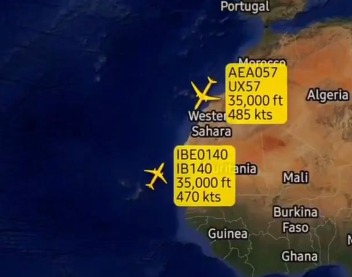
- Air Europa Flight UX57, a Boeing 787-9 operating from Madrid to São Paulo.
- Iberia Flight IB140, an Airbus A321XLR operating from Recife to Madrid.
According to reports from The Aviation Herald, the aircraft were flying near the West Saharan coast on airway N857, between the reporting points ETIBA and BIPET, when both crews received Traffic Collision Avoidance System (TCAS) alerts. The event occurred at approximately 01:23 UTC while both aircraft were at FL360 (36,000 ft).
The situation was resolved exactly as the system was designed to work.
The Boeing 787 received a TCAS Resolution Advisory (RA) instructing the crew to climb, while the Airbus A321XLR received a complementary RA instructing the crew to descend. Both flight crews complied immediately, safely restoring separation before continuing to their destinations without injuries or aircraft damage.
Although no accident occurred, the incident immediately attracted attention because encounters requiring TCAS Resolution Advisories during cruise flight in oceanic airspace are extremely uncommon.
Understanding What TCAS Actually Did
Many media reports describe TCAS as “saving the day,” and in this case that description is justified.
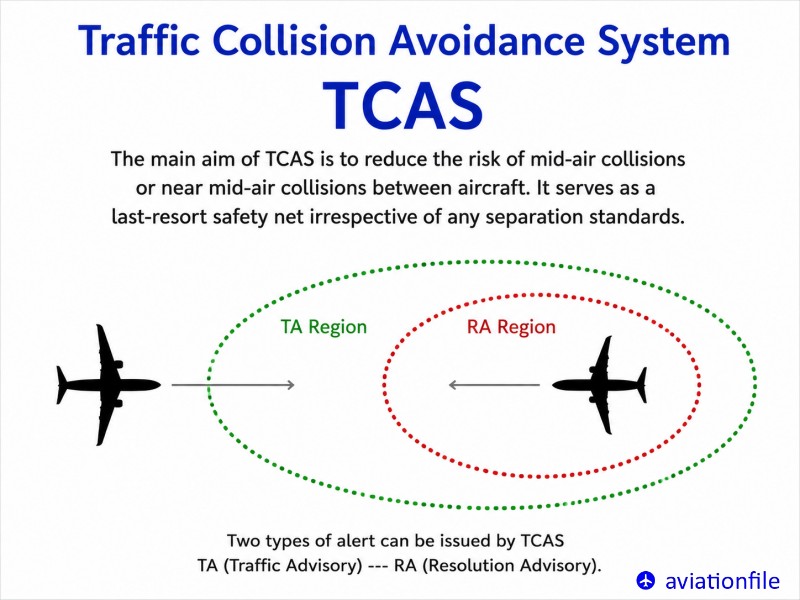
The Traffic Collision Avoidance System (TCAS) continuously monitors nearby aircraft using transponder signals. Unlike ground-based ATC surveillance, TCAS operates independently aboard the aircraft.
The system provides two levels of protection:
- Traffic Advisory (TA): alerts pilots to nearby traffic.
- Resolution Advisory (RA): provides mandatory vertical avoidance instructions when collision risk becomes significant.
During this event, both aircraft reportedly received Resolution Advisories, meaning the predicted loss of separation had reached the threshold where immediate pilot action was required. The two aircraft received coordinated instructions so that one climbed while the other descended, preventing conflicting pilot responses.
This coordination is one of the greatest strengths of modern TCAS technology.
Why Was This So Serious?
At cruise altitude, commercial aircraft typically travel between Mach 0.78 and Mach 0.85. When two aircraft fly directly toward one another, their closing speed can exceed 900 knots (over 1,650 km/h). That means every second counts.
Unlike conflicts during approach or departure, a head-on conflict at cruise altitude leaves very little time for human decision-making. By the time pilots visually identify another aircraft—which is often impossible at cruise altitude—the available reaction time may be only a few seconds.
This is precisely why TCAS was developed following several historic mid-air collisions.
What Could Have Caused the Conflict?
At the time of writing, no official investigation has determined the cause. Several possibilities exist, including:
- an incorrect ATC clearance,
- a misunderstanding of a clearance,
- an altitude assignment error,
- incorrect flight management system programming,
- coordination issues between oceanic control sectors.
However, there is currently no public evidence identifying which factor was responsible, and any conclusion would be speculative until investigators publish their findings.
Oceanic Airspace Is Different
Many passengers assume that air traffic controllers continuously monitor aircraft using radar. Over large portions of the Atlantic Ocean, that assumption is incorrect.
Although surveillance capabilities have improved dramatically through technologies such as ADS-C and CPDLC, many oceanic sectors still rely heavily on procedural separation rather than continuous radar monitoring. Aircraft receive strategic clearances, position reporting remains important, and controllers maintain safe separation using carefully planned longitudinal, lateral, and vertical spacing. ICAO’s North Atlantic Operations Manual describes these specialized procedures and the operational environment unique to oceanic control.
Because aircraft spend hours flying predictable oceanic routes, accurate coordination between pilots and oceanic air traffic controllers is essential.
TCAS Is the Last Safety Barrier—Not the First
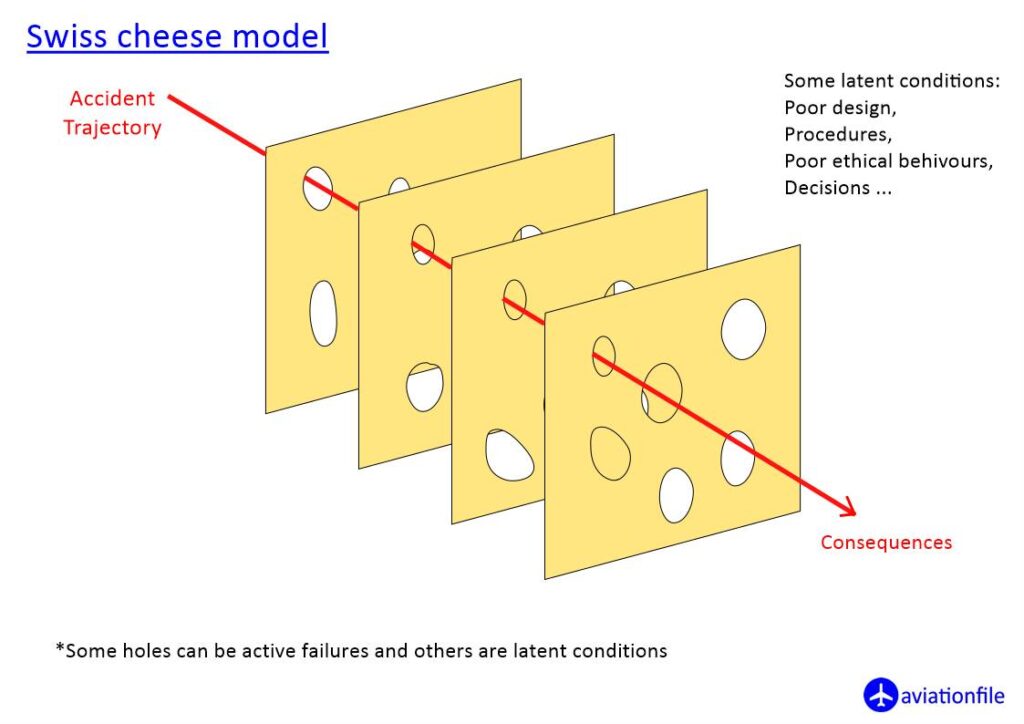
This event demonstrates an important principle of aviation safety. TCAS should never become the primary method of maintaining separation. Instead, it is intentionally designed as the last independent safety barrier after every other layer has failed.
Commercial aviation relies on multiple defensive layers:
- Flight planning
- Standard routes
- Air traffic control
- Pilot situational awareness
- Aircraft navigation systems
- Finally, TCAS
This “Swiss Cheese Model” approach means that accidents usually require multiple independent failures to align simultaneously. In this incident, one or more earlier safety barriers may have failed or degraded, but TCAS successfully prevented the situation from escalating into a collision.
Recommended: Swiss Cheese Model – Aviation Safety
Why Air Traffic Controllers Remain Critical
Incidents like this sometimes lead to the misconception that onboard technology has replaced air traffic controllers.
The opposite is true.
Modern ATC provides the strategic separation that prevents aircraft from ever reaching TCAS alert conditions. Controllers coordinate thousands of flights every day while balancing traffic flow, weather deviations, military airspace restrictions, aircraft performance differences, and international sector handovers.
When separation is maintained correctly, passengers never notice.
When a Resolution Advisory occurs, it usually indicates that several protective layers have already been challenged.
This incident serves as a reminder that ATC and TCAS are complementary—not competing—systems. Air traffic controllers provide the primary separation service, while TCAS acts as the independent emergency safeguard.
Neither system alone provides the remarkable level of safety achieved by modern commercial aviation.
Lessons for Aviation Safety
- The Atlantic TCAS event ended safely because every participant responded exactly as designed.
- The aircraft were equipped with certified collision avoidance technology.
- The crews reacted immediately to their Resolution Advisories.
- The coordinated climb and descent restored safe separation within seconds.
- While investigators continue examining why the aircraft reached this situation, the event reinforces an encouraging fact: aviation’s layered safety philosophy works.
- Rather than relying on a single defence, modern aviation combines human expertise, rigorous procedures, advanced automation, and independent safety systems to prevent accidents.
- In this case, those layers transformed what could have become one of the most serious mid-air collisions in recent years into a valuable safety lesson for the entire aviation community.