
Artificial intelligence is rapidly transforming aviation, but can it actually prevent airplane accidents? The answer is both encouraging and realistic: AI has the potential to significantly reduce aviation risks, yet it cannot eliminate accidents entirely. The future of aviation safety lies not in replacing humans with AI, but in creating intelligent partnerships between pilots, air traffic controllers, maintenance engineers, and advanced machine learning systems.
The Evolution of Aviation Safety
Commercial aviation is already one of the safest forms of transportation ever created. Modern aircraft incorporate multiple layers of redundancy, advanced avionics, highly trained flight crews, predictive maintenance systems, and strict international regulations. ICAO’s long-term strategic objective is to move the industry toward zero fatalities through continuous improvements in safety management, technology, and global cooperation.
Artificial intelligence represents the next major step in this evolution.
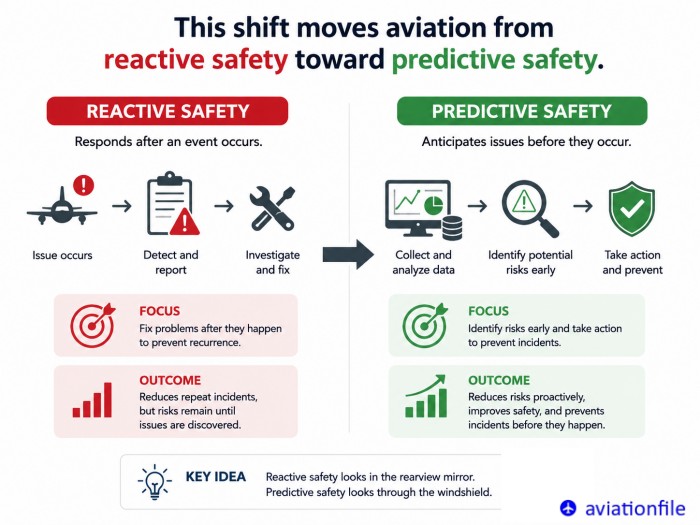
Rather than replacing existing safety systems, AI enhances them by processing enormous amounts of operational data far faster than humans ever could. Every day, airlines generate millions of data points from aircraft sensors, flight recorders, maintenance logs, weather observations, and air traffic systems. AI excels at finding patterns hidden within these datasets before humans recognize them.
This shift moves aviation from reactive safety toward predictive safety.
How AI Can Help Prevent Accidents
Artificial intelligence is already finding practical applications across nearly every stage of flight operations.
Predictive Aircraft Maintenance
Unexpected mechanical failures have become increasingly rare, largely because maintenance has evolved from scheduled inspections to condition-based monitoring. Machine learning algorithms continuously analyze engine performance, vibration levels, hydraulic systems, fuel efficiency, brake temperatures, and thousands of additional sensor readings. Instead of waiting for a component to fail, AI can identify subtle performance changes that may indicate future problems.
For example, if an engine begins behaving slightly differently from thousands of similar engines worldwide, the system can alert engineers before the issue becomes operationally significant. This reduces unscheduled failures while increasing aircraft availability and reliability.
Better Weather Hazard Detection
Weather remains one of aviation’s greatest operational challenges.
Artificial intelligence can combine satellite imagery, radar observations, numerical weather models, aircraft reports, and historical weather databases to improve forecasting accuracy.
These systems can help identify:
- developing thunderstorms
- wind shear
- turbulence
- icing conditions
- volcanic ash
- rapidly changing weather near airports
Earlier detection allows dispatchers, pilots, and controllers to modify routes before hazards become dangerous.
NASA has also been developing AI-powered decision support tools capable of generating safer and more fuel-efficient flight trajectories by processing large amounts of operational data in real time.
Air Traffic Management
Modern air traffic management involves thousands of aircraft moving simultaneously through complex airspace.
Artificial intelligence can support controllers by:
- predicting traffic conflicts several minutes earlier
- suggesting optimal sequencing during busy arrivals
- reducing runway congestion
- optimizing departure flows
- detecting abnormal aircraft behavior
Importantly, these systems act as decision-support tools rather than autonomous controllers.
NASA and other research organizations are actively investigating AI-assisted air traffic management to improve both safety and efficiency while keeping human controllers firmly in charge.

Enhanced Pilot Decision Support
Pilots already receive assistance from sophisticated flight management systems, terrain awareness systems, weather radar, and collision avoidance technology.
Future AI systems could provide an additional safety layer by:
- recognizing unstable approaches earlier
- detecting pilot workload saturation
- identifying checklist omissions
- suggesting safer alternatives during abnormal situations
- monitoring aircraft energy states during approach and landing
Rather than making decisions independently, AI would function as an intelligent advisor capable of rapidly evaluating thousands of variables simultaneously.
Learning from Millions of Flights
Every flight contributes valuable operational knowledge. Artificial intelligence can analyze decades of accident reports, incident investigations, flight data monitoring programs, maintenance records, and voluntary safety reports to discover trends that would otherwise remain hidden.
For example, AI may identify that specific combinations of weather, runway conditions, aircraft configuration, and operational procedures consistently increase risk—even when each individual factor appears relatively harmless. This enables airlines to update procedures before accidents occur.
Recent research reviewing 175 aviation AI studies concluded that accident analysis, operational safety, and human factors have become among the fastest-growing applications of artificial intelligence in aviation. Research link (enhancing aviation safety with artificial intelligence: A systematic literature review on recent advances, challenges and future perspectives)
Can AI Replace Pilots?
Probably not—and, more importantly, it does not need to. A common misconception is that preventing accidents requires fully autonomous aircraft. Current regulatory thinking points in a different direction. The European Union Aviation Safety Agency (EASA) emphasizes a human-centric approach to artificial intelligence. Instead of replacing pilots, AI should enhance human performance while ensuring clear oversight, explainability, certification, and accountability.
Modern commercial aviation depends heavily on human judgment in situations involving uncertainty, rapidly changing conditions, ethical considerations, and unexpected system failures.
Pilots do far more than manipulate flight controls.
They manage risks, communicate with air traffic control, coordinate with cabin crews, evaluate weather, make operational decisions, and handle situations that may never have been encountered during AI training. The safest future is likely one in which experienced pilots and intelligent automation complement each other’s strengths.
The Challenges of AI in Aviation
Despite its enormous potential, artificial intelligence introduces new challenges that cannot be ignored.
Machine learning systems often function as “black boxes,” making it difficult to explain exactly why a particular recommendation was generated. In aviation, regulators require systems to be understandable, predictable, and certifiable before they can be trusted in safety-critical environments. Cybersecurity is another major concern. AI-powered systems must be protected against manipulation, data corruption, and malicious interference.
Training data quality is equally important. An AI system trained on incomplete, biased, or unrepresentative datasets could produce unreliable recommendations under unusual operating conditions.
There is also the issue of human trust.
If pilots become overly dependent on AI recommendations, they may lose valuable manual decision-making skills. Conversely, if crews distrust accurate AI advice, potential safety improvements could be lost.
Finding the right balance between automation and human authority remains one of aviation’s greatest technological challenges.
AI Is Already Improving Aviation Safety
Many people imagine AI as a future technology, but elements of artificial intelligence are already contributing to safer aviation today.
Airlines increasingly use machine learning for predictive maintenance, flight operations analysis, fuel optimization, weather assessment, and safety reporting. Researchers are applying natural language processing to analyze thousands of accident and incident reports automatically, helping identify recurring safety trends much faster than traditional manual reviews.
NASA is also developing machine learning technologies designed to detect safety risks earlier and provide “in-time aviation safety,” allowing hazards to be identified before they develop into accidents. Source
Although these systems rarely make headlines, they quietly improve operational safety every day.
The Future: Human-AI Teaming
The next decade is unlikely to see fully autonomous passenger airliners replacing flight crews.
Instead, aviation is moving toward what regulators and researchers describe as human-AI teaming.
In this model:
- AI processes enormous volumes of operational data.
- Humans remain responsible for critical decisions.
- Both continuously monitor each other.
- Safety benefits from the strengths of both machine intelligence and human expertise.
This philosophy aligns with the aviation industry’s long-standing principle that safety is achieved through multiple independent layers of defense rather than reliance on a single technology.
Conclusion
Artificial intelligence alone will never guarantee that airplane accidents disappear completely. Aviation is an extraordinarily complex system involving humans, aircraft, weather, infrastructure, maintenance, regulation, and countless unpredictable variables.
However, AI has the potential to become one of the most powerful safety tools ever introduced into aviation.
By predicting equipment failures, identifying operational risks earlier, supporting pilots and air traffic controllers, improving weather analysis, and learning continuously from millions of flights, artificial intelligence can significantly reduce accident risk long before hazards become emergencies.
The future of aviation safety is therefore not humans versus artificial intelligence, but humans empowered by artificial intelligence—a partnership that may help bring the industry closer than ever to its ultimate goal of zero fatalities.
References and Further Reading:
- https://www.easa.europa.eu/en/document-library/general-publications/easa-artificial-intelligence-concept-paper-issue-2
- https://arxiv.org/abs/2501.06210?
- https://www.easa.europa.eu/en/domains/research-innovation/ai
- https://www.sciencedirect.com/science/article/pii/S1474034626000704?
- https://www.nasa.gov/ames/aviationsystems/publications/ai/
- https://www.icao.int/strategic-goals/every-flight-safe-and-secure