
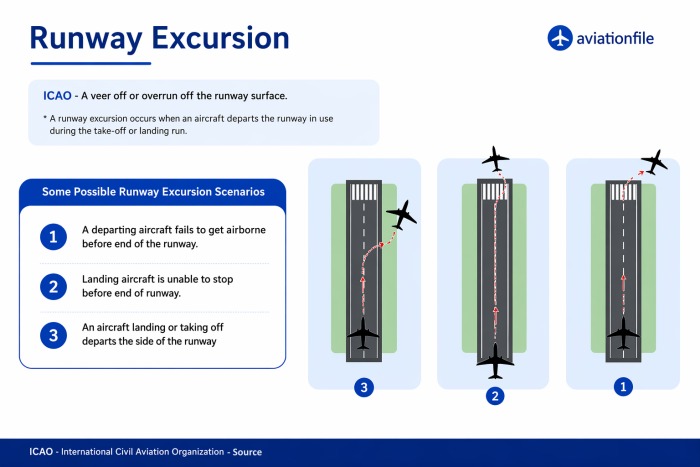
On 27 August 1994, a Turkish Airlines Boeing 737 experienced one of the most dramatic runway overruns in Türkiye’s civil aviation history. Although no lives were lost, the aircraft came to rest only a short distance from a busy railway line after leaving the end of the runway at Istanbul’s Yeşilköy Airport, now known as Istanbul Atatürk Airport.
The accident is often overshadowed by more recent runway excursion events, yet it remains an important case study in landing performance, runway safety, and operational decision-making. More than three decades later, the incident still illustrates how a chain of seemingly manageable factors can rapidly escalate into a potentially catastrophic situation.
Flight Overview
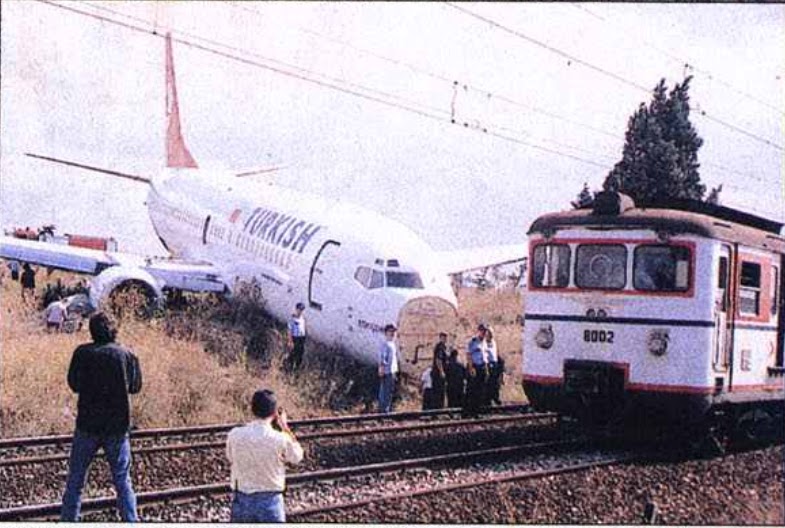
On the morning of 27 August 1994, Turkish Airlines Flight TK284 was operating a scheduled domestic service from Trabzon to Istanbul using a Boeing 737-4Q8 (registration TC-JEL). Weather conditions in Istanbul were unfavorable, with rain leaving the runway wet during the aircraft’s arrival.
The approach itself was not reported as abnormal. The aircraft completed its landing, but after touchdown it failed to decelerate within the available runway distance. Instead of stopping safely on the pavement, the Boeing continued beyond the runway end, crossed the safety area, broke through the airport perimeter fence, and exited the airport boundary before finally coming to a stop near the suburban railway corridor.
Despite the severity of the overrun, all passengers and crew survived, making the event one of the most fortunate runway excursion incidents in Turkish aviation history.
A Near Disaster Beyond the Airport
What made this accident particularly alarming was not simply the runway overrun itself, but where the aircraft stopped.
After leaving the airport, the Boeing crossed a roadway where motorists narrowly avoided a collision. It eventually halted only a short distance before reaching the railway tracks that served Istanbul’s suburban rail network.
Had the aircraft continued only a little farther, the consequences could have been dramatically different. A collision with a passing train or the railway’s overhead electrical infrastructure might have transformed a survivable accident into one involving significant casualties. The event therefore highlights that the risks associated with runway overruns often extend well beyond airport boundaries.
Why Did the Aircraft Fail to Stop?
No detailed public accident investigation report has been released, meaning some technical details remain unavailable. However, information from reliable aviation databases and contemporary reports indicates that the accident resulted from a combination of operational and environmental factors rather than a catastrophic mechanical failure.
Several elements likely contributed to the runway overrun:
- Wet runway conditions reduced braking effectiveness.
- Hydroplaning may have decreased tire-to-runway friction.
- The aircraft appears to have required a longer stopping distance than the runway conditions allowed.
- The event has been classified as a runway overrun (runway excursion) rather than an in-flight emergency.
Without access to the cockpit voice recorder (CVR), flight data recorder (FDR), and the complete investigative findings, it is not possible to determine the precise contribution of each factor. Nevertheless, the accident remains consistent with many runway excursion events where weather, landing performance, and stopping distance combine to create a critical situation.
recommended: Debunking the Myths: All About Flight Recorders (CVRs, FDRs, and ULBs)
Understanding the Risk of Wet Runways
Landing on a wet runway presents challenges that are not always obvious to passengers.
When sufficient water accumulates on the runway surface, aircraft tires may begin to ride on a thin layer of water instead of maintaining full contact with the pavement. This phenomenon, known as hydroplaning (aquaplaning), significantly reduces tire friction and limits braking effectiveness.
Even modern transport aircraft equipped with anti-skid braking systems, spoilers, and thrust reversers cannot completely eliminate the effects of severely degraded runway friction. For this reason, airlines carefully calculate landing distances before every approach, taking into account aircraft weight, runway condition, wind, temperature, and other operational variables.
The Importance of Runway Safety Areas
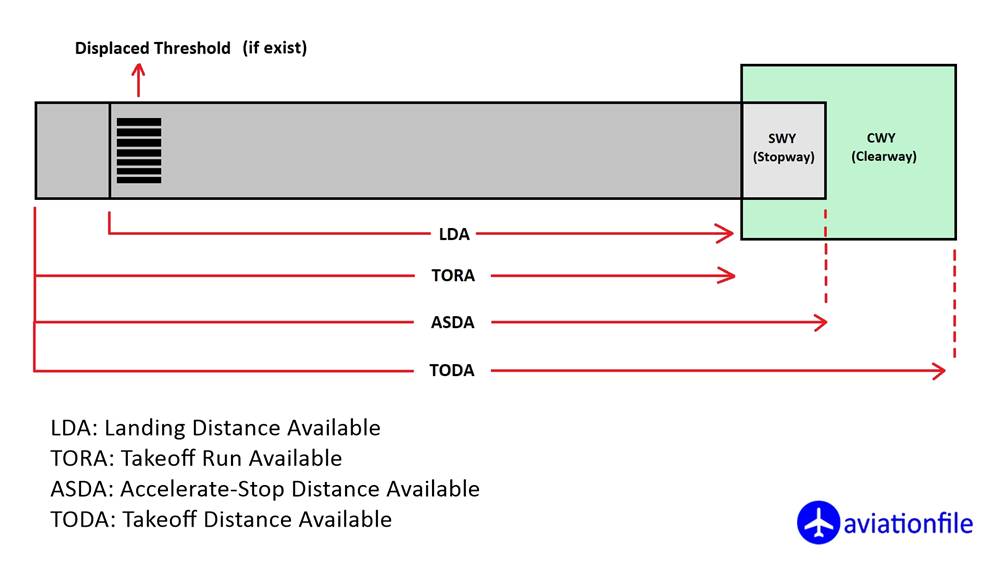
The Yeşilköy accident also demonstrated why airports require adequate protection beyond the physical runway.
International aviation standards recommend Runway End Safety Areas (RESA) to reduce damage when aircraft cannot stop within the runway. In more recent years, some airports have also adopted Engineered Materials Arresting Systems (EMAS), which are specially designed surfaces capable of safely slowing overrunning aircraft where sufficient land for a larger RESA is unavailable.
Although these technologies have evolved considerably since 1994, the fundamental objective remains unchanged: preventing a runway overrun from becoming a far more serious accident outside airport boundaries.
Lessons That Still Matter Today
The 1994 Yeşilköy runway overrun continues to offer valuable lessons for modern aviation. It reinforces the importance of stable approaches, accurate landing performance calculations, proper touchdown within the designated landing zone, and continuous assessment of runway conditions before and during landing.
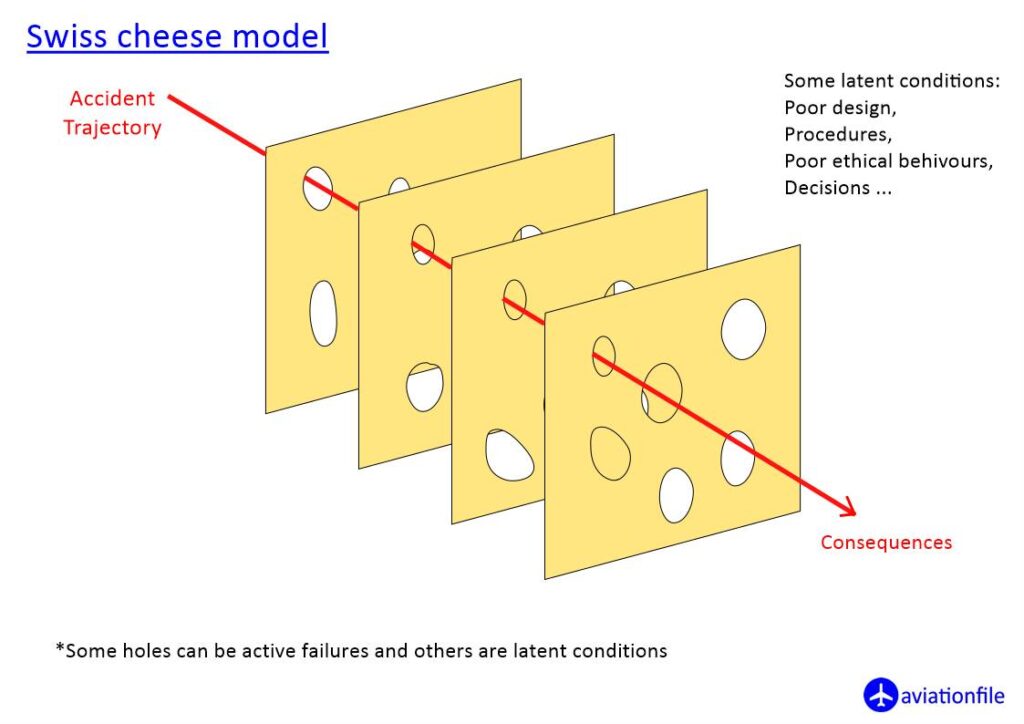
Perhaps its greatest lesson is that runway excursions rarely result from a single mistake. Instead, they usually develop through a sequence of contributing factors, including weather, aircraft performance, pilot decision-making, and airport infrastructure. Breaking any one link in that chain can prevent an accident.
Although the Boeing 737 suffered substantial damage, every occupant survived, and the aircraft was later repaired and returned to service before continuing its operational life with other airlines. The event therefore stands as both a warning and a reminder that good fortune should never be mistaken for safety.
Conclusion
The Turkish Airlines runway overrun at Yeşilköy on 27 August 1994 remains one of Türkiye’s most remarkable aviation incidents. While it did not claim any lives, it exposed the serious hazards associated with wet runway operations and highlighted the importance of airport safety design beyond the runway itself.
Today, as runway excursion prevention continues to be a major focus for airlines, airports, and regulators worldwide, the lessons from the TC-JEL accident remain as relevant as ever.