
In today’s fast-paced aviation environment, keeping aircraft safely separated, on the correct route, and connected to the ground depends on one essential framework: CNS infrastructure. Standing for Communication, Navigation, and Surveillance, CNS describes the full set of systems that allow pilots and air traffic controllers to exchange information, guide aircraft precisely, and maintain reliable situational awareness.
Although passengers rarely think about what keeps thousands of aircraft moving smoothly above them, CNS infrastructure is one of the silent forces behind global aviation safety. As the skies become more crowded and air traffic management systems modernize, CNS plays an even more critical role.

Communication: The Airspace’s Information Highway
Effective communication is the foundation of safe flight operations. The communication part of CNS ensures that pilots and controllers can exchange instructions clearly, quickly, and reliably.
Key Communication Systems
- VHF Voice Communication: The main method of pilot–ATC communication in continental airspace.
- HF Radio: Used for long-range routes where line-of-sight VHF is not possible, especially over oceans.
- CPDLC (Controller–Pilot Data Link Communications): Digital messaging that reduces frequency congestion and improves clarity.
- ACARS: Used by airlines for operational messages like flight plans, weather information, and performance data.
- SATCOM: Satellite-based communication enabling global coverage, including polar and oceanic regions.
Modern communication systems focus on reducing workload, preventing misunderstandings, and supporting advanced air traffic management tools.
Navigation: Guiding Aircraft with Precision
Navigation infrastructure provides the tools and signals that allow aircraft to determine their position, follow defined routes, and conduct accurate approaches.
Key Navigation Technologies
- GNSS (Global Navigation Satellite Systems): GPS, Galileo, and other satellite systems provide high-accuracy positioning.
- VOR/DME: Traditional radio navigation aids still widely used as backups.
- ILS (Instrument Landing System): Enables precision landings during low-visibility operations.
- PBN (Performance-Based Navigation): Includes RNAV and RNP, allowing aircraft to fly optimized and fuel-efficient routes.
- INS/IRS: Internal sensors that provide position data independent of external signals.
The global shift toward satellite-based navigation reduces reliance on older ground stations and supports more flexible airspace design.
Surveillance: Knowing Where Every Aircraft Is
Surveillance systems allow ATC to identify, track, and monitor aircraft movement in real time. As traffic density increases, accurate surveillance becomes even more vital.
Key Surveillance Systems
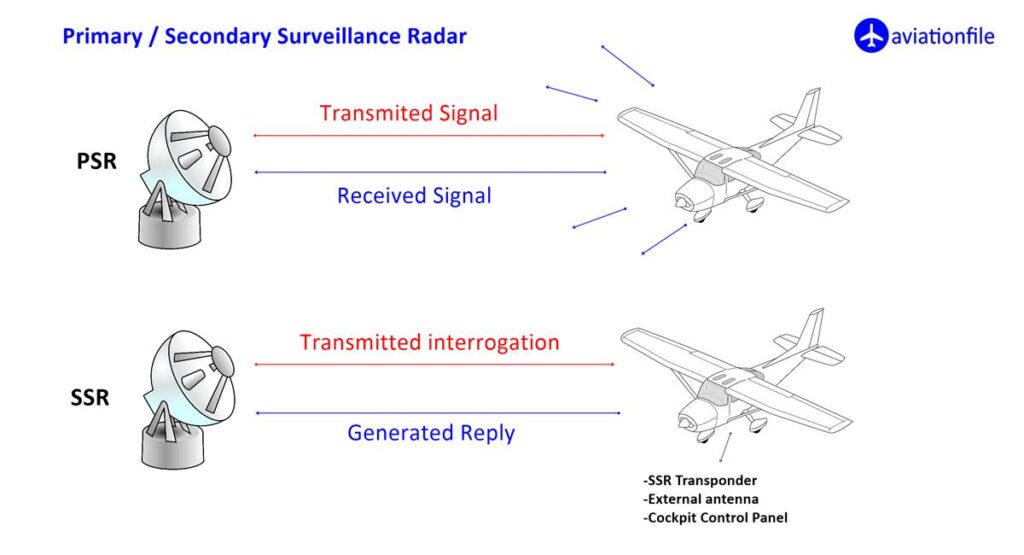
- Primary Surveillance Radar (PSR): Detects aircraft by sending radio waves and receiving reflections—useful for areas where transponder signals may not be available.
- Secondary Surveillance Radar (SSR): Requires aircraft transponders, enabling accurate altitude and identity information.
- Mode S Transponders: Provide selective interrogation and detailed aircraft data.
- ADS-B (Automatic Dependent Surveillance–Broadcast): Uses GNSS to continuously broadcast aircraft position to ground receivers and nearby aircraft.
- MLAT (Multilateration): Calculates aircraft position by measuring the time difference of transponder signals.
ADS-B, in particular, has become a cornerstone of next-generation surveillance due to its low infrastructure cost and exceptional accuracy.
Why CNS Infrastructure Matters
Aviation without CNS would be slow, inefficient, and far less safe. This infrastructure enables:
- Safe separation between aircraft
- Efficient use of airspace
- Precision approach and landing capability
- Real-time situational awareness
- Reduced delays and improved flow management
- Support for modern tools like ATFM, PBN routes, and ATC automation
In essence, CNS is the technological backbone of everything air traffic control does.
CNS and the Future of Air Traffic Management
As the aviation industry transitions toward SESAR, NextGen, and digital ATM systems, CNS infrastructure is evolving with innovations such as:
- Satellite-based communication and navigation
- Space-based ADS-B surveillance
- Integrated ATC automation platforms
- Cyber-secure data link systems
- Enhanced trajectory-based operations (TBO)
These advancements will support a safer, more sustainable, and more efficient global airspace system.
Single European Sky ATM Research – SESAR
Conclusion
CNS infrastructure may be invisible to most travelers, but it forms the backbone of modern aviation. Whether it’s a pilot receiving instructions, an aircraft following an optimized route, or ATC monitoring traffic at a busy airport, CNS ensures that every phase of flight is supported by reliable communication, accurate navigation, and precise surveillance. As airspace becomes more complex, the importance of CNS will only continue to grow—making it a key component of aviation’s future.