
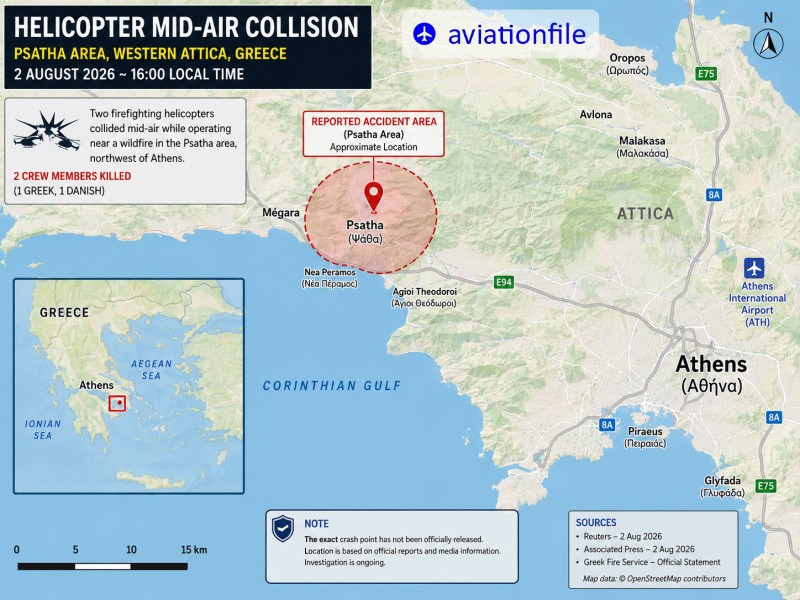
A tragic mid-air collision involving two firefighting helicopters in Greece has highlighted the extreme risks faced by aerial firefighting crews operating close to wildfires. The accident occurred on August 2, 2026, near Psatha in the Attica region, west of Athens, while the helicopters were supporting efforts to contain a major wildfire.
Two crew members — a Greek national and a Danish national — were killed when one of the helicopters crashed following the collision. Two people aboard the second helicopter, a Greek national and a British national, survived.
Greek authorities have launched an investigation to determine exactly what caused the two aircraft to collide.
What Happened in the Greece Helicopter Crash?
The accident occurred over the Psatha area as two firefighting helicopters were operating against a large wildfire that had spread across parts of western Attica.
According to Greek authorities and international news reports, both helicopters were Bell aircraft and each was carrying two people.
Video footage circulating after the accident appeared to show the helicopters operating at low altitude and converging shortly before the collision. One helicopter subsequently crashed in flames, while the second aircraft remained airborne and was able to leave the immediate area.
Reuters reported that the footage appeared to show the main rotor of the lower helicopter striking the underside of the other aircraft. However, Reuters also noted that it had not independently verified the authenticity of the footage. Therefore, the precise collision sequence and its underlying causes should not be considered established until investigators release their findings.
The Greek fire service confirmed that an investigation had begun.

Two Crew Members Killed, Two Survive
The helicopter that crashed carried a Greek national and a Danish national, both of whom were killed.
The second helicopter carried another Greek national and a British national. Both survived and were taken to hospital following the accident.
European Commission President Ursula von der Leyen expressed condolences following the crash and paid tribute to the crews involved in aerial firefighting operations.
Greek Prime Minister Kyriakos Mitsotakis also expressed his sorrow over the deaths.
The accident occurred during an exceptionally demanding period for Greek emergency services, with numerous wildfires burning across the country.
Bell Helicopters Involved in the Collision
Associated Press reported that the aircraft involved were Bell helicopters operating over Psatha, each with a two-person crew.
Firefighting helicopters play an important role in wildfire suppression, particularly in mountainous or inaccessible terrain where ground crews may have difficulty reaching the fire.
Their missions can include dropping water or fire retardant, supporting ground crews and repeatedly flying between water sources and active fire fronts.
These operations, however, can place aircraft in an unusually demanding environment.
Unlike conventional helicopter operations, wildfire missions may require repeated low-level maneuvering near terrain while multiple aircraft operate within the same relatively confined area. Smoke can reduce visibility, while turbulence, strong winds, rapidly changing fire behavior and high cockpit workload can further complicate operations.
Why Aerial Firefighting Operations Are Particularly Challenging
The conditions surrounding the Greek wildfires were severe.
Nearly 500 firefighters and 23 aircraft were reportedly deployed against the fires in the wider region. Gale-force winds pushed flames through dry vegetation and, according to Associated Press, were strong enough at times to prevent some firefighting aircraft from reaching the sea to collect water.
These environmental factors do not establish the cause of the helicopter collision. That distinction is important.
Nevertheless, they illustrate the operational environment in which aerial firefighting crews were working.
Firefighting aviation often combines several demanding factors simultaneously: low-altitude flight, proximity to terrain, reduced visibility from smoke, strong or turbulent winds, multiple aircraft operating near the same target and frequent transitions between water collection points and fire-drop zones.
Aircraft may also need to sequence their runs carefully while maintaining separation from other helicopters and fixed-wing firefighting aircraft.
For this reason, coordination between flight crews, aerial supervisors and ground firefighting organizations is an essential part of large-scale aerial firefighting operations.
Investigation Into the Mid-Air Collision
At the time of writing, investigators have not announced a definitive cause of the accident.
Although available video footage may provide investigators with important evidence about the final seconds before the collision, determining why two aircraft came into conflict generally requires a much broader investigation.
Investigators may examine aircraft trajectories, crew communications, operational procedures, environmental conditions, visibility, aircraft performance, mission coordination and other human and technical factors.
It is therefore premature to attribute the accident to pilot error, weather conditions, communication problems or any other specific factor.
The distinction between the collision mechanism and the cause of the accident is particularly important. Video may eventually establish how the aircraft physically contacted each other, but investigators must determine the chain of circumstances that allowed the conflict to develop.
Greece Battles Major Wildfires
The helicopter accident occurred against the backdrop of a serious wildfire emergency across Greece.
Sky News reported that the Greek fire service recorded approximately 220 wildfires across the country during the preceding week. The wildfire associated with the helicopter accident had destroyed more than 100 homes, while evacuation alerts were issued for several communities in western Attica.
The fire reportedly began in the Greek region of Boeotia before spreading toward Attica. Reuters reported that investigators were examining indications that sparks from electrical conductors on a private power network may have started the blaze.
Strong winds subsequently complicated firefighting efforts and pushed flames toward populated areas.
The emergency was not limited to mainland Greece. Wildfires were also reported in other parts of the country, including Kefalonia.
A Growing Challenge for Firefighting Aviation in Europe
The Greek helicopter collision also occurred during a wider period of severe wildfire activity across Europe.
Large fires affected Greece, France and Spain, placing significant pressure on firefighting resources and forcing large-scale evacuations.
Europe entered 2026 after an exceptionally destructive 2025 wildfire season. Associated Press, citing European environmental data, reported that more than 10,000 square kilometers burned across Europe during 2025.
Rising temperatures and increasingly severe fire-weather conditions are making wildfire response an important long-term challenge for European emergency services.
For aviation, this can mean greater demand for specialized aircraft, pilots, maintenance personnel, aerial coordination systems and international firefighting cooperation.
Greece already relies on both domestic and international aerial firefighting resources during its summer fire season, and foreign crews regularly participate in operations when fire activity intensifies.
Aviation Safety Lessons Will Depend on the Investigation
The August 2 collision is a reminder of the complexity of aerial firefighting, but meaningful safety conclusions should wait for the official investigation.
Mid-air collisions are rarely understood simply by examining the final seconds before impact. Investigators will need to reconstruct how the two helicopters were positioned, what instructions or coordination procedures were in effect, what each crew could see, and how environmental and operational factors may have influenced the sequence.
Any recommendations concerning aircraft separation, communication, formation or sequencing procedures, crew situational awareness or aerial firefighting coordination should therefore be based on verified investigative findings rather than early assumptions.
What is already clear is the demanding nature of the mission being performed.
Aerial firefighting crews routinely operate close to terrain and active fires under conditions that can change rapidly. The deaths of the two crew members in Greece demonstrate once again that the people flying these missions accept considerable risk while protecting communities threatened by wildfires.
As the investigation progresses, its findings may provide important lessons for firefighting aviation not only in Greece but across Europe and other regions increasingly dependent on aerial resources during major wildfire emergencies.
Recommended: Suat Al: The Legacy of Türkiye’s First Aerial Firefighting Pilot