
Modern aviation increasingly relies on automated systems capable of processing large volumes of information and supporting operational decision-making. In Air Traffic Management (ATM), Decision Support Systems (DSS) assist air traffic controllers in monitoring traffic, identifying potential conflicts, evaluating alternative solutions, and managing complex operational situations.
However, the effectiveness of a decision support system depends not only on the accuracy of its recommendations but also on how quickly those recommendations become available to the human operator.
A system may generate an accurate solution within milliseconds, yet additional delays can occur before that solution appears on the Human–Machine Interface (HMI). Furthermore, displaying information does not necessarily mean that the operator has immediately perceived, understood, or acted upon it.
Consequently, latency in aviation decision support systems should be examined as a sequence of interconnected technical and human processes rather than a single measure of computational speed.
Understanding Latency in Decision Support Systems
In systems engineering, latency generally refers to the elapsed time between a defined event and its corresponding response. Within aviation decision support systems, several distinct forms of latency can be identified.
Computation latency represents the time required for the system to process available information and generate a decision, prediction, or recommendation. This duration depends on factors such as algorithm complexity, data volume, processing capacity, and computational workload.
Output-to-display latency describes the interval between the completion of a decision-support output and its visible presentation on the HMI. The expression decision output-to-display latency may be used to describe this specific interval, although it should not be interpreted as a universally standardized aviation term.
End-to-end latency covers a broader processing chain, such as the interval between the reception of input data and the presentation of the resulting information on the display. Its precise meaning depends on the selected measurement boundaries.
Finally, human response time concerns the period between the presentation of information and a defined operator response. Depending on the task, this may involve detecting an alert, interpreting a recommendation, making a decision, or initiating an operational action. These measurements are related but should not be treated as interchangeable.
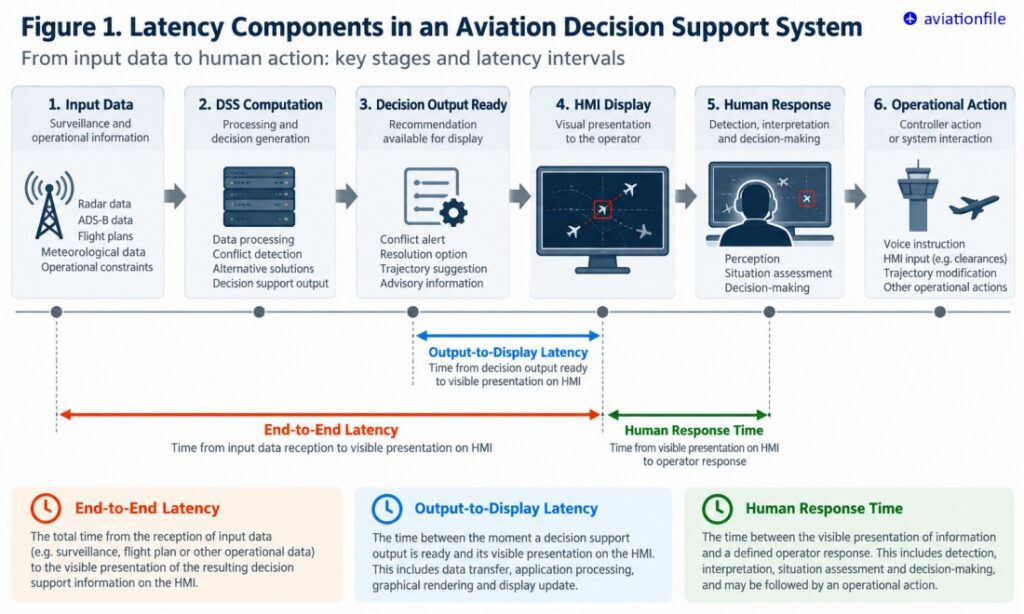
Conceptual illustration synthesizing technical latency and human-response stages. Not a standardized aviation timing model.
From Decision Computation to HMI Presentation
The completion of a computational process does not necessarily indicate that its output is immediately available to the operator. Before a recommendation becomes visible, it may pass through several technical stages, including internal communication, data transmission, application-level processing, graphical rendering, and physical display updates. These stages are particularly relevant in distributed ATM architectures, where decision support functions and Controller Working Positions (CWPs) may operate on separate computing platforms. Network conditions, processing queues, software architecture, and display hardware can contribute to overall presentation delays. An important distinction also exists between the moment an HMI application completes a rendering operation and the moment the resulting information becomes physically visible on the screen. Display refresh cycles and hardware characteristics may introduce additional delays that are not fully represented by application-level timestamps. For this reason, evaluating HMI latency may require both software measurements and physical display verification. Furthermore, display latency should not be confused with display update frequency. A system that refreshes information at regular intervals does not necessarily have an equivalent delay between receiving information and presenting it.
NASA Standards and Display Latency
NASA provides an important technical reference for understanding latency in safety-critical human–machine interfaces. NASA-STD-3001, Volume 2, addresses human factors and interface requirements for human spaceflight systems. Section 10.2.3 establishes a maximum display system latency of 50 milliseconds for information elements used in manual vehicle flight control and the monitoring of time-critical automated flight control tasks. In this context, display system latency includes the interval between a change in vehicle dynamics and the presentation of the corresponding information on the display, covering the processing chain from sensors to visual presentation. The requirement is intended to support satisfactory vehicle handling performance and prevent undesirable display behavior, including excessive jitter or irregular motion. However, this 50-millisecond requirement applies to the specific piloting functions identified by NASA. It should not be interpreted as a universal latency limit for all aviation decision support systems, particularly those used in air traffic control. Nevertheless, the standard demonstrates that display latency can be an explicitly defined engineering requirement in time-critical aerospace operations.
EUROCONTROL: Latency and Information Freshness
In ATM, another important consideration is the age of the information presented to the controller. EUROCONTROL’s Specification for ATM Surveillance System Performance (ESASSP) establishes performance requirements and assessment methods for surveillance systems, including time-related characteristics of surveillance information. This introduces an important distinction between how quickly information is displayed and how current that information actually is. A decision support system may present its recommendation with minimal output-to-display latency while relying on surveillance information that no longer accurately represents the current traffic situation.
For example, a conflict-resolution recommendation generated from outdated aircraft position information may become operationally less useful even if the recommendation itself appears almost immediately on the controller’s screen. Accordingly, the temporal performance of a decision support system cannot be evaluated solely through its display latency. The freshness of the underlying data, the time required for computation, and the delay associated with presenting the resulting information must also be considered. This distinction is particularly relevant in ATM environments where aircraft positions, trajectories, and operational constraints continuously evolve.
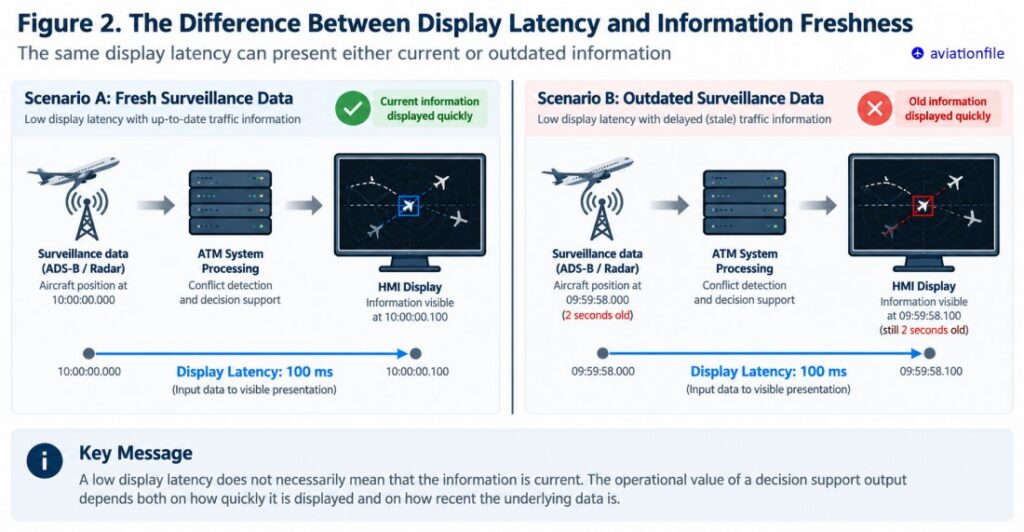
Conceptual illustration based on surveillance data age and display latency principles. The 100 ms and 2-second values are hypothetical and do not represent regulatory limits.
Safety Alerts and Time-Critical System Performance
Latency becomes especially significant when automated systems are responsible for detecting potentially hazardous situations and presenting safety-related alerts. Advanced Surface Movement Guidance and Control Systems (A-SMGCS) provide a relevant example. ETSI EN 303 213-2 addresses performance requirements for A-SMGCS Airport Safety Support Services and refers to EUROCAE ED-87D for specific latency requirements. Two relevant concepts are identified: Alert Processing Latency (APL) and Alert Response Time (ART). These metrics demonstrate that the temporal performance of automated safety alerts is addressed through explicit technical requirements. However, their definitions should not be automatically equated with computation latency, HMI display latency, or the response time of a human controller. Their exact measurement boundaries must be interpreted according to the applicable standard. A similar operational concern exists in Short-Term Conflict Alert (STCA) systems used in air traffic control.The effectiveness of an alert depends not only on the system detecting a potential conflict but also on providing sufficient time for the controller to assess the situation and initiate appropriate action. In such applications, the operational consequences of latency depend on the available intervention time, the development of the hazardous situation, and the effectiveness of the subsequent response.
Human Response Time and Cognitive Processing
Technical system performance represents only one part of the overall decision-making process. Once information becomes visible on the HMI, the human operator must detect, interpret, and evaluate it before taking appropriate action. These activities involve cognitive processes influenced by workload, attention, task complexity, operational experience, and interface design. A relevant study by Metzger and Parasuraman (2005), published in Human Factors, examined the effects of automated conflict decision aids on air traffic controller performance and mental workload. The researchers found that reliable automation improved controller performance and reduced mental workload in their simulated environment. However, imperfect automation could negatively affect the detection of certain conflicts. These findings highlight the importance of automation reliability and human–automation interaction. They also demonstrate why faster technical processing should not automatically be associated with better operational performance. An inaccurate recommendation delivered rapidly may be less useful than a reliable recommendation presented within an operationally acceptable timeframe. Furthermore, human response time is not identical to perception time. An operator may notice an alert quickly but require additional time to understand its implications and determine an appropriate response. Therefore, studies examining human response should clearly define whether they measure initial detection, decision-making, action initiation, or task completion.
Recommended: Artificial Intelligence and Legal Liability in Aviation: Who Is Responsible When AI Fails?
The Role of HMI Design
The design of the Human–Machine Interface can significantly influence how efficiently operators process information. In air traffic control, displays frequently contain multiple aircraft tracks, flight data labels, alerts, and operational indicators. Controllers must continuously distribute their attention across these information sources. The presentation of decision-support recommendations should therefore consider visual prominence, consistency, prioritization, and compatibility with the controller’s operational tasks. A recommendation that appears immediately may still require considerable cognitive processing if its presentation is ambiguous or visually difficult to interpret. Conversely, a clearly structured interface may help operators identify and evaluate relevant information more efficiently. This distinction illustrates the relationship between technical latency and human response performance. Reducing system latency is important, but the operational benefits may remain limited if the interface does not support effective human interpretation. Consequently, HMI performance should be evaluated through both technical measurements and human-in-the-loop assessments.
Measuring Latency in Aviation Systems
Reliable latency assessment requires clearly defined measurement boundaries. For technical measurements, timestamps can be collected at important processing stages, including data reception, completion of decision computation, transmission to the HMI, and visual presentation. In distributed architectures, appropriate clock synchronization is essential when timestamps from different computing platforms are compared. Application-level measurements may also be supplemented by physical display measurements, particularly when precise presentation timing is required. For human performance assessments, simulation-based experiments can be used to examine operator response under different latency conditions. Eye-tracking technologies, reaction-time measurements, task completion times, and workload assessments may provide additional insight into the relationship between technical delays and operational behavior. Importantly, average latency alone is not sufficient to characterize system performance. Measurements should also consider latency variability, high-percentile delays, maximum observed delays, and the frequency with which defined timing requirements are exceeded.A system with consistently moderate latency may behave differently from a system with a similar average but occasional substantial delays. For safety-related applications, these differences may be operationally significant.
What Is an Acceptable Latency in Aviation?
There is no single latency threshold applicable to every aviation decision support system. Acceptable timing depends on the operational function, system architecture, human responsibilities, and the consequences of delayed information. NASA’s 50-millisecond requirement for specified flight-control display functions illustrates the importance of stringent latency limits in certain aerospace applications. However, this value cannot be directly transferred to every ATM decision support function. A short-term conflict warning, a tactical trajectory recommendation, and a strategic traffic-flow management tool operate under different temporal constraints. Consequently, latency requirements should be established through task analysis, system safety assessment, and operational validation. The relevant question is not simply how many milliseconds a system requires to display a recommendation, but whether that recommendation reaches the operator early enough to support a safe and effective decision.
Conclusion
Latency is an important but often multidimensional aspect of aviation decision support system performance. Computation latency, output-to-display latency, end-to-end latency, and human response time represent distinct stages of the interaction between automated systems and human operators. NASA’s human–system interface requirements, EUROCONTROL’s surveillance performance specifications, and the A-SMGCS standards developed through EUROCAE and ETSI demonstrate the importance of temporal performance in aerospace and aviation systems. However, reducing technical delays alone does not guarantee improved operational outcomes. The accuracy and freshness of information, the reliability of automation, the quality of HMI design, and the cognitive capabilities of the human operator must also be considered. For future ATM decision support systems, the objective should therefore extend beyond faster computation and display performance.
The fundamental requirement is to deliver accurate, relevant, and timely information in a form that enables human operators to make safe and effective operational decisions.
References
- NASA. (2026). NASA-STD-3001, Volume 2, Revision F: Human Factors, Habitability, and Environmental Health. Section 10.2, Crew Interfaces. https://www.nasa.gov/reference/nasa-std-3001v2/
- EUROCONTROL. (2024). EUROCONTROL Specification for ATM Surveillance System Performance (ESASSP), Edition 1.3. https://www.eurocontrol.int/publication/eurocontrol-specification-atm-surveillance-system-performance-esassp
- EUROCAE. ED-87D: Minimum Aviation System Performance Specification for Advanced Surface Movement Guidance and Control Systems (A-SMGCS). https://www.eurocae.net/
- ETSI. (2020). ETSI EN 303 213-2 V2.1.1: Advanced Surface Movement Guidance and Control System (A-SMGCS), Part 2. https://www.etsi.org/deliver/etsi_en/303200_303299/30321302/02.01.01_60/en_30321302v020101p.pdf
- Metzger, U., & Parasuraman, R. (2005). Automation in future air traffic management: Effects of decision aid reliability on controller performance and mental workload. Human Factors, 47(1), 35–49. https://doi.org/10.1518/0018720053653802