
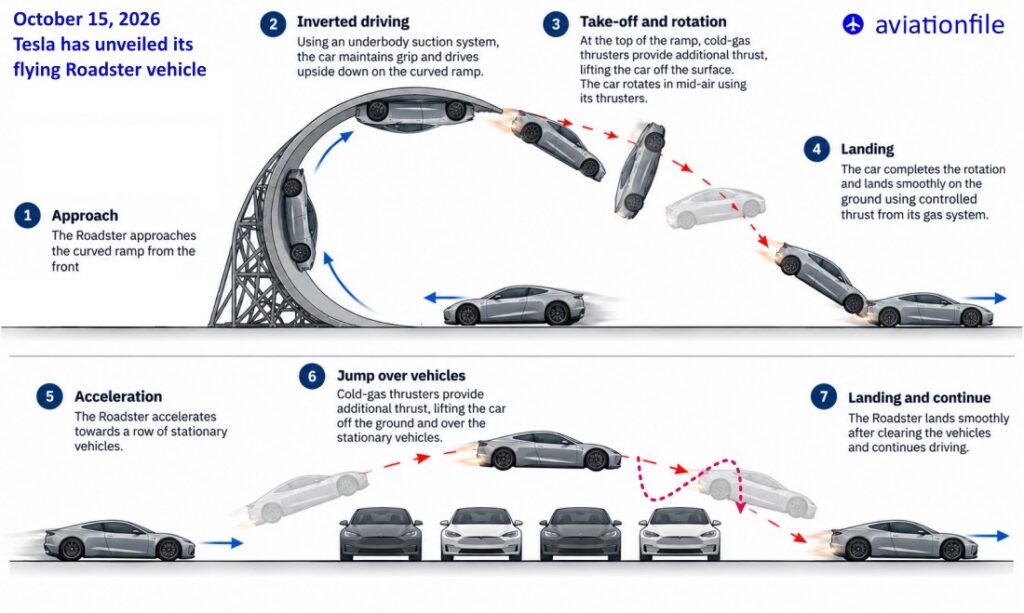
On October 15, 2026, Tesla unveiled a redesigned version of its long-awaited Roadster at SpaceX’s testing facility in McGregor, Texas. The demonstration showed an electric sports car driving upside down, rotating in mid-air, and briefly lifting off the ground using a propulsion system developed in collaboration with SpaceX. The event represents an interesting development at the intersection of automotive and aerospace engineering. Unlike conventional flying vehicles that rely on wings or rotors, the experimental Roadster uses high-pressure gas thrusters to generate additional forces and perform short airborne maneuvers.
However, an important distinction remains: brief airborne movement does not necessarily make a vehicle a practical flying car.
From Electric Supercar to Experimental Flying Vehicle
Tesla first introduced the second-generation Roadster in November 2017, promising extraordinary performance, including acceleration from 0 to 60 mph (97 km/h) in 1.9 seconds, a top speed exceeding 250 mph (402 km/h), and a driving range of approximately 620 miles (998 km).
These were initial design targets, not independently verified production specifications.
In subsequent years, Elon Musk suggested that a special Roadster configuration could incorporate SpaceX-inspired rocket thrusters, potentially enabling the vehicle to leave the ground. The October 2026 demonstration provided the clearest public example of this concept. During the event, the prototype traveled along a specially constructed inverted ramp, performed an airborne rotation, and used its thrusters to jump over several stationary Tesla vehicles. The maneuvers demonstrated limited airborne capability under controlled conditions rather than sustained flight.
How Does the Tesla Roadster Fly?
The Roadster’s propulsion system is based on Newton’s third law of motion: every action produces an equal and opposite reaction. When compressed gas is expelled through a nozzle, the resulting reaction force pushes the vehicle in the opposite direction. This technology, known as cold-gas propulsion, is already used in aerospace applications, particularly spacecraft attitude-control systems. Unlike conventional chemical rocket engines, cold-gas thrusters generate force without combustion.
In the Roadster, appropriately positioned thrusters can potentially assist with acceleration, braking, vehicle orientation, and short-duration airborne movement. Another important feature is the underbody suction system. By creating a pressure difference beneath the vehicle, this system generates additional downforce and helps maintain contact with the driving surface. The two technologies serve different purposes: the suction system improves surface adhesion, while the thrusters provide directional forces that can influence the vehicle’s motion, including when airborne. A major limitation is that compressed-gas propulsion depends on a finite supply of stored gas and pressure. Generating high thrust for a short period is therefore different from maintaining sustained flight.
Tesla Roadster: Specifications and Demonstrated Capabilities
| Feature | Reported information |
|---|---|
| Propulsion | Electric drivetrain with optional compressed-gas thrusters |
| Acceleration | 0–60 mph in under 1 second, according to Tesla |
| Maximum speed | Over 230 mph (370 km/h), announced target |
| Driving range | Over 300 miles (483 km), announced target |
| Airborne capability | Brief controlled maneuvers demonstrated |
| Flight duration | No verified maximum published |
| Production target | 2028 |
Note: Performance figures are manufacturer announcements and have not been independently certified for a production Roadster.
Three Roadster Configurations
Tesla’s official reservation information identifies three configurations:
- Performance: A two-seat road-oriented model with active aerodynamics and a multifunction suction system.
- Thrust: A two-seat, track-oriented configuration adding acceleration thrusters.
- Rocket: An invitation-only, single-seat version incorporating a full flight system.
The Rocket configuration is particularly significant because it introduces aerospace propulsion and flight-control challenges into a vehicle originally designed for road transportation.
Nevertheless, its final operating limitations, flight envelope, and certification status remain uncertain.
Is the Tesla Roadster Really a Flying Car?
The Roadster has demonstrated the ability to leave the ground and perform short airborne maneuvers using additional propulsion. However, this does not establish that it can function as a conventional aircraft or an electric vertical takeoff and landing (eVTOL) vehicle.
A practical flying vehicle must demonstrate sustained controlled flight, adequate endurance, reliable stability, and an acceptable level of operational safety. The Roadster has not yet publicly demonstrated all these capabilities. It is therefore more accurate to describe the new Roadster as an experimental electric sports car equipped with aerospace-derived propulsion technology and limited airborne maneuvering capability.
Recommended: What Is a Tiltwing Aircraft? A Complete Guide to VTOL Flight, History, Advantages, and Future Applications
Major Aerospace Engineering Challenges
Despite the impressive demonstration, several important technical questions remain.
Thrust and flight duration: To remain airborne without aerodynamic lift or another supporting force, a vehicle must generate sufficient upward thrust to counteract its weight.
The basic relationship is: Thrust ≥ Mass × Gravitational Acceleration
For example, a hypothetical 1,700 kg vehicle would require approximately 16.7 kN of upward thrust merely to balance gravity. This is an illustrative calculation, not a confirmed specification of the Roadster.
Flight stability: Once airborne, conventional steering and tire forces can no longer control the vehicle. The propulsion system must provide adequate control over pitch, roll, and yaw.
Safety: High-pressure gas storage, propulsion failures, uncontrolled movement, and emergency landing procedures introduce challenges beyond those of conventional road vehicles.
Regulation: Powered airborne operation may introduce aviation regulatory requirements. In the United States, the Federal Aviation Administration (FAA) oversees civil aviation safety, while road vehicles operate under a separate regulatory framework.
A controlled demonstration does not automatically establish that the vehicle is approved for flight on public roads or in unrestricted airspace.
Could This Technology Change Transportation?
The Roadster’s significance extends beyond its spectacular maneuvers. The integration of SpaceX-associated propulsion technology into an electric sports car illustrates how engineering solutions developed for aerospace applications can influence automotive design. Such technologies could encourage research into propulsion-assisted vehicle dynamics, advanced control systems, and unconventional mobility concepts. Nevertheless, practical flying transportation requires much more than brief lift-off capability. Safety, endurance, energy efficiency, operational infrastructure, and regulatory approval remain essential challenges. Tesla has announced a 2028 production target, although the Roadster project has experienced repeated delays since its introduction in 2017. Final pricing, production specifications, and the operational capabilities of the Rocket version have not yet been fully established.
Conclusion
Tesla’s October 2026 Roadster demonstration represents a notable example of aerospace technology being integrated into automotive engineering. By using compressed-gas thrusters developed in collaboration with SpaceX, Tesla has demonstrated that a road-oriented electric vehicle can perform short airborne maneuvers beyond the capabilities of conventional cars. However, limited airborne movement should not be confused with sustained, certified, and operationally practical flight. For now, the Roadster is best understood as an experimental platform demonstrating the potential of aerospace-inspired propulsion in future vehicle design. Its ultimate significance will depend on whether Tesla can transform these impressive demonstrations into a safe, reliable, and commercially viable technology.
References
- Tesla (2026). Roadster – Official Specifications and Configurations
- Reuters (2026). Tesla’s New Roadster Turns in Air With SpaceX Thrusters
- TechCrunch (2026). Tesla Reveals SpaceX-Powered Roadster That Flies and Falls With Style
- The Verge (2026). The Tesla Roadster Flew, Drove Upside Down, and Hit 60 mph in Under a Second
- Financial Times (2026). Tesla Unveils Flying Sports Car With SpaceX Rocket Thrusters
- Federal Aviation Administration (FAA). Aircraft Certification