
In aviation, technical knowledge and procedural discipline are essential, but psychology also plays a significant role in shaping pilot performance. One psychological phenomenon that deserves greater attention is the Golem Effect—the tendency for low expectations to produce poorer performance.
Although the Golem Effect has been widely studied in education and organizational psychology, its principles are highly relevant to aviation environments, where instructors, examiners, captains, and supervisors constantly influence the development of pilots, air traffic controllers, maintenance personnel, and cabin crews.
This article explores what the Golem Effect is, why it matters in aviation, and how instructors and aviation leaders can avoid unintentionally creating negative performance cycles.
What Is the Golem Effect?
The Golem Effect is a psychological phenomenon in which low expectations placed on an individual contribute to lower performance. It is considered a form of a self-fulfilling prophecy, where negative expectations subtly influence behavior and eventually lead to the very outcome that was expected.
The concept was formally described by Babad, Inbar, and Rosenthal (1982) as the negative counterpart of the better-known Pygmalion Effect, where high expectations tend to improve performance. Unlike deliberate criticism or unfair treatment, the Golem Effect is usually unconscious. Supervisors often believe they are behaving objectively, while their expectations quietly shape the way they communicate, coach, and evaluate others.
Simply put, when people consistently signal that they expect someone to perform poorly, that individual becomes more likely to do exactly that.
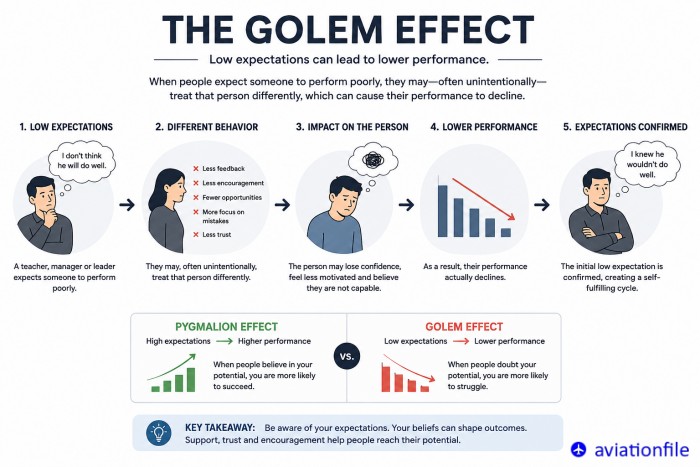
How Does the Golem Effect Work?
The Golem Effect develops gradually rather than appearing overnight. It often begins when a supervisor, instructor, or team leader forms an early negative impression of someone. Once that expectation exists, it can subtly influence daily interactions. The individual may receive less encouragement, fewer opportunities to demonstrate competence, and feedback that focuses primarily on mistakes rather than progress.
Over time, this treatment can reduce confidence and motivation. As self-belief declines, performance may genuinely worsen, appearing to confirm the original assumption. This creates a self-reinforcing cycle in which the expectation and the outcome continue to strengthen one another.
Why Is It Relevant in Aviation?
Aviation is one of the world’s most performance-driven industries. Pilots, student pilots, air traffic controllers, maintenance technicians, dispatchers, and cabin crew all develop their skills through structured training, continuous assessment, and regular feedback from experienced professionals.
Unlike many other professions, aviation requires individuals to perform under pressure while demonstrating both technical competence and sound judgment. Because learning is closely guided by instructors and examiners, the expectations communicated during training can have a meaningful influence on confidence, decision-making, and long-term professional development.
For this reason, understanding the psychological impact of expectations is just as important as understanding technical procedures or operational standards.
Flight Training: When Expectations Shape Learning
Imagine a student pilot who struggles during the first few training flights. An instructor may unintentionally conclude that the student lacks natural aptitude for flying. From that moment onward, the instructor may become slightly less patient, provide shorter explanations, or intervene more quickly during exercises instead of allowing the student to solve problems independently.
None of these actions are necessarily intentional, yet together they can send a powerful message that the student is not expected to succeed. As confidence decreases, the student may become hesitant, second-guess routine decisions, and make more mistakes than their actual ability would predict. Eventually, weaker performance appears to validate the instructor’s original opinion, even though that opinion may have contributed to the outcome.
The Golem Effect During Type Rating
A similar situation can occur during aircraft type rating programs. Pilots transitioning to a new aircraft are expected to master unfamiliar systems and procedures within a relatively short period. If one trainee is viewed as weaker than others early in the course, instructors may unknowingly provide fewer opportunities for independent decision-making while focusing more heavily on errors than successful performance.
This imbalance can increase mental workload during simulator sessions and gradually reduce confidence. As pressure grows, the pilot may begin making mistakes that reinforce the belief that additional supervision is necessary, creating a cycle that becomes increasingly difficult to break.
Crew Resource Management and Cockpit Communication
Crew Resource Management (CRM) emphasizes communication, teamwork, and mutual respect regardless of rank or experience. However, the Golem Effect can subtly undermine these principles.
For example, if a captain assumes that a newly qualified first officer has little to contribute, the first officer may receive fewer invitations to participate in decision-making or may feel discouraged from speaking up altogether. Over time, this hesitation can reduce the exchange of critical information within the cockpit. Although CRM is specifically designed to encourage open communication, negative expectations may unintentionally create barriers that weaken crew coordination and situational awareness.
Air Traffic Control Training
The same psychological mechanism can also be observed in air traffic control training. A trainee controller who makes several early mistakes may quickly be perceived as less capable than other students. In response, an instructor might intervene more frequently, reduce opportunities for independent control, or focus primarily on correcting errors.
While these actions are often intended to maintain safety, they may also prevent the trainee from building confidence through successful experience. The result can be increased hesitation, slower decision-making, and reduced confidence during complex traffic situations. In this way, expectations—not just technical ability—can influence learning outcomes.
Why Confidence Matters in Aviation
Confidence should never be confused with overconfidence. Aviation training is designed to build competence first, with confidence developing as a natural result of experience and proficiency.
Healthy confidence enables aviation professionals to communicate clearly, make timely decisions, manage workload effectively, and recover constructively from mistakes. Conversely, when individuals repeatedly receive signals that others doubt their abilities, they may become reluctant to take initiative or trust their own judgment, even when they possess the necessary knowledge and skills.
Maintaining realistic confidence is therefore an important element of effective human performance.
The Relationship Between the Golem Effect and Flight Safety
The Golem Effect is not officially identified as a direct cause of aviation accidents by organizations such as the International Civil Aviation Organization (ICAO) or the Federal Aviation Administration (FAA). Nevertheless, its underlying mechanisms closely align with many established human factors concepts that influence operational safety.
Modern aviation recognizes that communication quality, leadership style, learning culture, teamwork, and psychological safety all affect performance. These same factors are central to the Golem Effect. An environment where individuals feel trusted, supported, and encouraged to learn from mistakes is more likely to produce competent professionals than one dominated by negative assumptions and limited opportunities.
Preventing the Golem Effect in Aviation
Preventing the Golem Effect does not require lowering standards or avoiding honest feedback. Instead, it requires ensuring that expectations remain objective and evidence-based throughout the learning process.
Effective instructors evaluate performance according to consistent standards rather than early impressions. They provide balanced feedback that recognizes progress alongside areas requiring improvement, encourage trainees to solve problems independently whenever safety permits, and create an atmosphere in which asking questions is viewed as a normal part of professional development.
Such practices not only improve learning outcomes but also strengthen psychological safety—an increasingly important component of modern Safety Management Systems (SMS).
Golem Effect vs. Pygmalion Effect
| Golem Effect | Pygmalion Effect |
|---|---|
| Low expectations | High expectations |
| Reduced confidence | Increased confidence |
| Less encouragement | More encouragement |
| Fewer learning opportunities | More developmental opportunities |
| Lower performance | Higher performance |
Both psychological phenomena demonstrate that expectations influence behavior. While the Pygmalion Effect can accelerate learning through positive expectations, the Golem Effect reminds us that negative assumptions may unintentionally limit human potential.
Final Thoughts
Aviation has always been built on the principle of continuous improvement. Technical knowledge, standard operating procedures, and recurrent training remain the foundation of safe operations, but human psychology also plays a vital role in determining how effectively people learn and perform.
The Golem Effect illustrates that expectations are never entirely neutral. Even subtle differences in feedback, communication, and trust can influence confidence, motivation, and ultimately performance. By recognizing this psychological phenomenon, flight instructors, training captains, examiners, and supervisors can create learning environments that challenge aviation professionals while still communicating confidence in their ability to succeed.
Supporting high standards and maintaining positive, realistic expectations are not contradictory goals. Together, they help develop safer, more capable, and more confident aviation professionals.
References
- Babad, E. Y., Inbar, J., & Rosenthal, R. (1982). Pygmalion, Galatea, and the Golem: Investigations of biased and unbiased teachers. Journal of Educational Psychology, 74(4), 459–474.
- Rosenthal, R., & Jacobson, L. (1968). Pygmalion in the Classroom: Teacher Expectation and Pupils’ Intellectual Development.
- International Civil Aviation Organization (ICAO). Human Factors Training Manual (Doc 9683).
- International Civil Aviation Organization (ICAO). Safety Management Manual (Doc 9859).
- Federal Aviation Administration (FAA). Aviation Instructor’s Handbook (FAA-H-8083-9).
- Federal Aviation Administration (FAA). Pilot’s Handbook of Aeronautical Knowledge.