Can You Feel an Earthquake While Flying? What Happens If an Earthquake Strikes Below an Airplane?
Can You Feel an Earthquake While Flying?
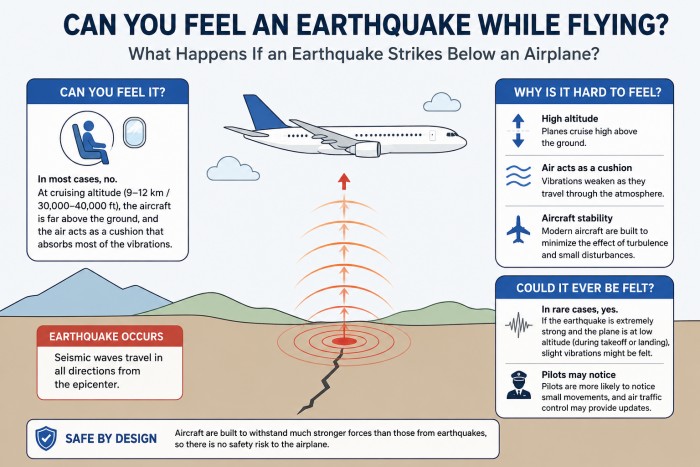
Imagine you’re cruising at 35,000 feet (10,700 meters) when a powerful earthquake strikes directly beneath your flight path. Would the aircraft shake? Would the pilots notice? Could the earthquake affect the flight?
It’s a surprisingly common question, especially after major earthquakes make international headlines. The short answer is:
In almost all cases, no. Aircraft flying at cruising altitude do not feel earthquakes occurring on the ground.
Here’s why.
Why Earthquakes Are Not Felt by Aircraft
An earthquake is the sudden release of energy within the Earth’s crust, producing seismic waves that travel through rock and, to a much smaller extent, through the ground’s surface.
Commercial aircraft, however, are flying far above the Earth’s surface. They are supported by the surrounding air, not by the ground. Unlike buildings, cars, or trains, airplanes have no physical connection to the Earth once airborne. Since seismic waves travel through solid ground rather than through the atmosphere, the shaking simply doesn’t reach the aircraft.
Even during very powerful earthquakes, the energy transmitted into the atmosphere is extremely small compared with normal atmospheric disturbances.
What About the Air Above the Earthquake?
Some people wonder whether a massive earthquake could shake the air enough to affect an aircraft.
Large earthquakes can indeed generate low-frequency atmospheric waves, known as infrasound or acoustic-gravity waves. Scientists often detect these waves using specialized instruments.
However, these atmospheric disturbances are:
- Extremely weak by the time they reach typical cruising altitudes.
- Spread over enormous distances.
- Far less energetic than ordinary atmospheric turbulence.
As a result, passengers and pilots almost certainly wouldn’t notice them.
Is Turbulence Stronger Than an Earthquake in the Sky?
Ironically, yes.
The bumps experienced during normal turbulence are generally much stronger than any atmospheric disturbance produced by an earthquake. Aircraft are routinely designed to withstand:
- Moderate turbulence
- Severe turbulence
- Strong jet streams
- Convective weather
- Mountain waves
Compared to these everyday atmospheric phenomena, earthquake-generated air disturbances are essentially negligible.
Could Pilots Even Know an Earthquake Happened?
Usually, pilots only learn about a major earthquake through:
- Air Traffic Control (ATC)
- Airline operations centers
- Weather or operational messages
- News reports after landing
The aircraft itself does not have sensors that detect earthquakes because there is generally no operational need to do so while airborne.
Are There Any Indirect Effects on Aviation?
Although the earthquake itself is unlikely to affect an aircraft already in flight, it can create significant operational challenges on the ground. Possible indirect effects include:
Airport Inspections
Following a significant earthquake, airports may temporarily suspend operations while crews inspect:
- Runways
- Taxiways
- Aprons
- Lighting systems
- Navigation aids
- Fuel infrastructure
Even minor pavement damage must be assessed before aircraft movements resume safely.
Air Traffic Delays
If an airport closes for inspections or emergency response, arriving aircraft may:
- Enter holding patterns
- Divert to alternate airports
- Experience departure delays
These operational decisions are precautionary rather than a result of the aircraft being affected by the earthquake itself.
Infrastructure Damage
A major earthquake can also disrupt:
- Air traffic control facilities
- Radar installations
- Communication systems
- Power supplies
- Airport access roads
Modern aviation systems include backup procedures, but significant infrastructure damage can still reduce airport capacity.
Can Earthquakes Trigger Other Aviation Hazards?
In certain situations, yes—but indirectly.
For example, earthquakes may trigger:
- Tsunamis that threaten coastal airports.
- Landslides near airport infrastructure.
- Damage to runways and taxiways.
- Fuel supply interruptions.
- Passenger terminal evacuations.
The aircraft already in cruise flight remains safe, but airport operations may be significantly affected.
What About Volcanic Earthquakes?
One important exception involves earthquakes associated with volcanic activity.
Earthquakes often occur before volcanic eruptions. If an eruption releases volcanic ash into the atmosphere, aviation can be seriously affected.
Unlike ordinary earthquakes, volcanic ash poses a genuine hazard to aircraft because it can:
- Damage jet engines.
- Abrade cockpit windows.
- Contaminate aircraft systems.
- Reduce visibility.
This is why volcanic ash is continuously monitored by international aviation organizations and Volcanic Ash Advisory Centers (VAACs).
Recommended: ASHTAM: Enhancing Aviation Safety by Alerting Aviators to Volcanic Activities
Has an Aircraft Ever Been Shaken by an Earthquake?
There are no well-documented cases of a commercial airliner at cruising altitude being directly shaken by an earthquake occurring beneath it.
Pilots occasionally report unusual turbulence caused by:
- Mountain waves
- Convective weather
- Wake turbulence
- Clear-air turbulence
However, these atmospheric phenomena are unrelated to seismic activity.
Although it may seem intuitive that an aircraft flying above a major earthquake would experience some kind of shaking, physics tells a different story. Commercial airplanes cruise high above the Earth’s surface and are isolated from the seismic waves traveling through the ground. In practice, the turbulence encountered during an ordinary flight is far more noticeable than any atmospheric effect produced by an earthquake.
The real aviation impact of an earthquake is typically felt after the event, as airports inspect infrastructure, air traffic controllers manage disruptions, and airlines adjust their operations. For passengers already in the sky, however, an earthquake below is almost always something they will never notice.