
A recent ground collision at LaGuardia Airport has drawn global attention after an Air Canada regional aircraft struck an airport emergency vehicle during landing. (The aircraft was operated by Jazz Aviation, a regional partner of Air Canada.)
The incident, which remains under active investigation, highlights the complexity of airport ground movements and the critical importance of coordination between air traffic control, flight crews, and ground vehicles.
Flight Details: Aircraft, Route, and Timeline
The aircraft involved was operated by Air Canada Express, typically flown by Jazz Aviation.
- Aircraft type: Bombardier CRJ900
- Route: Montreal (Montréal–Trudeau International Airport) → New York LaGuardia
- Operation: Scheduled passenger flight
- Capacity: Approximately 70–90 passengers (typical CRJ900 configuration)
According to available reports, the flight departed Montreal and arrived at LaGuardia without any reported en-route issues. The event occurred on the runway after the aircraft had landed and slowed down to some extent.
At this stage of flight, workload typically shifts from approach and landing to surface navigation, taxi instructions, and traffic awareness—a phase that still requires high situational awareness from all parties involved.
The Collision: What We Know So Far
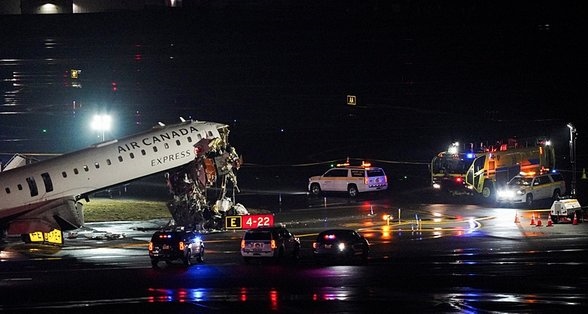
The collision occurred between the Air Canada aircraft and an airport fire truck (ARFF – Aircraft Rescue and Fire Fighting vehicle) operating on or near the runway.
Key confirmed points:
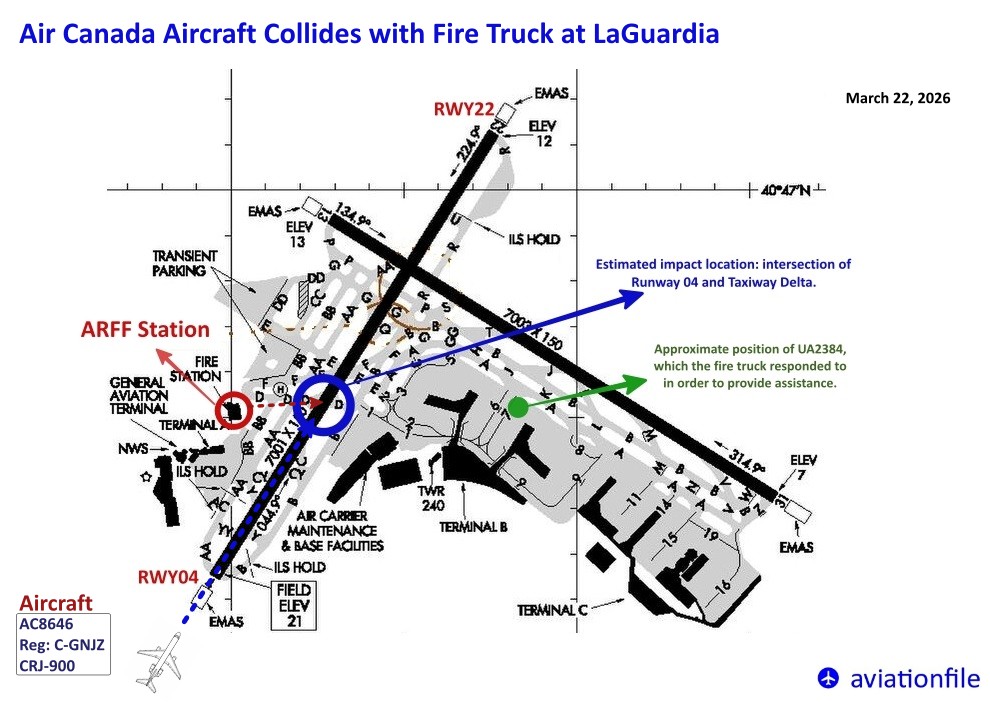
- The aircraft had already landed at LaGuardia Airport, runway 04.
- The fire truck was responding to a separate operational situation.
- Both the aircraft and the vehicle were present in the same movement area
- A collision occurred during ground movement
Casualties:
According to initial reports, the accident resulted in two fatalities and 41 people injured, with several individuals requiring hospitalization. Emergency response teams were quickly dispatched to the scene, and injured passengers and personnel were transported to nearby medical facilities.
Authorities have emphasized that this is an evolving situation, and casualty figures may be updated as more verified information becomes available.
ARFF Response to UA2384
The sequence of events began with United Airlines flight UA2384, a Boeing 737-8 MAX, which was en route to Chicago but decided to return to gate due to reports of unusual fumes on board. As a precaution, emergency assistance was requested.
In response to the situation, an Airport Rescue and Firefighting (ARFF) vehicle was dispatched to support UA2384 upon its arrival.
Meanwhile, Air Canada Express flight AC8646, operated by a CRJ-900, had already landed at LaGuardia. While decelerating on the runway after touchdown, the aircraft collided with the ARFF truck, which was moving to assist UA2384.
A Possible Context: Runway Incursion Scenario
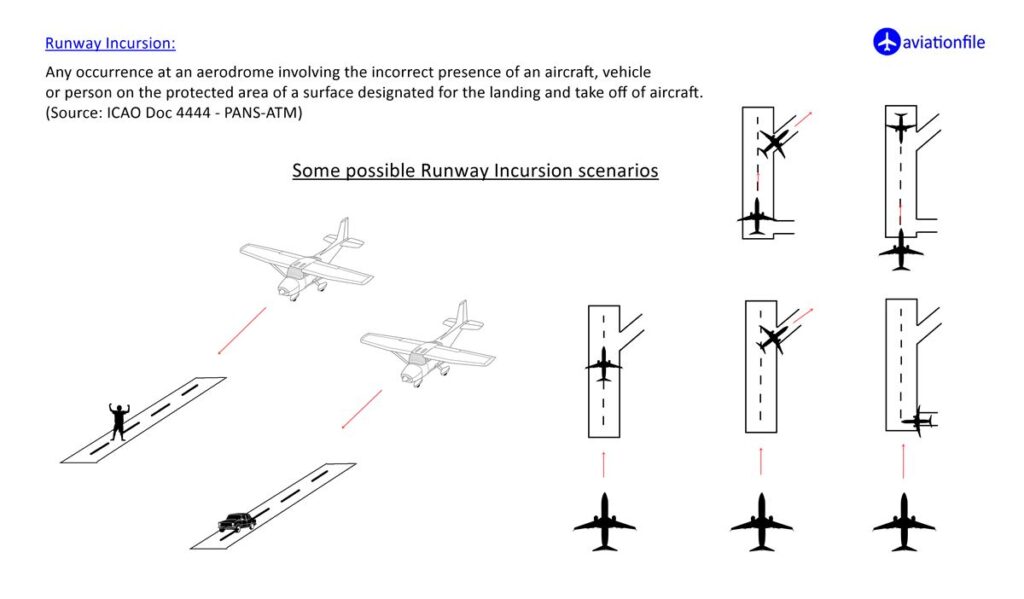
A runway incursion is defined as:
Any occurrence involving the incorrect presence of an aircraft, vehicle, or person on the protected area of a runway.
In simple terms:
👉 A runway is occupied by more than one traffic element in a conflicting manner.
ATC Perspective: Complexity and Workload
At major airports like LaGuardia, air traffic controllers manage:
- Continuous arrival and departure flows
- Ground vehicle movements
- Emergency operations
- Rapidly changing priorities
During abnormal situations—such as when emergency vehicles are dispatched—operational complexity increases significantly.
It is important to emphasize:
At this stage, no official report has concluded that this was an air traffic control error
However, as widely discussed in early media coverage, such events may involve:
- High workload conditions
- Time-critical decisions
- Multiple simultaneous clearances
- Rapid coordination between units
In aviation, even small timing mismatches in such environments can lead to serious consequences.
Investigation Ongoing
Authorities, including Federal Aviation Administration and National Transportation Safety Board, have launched a full investigation.
At the time of writing:
- The exact sequence of clearances is still being analyzed
- ATC recordings, vehicle communications, and cockpit data will be reviewed
- Human factors, procedures, and coordination aspects will all be examined
Recommended Article: https://www.aviationfile.com/flight-recorder-cvr-fdr-ulb/
Final Thoughts
This incident is a strong reminder that:
Aviation safety is not only about flight, but also about ground operations. Even in highly controlled environments, the interaction between aircraft and ground vehicles requires:
- Precise communication
- Clear situational awareness
- Strict adherence to procedures
As the investigation continues, more details will clarify exactly how this event unfolded.