
Aviation is widely recognized as one of the safest modes of transportation, supported by continuous improvements in technology, operational procedures, and safety management practices (Barnett, 2020). Nevertheless, every phase of flight involves potential risks, ranging from adverse weather conditions and loss of separation to runway excursions and runway incursions. Although aviation safety has improved significantly over the decades, preventing accidents and incidents remains a fundamental priority for the industry.
Among these safety challenges, runway incursions are particularly significant because they can lead to serious ground collisions involving aircraft, vehicles, or personnel. As airports become increasingly complex and air traffic operations continue to evolve, maintaining situational awareness and effective coordination on airport surfaces is essential.
This article examines the concept of runway incursions, explores notable historical incidents and accidents, and discusses the operational, human, and technological factors that contribute to these events. It also highlights preventive measures and modern safety initiatives designed to reduce runway incursion risks and enhance overall aviation safety.
A runway incursion is defined by ICAO as any occurrence involving the incorrect presence of an aircraft, vehicle, or person on the protected area of a runway. For example, a runway incursion may occur when a ground vehicle enters an active runway without authorization, an aircraft crosses a runway without clearance, or a departing aircraft begins its takeoff roll while another aircraft is still occupying the runway. These incidents may result from communication errors, reduced situational awareness, poor visibility, or operational mistakes, potentially leading to serious safety risks.
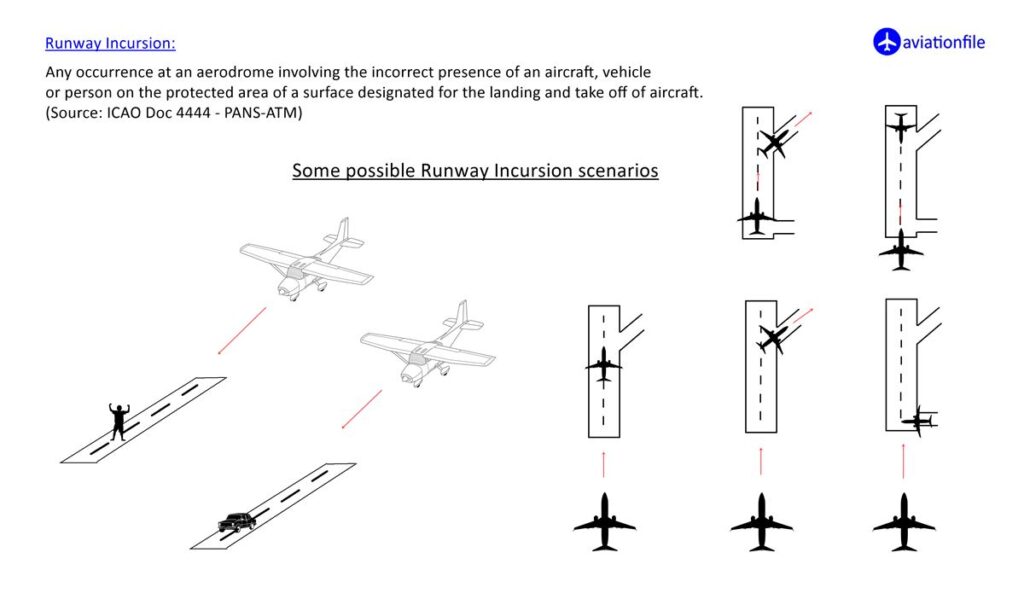
Runway incursions are generally a result of some mistakes of the responsible professionals like pilots, air traffic controllers and ground staff. Sometimes technical issues may cause or prepare the ground for incursions. Let’s look at some of incursion disasters.
Tenerife Disaster (27 March 1977)
KLM Flight4805 and Pan Am Flight1736 collided on runway at Tenerife North Airport (formerly was Los Rodeos Airport) and 583 people killed. It is still the deadliest accident in aviation history (hope to remain like that). The disaster was because of a runway incursion in brief and the result was terrible (You can find the documentary of Tenerife disaster there Click).

Omsk / RUSSSIA (11 October 1984)
On October 11, 1984, Aeroflot Flight 3352, a Tupolev Tu-154, collided with runway maintenance vehicles while landing at Omsk Airport in the Soviet Union (now Russia). The accident resulted in 178 fatalities, including 174 passengers and crew members and four ground workers, making it the deadliest aviation accident on Russian territory. The investigation revealed serious failures in air traffic control coordination, including a ground controller who had fallen asleep and failed to report the presence of maintenance vehicles on the runway.
Logan Int. Airport / Boston (09 June 2005)
On June 9, 2005, US Airways Flight 1170 and Aer Lingus Flight 132 narrowly avoided a collision at Boston Logan International Airport after receiving takeoff clearances just five seconds apart on intersecting runways. As both aircraft approached the intersection, the first officer of the US Airways flight recognized the danger and prevented the aircraft from rotating, allowing the Aer Lingus aircraft to pass overhead. Both flights continued safely to their destinations without injuries or damage.
This incident demonstrates how communication and coordination failures can create potentially catastrophic situations within seconds. While some runway incursions are resolved without serious consequences, others can result in devastating accidents, highlighting the critical importance of runway safety and situational awareness.
Runway Incursion Statistics and Trends: A Continuing Aviation Safety Challenge
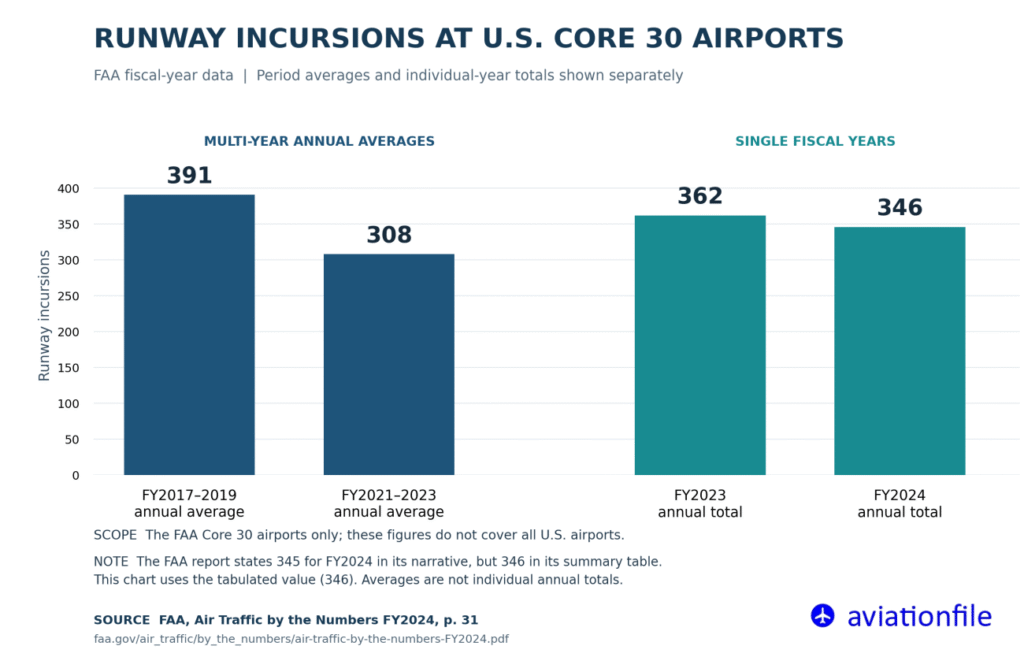
Despite continuous improvements in aviation safety, runway incursions remain a significant operational concern at airports worldwide. The increasing complexity of airport operations, combined with communication errors, human factors, and ground movement challenges, highlights the importance of effective runway safety management.
The Federal Aviation Administration (FAA) regularly publishes runway incursion statistics in the United States, classifying incidents according to their severity and operational characteristics. These data provide valuable insights into runway safety performance and help identify emerging risks and areas requiring additional preventive measures.
However, the total number of runway incursions alone does not necessarily reflect changes in aviation safety. Aircraft movement volumes, incident severity, and reporting practices must also be considered when evaluating long-term trends. Examining runway incursions relative to airport traffic activity provides a more meaningful understanding of how runway safety performance evolves over time.
Now, let’s briefly look at what can we do to prevent incursions.
Firstly, all professionals must pay attention and focus while on duty. Pilots, controllers and ground staff must always stay focused and alert. Rules like read back in R/T communication or checklist control must be obeyed strictly. Always keep in mind that all rules have at least one purpose that serves safety in aviation.
Moreover, staying focus and alert is a lot related with physical and mental condition of the worker which affects the performance. So fatigue is a vital subject for safety, keeping mental and physical health is a must for aviation workers. On that point executives must be aware of that subject and implement related applications on the working environment (For more reading about fatigue in aviation click.
- Clear signage and markings on runways and taxiways guide pilots and ground crew.
- Regular training ensures pilots, controllers, and crew understand proper procedures.
- Airport Surface Detection Equipment (ASDE) tracks ground movement for air traffic control.
- Runway incursion mitigation (RIM) programs identify and address runway incursion risks.
- Physical barriers like fences can prevent unauthorized runway access.
- Crew resource management (CRM) training improves communication and situational awareness in cockpits.
As we all know aviation industry is developing in a mind blowing speed. New rules, new regulations, new technological equipment are involving on the area of responsibility of the professionals. This situation increases the need for continuous refreshment training and education and self-development. All aviation workers must be aware of the need for staying with updated knowledge.
Finally, it is fair to say that runway incursions are like nightmares of aviation and may end with devastating results. On the other hand, if necessary precautions are taken they can be minimized by professionals and all related staff in aviation.
Recommended Article: The 2014 Vnukovo Crash: Aviation and Global Context of the Death of Total CEO Christophe de Margerie
References and Further Reading on Runway Incursion
- Federal Aviation Administration (FAA): https://www.faa.gov/airports/runway_safety/resources/runway_incursions
- International Civil Aviation Organization (ICAO): https://www.icao.int/NACC/Documents/Meetings/2015/GREPECASPF2/GRPECASF2-P06.pdf
- Airports Council International (ACI): https://store.aci.aero/product/aci-runway-safety-handbook-second-edition-2022/
- International Federation of Airline Pilots’ Associations (IFALPA): https://ifalpa.org/media/2273/runway-safety-manual-12.pdf
- https://www.faa.gov/air_traffic/by_the_numbers/air-traffic-by-the-numbers-FY2024.pdf
- https://www.faa.gov/airports/runway_safety/statistics
- https://store.icao.int/en/manual-on-the-prevention-of-runway-incursions-doc-9870
For more articles click.
Easy to read, good cover of topic. Nice…