Aircraft Health Monitoring Systems (AHMS)
Modern aircraft generate enormous amounts of operational and performance data during every flight. Airlines and maintenance organizations increasingly rely on Aircraft Health Monitoring Systems (AHMS) to analyze this data, improve reliability, reduce unscheduled maintenance, and enhance flight safety.
As aviation moves toward predictive and condition-based maintenance, AHMS has become one of the most important technologies in modern airline operations.
What is an Aircraft Health Monitoring System (AHMS)?
An Aircraft Health Monitoring System (AHMS) is an advanced monitoring and diagnostic system that continuously collects, analyzes, and transmits aircraft performance and system data to help detect abnormalities, predict failures, and optimize maintenance planning.
AHMS typically gathers information from multiple onboard systems, including:
- Engines
- Hydraulics
- Flight controls
- Electrical systems
- Avionics
- Environmental control systems
- Structural components
The system can automatically transmit fault messages and performance data to airline maintenance centers, sometimes even while the aircraft is still in flight.
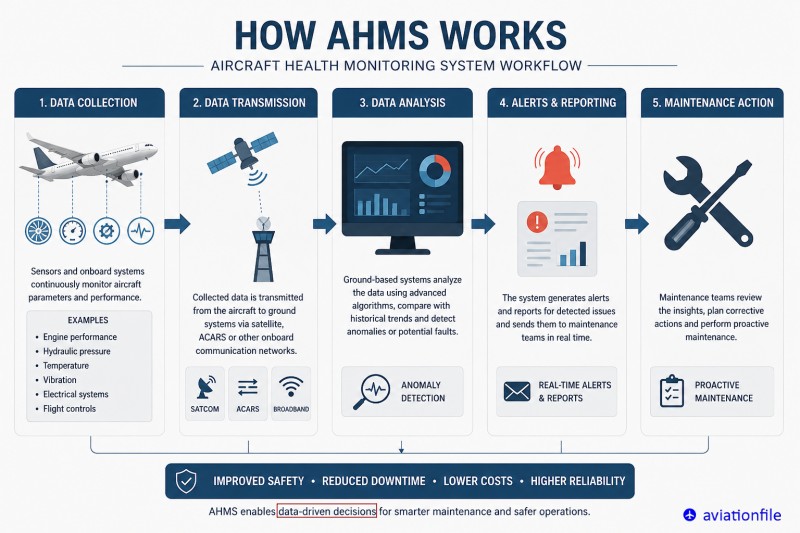
How AHMS Works
Modern AHMS platforms use a combination of onboard sensors, data acquisition systems, wireless communication technologies, and predictive analytics software.
The process generally includes:
1. Data Collection
Sensors installed throughout the aircraft continuously monitor parameters such as:
- Engine temperatures
- Oil pressure
- Vibration levels
- Fuel flow
- Hydraulic pressure
- Structural loads
- Electrical system performance
Aircraft Condition Monitoring Systems (ACMS) are often integrated into AHMS architecture to record and process operational data.
2. Data Transmission
Collected data can be transmitted to ground stations through satellite communication, ACARS, or broadband connectivity systems.
This allows maintenance teams to receive fault notifications before the aircraft lands.
3. Data Analysis
Advanced software platforms analyze trends, compare current data with historical performance, and identify anomalies that may indicate future failures.
Machine learning and predictive analytics increasingly play a major role in this stage.
4. Maintenance Decision Support
Based on the analysis, maintenance personnel can:
- Prepare spare parts in advance
- Schedule repairs proactively
- Reduce Aircraft on Ground (AOG) events
- Optimize maintenance planning
- Improve dispatch reliability
Predictive Maintenance and AHMS
One of the biggest advantages of AHMS is predictive maintenance.
Traditional aircraft maintenance often follows fixed inspection intervals. AHMS enables condition-based maintenance by monitoring the actual health status of aircraft components in real time.
Instead of replacing components solely based on flight hours or cycles, airlines can monitor deterioration trends and perform maintenance when necessary.
According to an International Air Transport Association (IATA) white paper, predictive maintenance using health monitoring technologies could help airlines save billions of dollars annually in maintenance costs.
Major Benefits of Aircraft Health Monitoring Systems
Improved Flight Safety
AHMS helps identify developing faults before they become critical failures.
Early detection of abnormal conditions can reduce operational risk and improve overall aircraft reliability.
Reduced Aircraft Downtime
Real-time fault monitoring allows maintenance teams to prepare corrective actions before aircraft arrival.
This can significantly reduce turnaround delays and unscheduled groundings.
Lower Maintenance Costs
Predictive maintenance minimizes unnecessary inspections and component replacements.
It also helps airlines reduce labor costs and optimize spare parts inventory management.
Better Operational Efficiency
AHMS improves fleet availability and dispatch reliability by reducing unexpected technical disruptions.
This is especially important for high-utilization commercial airline fleets.
Enhanced Fleet Reliability
Large-scale data analytics allows operators to identify recurring technical issues across an entire fleet and improve maintenance strategies.
Boeing and Airbus Health Monitoring Systems
Major aircraft manufacturers have developed their own health monitoring platforms.
Boeing Airplane Health Management (AHM)
Boeing Airplane Health Management
Boeing’s Airplane Health Management system provides:
- Real-time fault forwarding
- Predictive maintenance alerts
- Fleet reliability analytics
- Integration with maintenance planning systems
Boeing states that AHM helps airlines reduce delays, cancellations, and aircraft downtime through predictive analytics and real-time maintenance support.
Airbus Skywise
Airbus uses the Skywise digital platform to support predictive maintenance, fleet performance monitoring, and operational analytics.
Skywise integrates aircraft operational data with airline maintenance systems to improve maintenance efficiency and reliability.
AHMS and ATC Operational Perspective
Aircraft Health Monitoring Systems also have indirect operational benefits for air traffic management.
Unexpected technical issues can create:
- Diversions
- Emergency declarations
- Departure delays
- Airborne holding
- Increased ATC workload
- Runway occupancy disruptions
By reducing unscheduled technical failures, AHMS contributes to more stable airline operations and improved traffic flow management.
In high-density airspace environments, reducing technical disruptions can positively affect both airport efficiency and controller workload management.
Challenges of AHMS
Despite its advantages, AHMS also presents several challenges.
Data Management Complexity
Modern aircraft generate extremely large amounts of operational data.
Managing, filtering, storing, and analyzing this data requires advanced digital infrastructure.
Cybersecurity Risks
Connected aircraft systems increase the importance of cybersecurity protections and secure data transmission.
Integration Difficulties
Older aircraft fleets may lack the necessary onboard systems or connectivity capabilities required for advanced AHMS integration.
Regulatory and Certification Requirements
Condition-based maintenance and predictive maintenance systems must comply with strict airworthiness regulations established by authorities such as:
- ICAO
- FAA
- EASA
The Future of Aircraft Health Monitoring
The future of AHMS will likely involve:
- Artificial intelligence integration
- Digital twin technology
- Real-time cloud analytics
- Autonomous maintenance diagnostics
- Advanced structural health monitoring
- More accurate Remaining Useful Life (RUL) prediction models
As aviation becomes increasingly data-driven, AHMS is expected to become a central component of next-generation airline maintenance operations.
Recommended: Harnessing Digital Twin Technology for Transforming Aviation: Enhancing Safety, Efficiency, and Innovation
Final Thoughts
Aircraft Health Monitoring Systems are transforming the aviation industry from reactive maintenance toward predictive and condition-based maintenance strategies.
By continuously analyzing aircraft health data, AHMS helps airlines improve safety, reduce operational disruptions, optimize maintenance costs, and increase fleet reliability.
With the continued growth of artificial intelligence, big data analytics, and connected aircraft technologies, AHMS will likely play an even greater role in the future of commercial aviation.
References and Further Reading:
- https://www.researchgate.net/publication/397531617_Aircraft_Health_Monitoring_Systems_AHMS_Applications_in_Aviation
- https://www.captechu.edu/blog/aircraft-health-monitoring-systems-and-potential-effects-airspace-safety
- https://www.scribd.com/document/632867195/Aircraft-health-monitoring-systems
- https://skybrary.aero/articles/aircraft-health-monitoring-ahm-system