
A tiltwing aircraft is one of the most fascinating types of Vertical Takeoff and Landing (VTOL) aircraft ever developed. Combining the vertical lift capability of a helicopter with the speed and efficiency of a fixed-wing airplane, tiltwing designs have attracted military, commercial, and aerospace industry interest for decades.
Although relatively few tiltwing aircraft have reached operational service, the concept remains highly relevant today. The rapid growth of electric Vertical Takeoff and Landing (eVTOL) aircraft and urban air mobility (UAM) projects has renewed interest in tiltwing technology, making it an important topic in modern aviation.
This article explores the definition, history, operating principles, advantages, disadvantages, notable examples, and future prospects of tiltwing aircraft.
What Is a Tiltwing Aircraft?
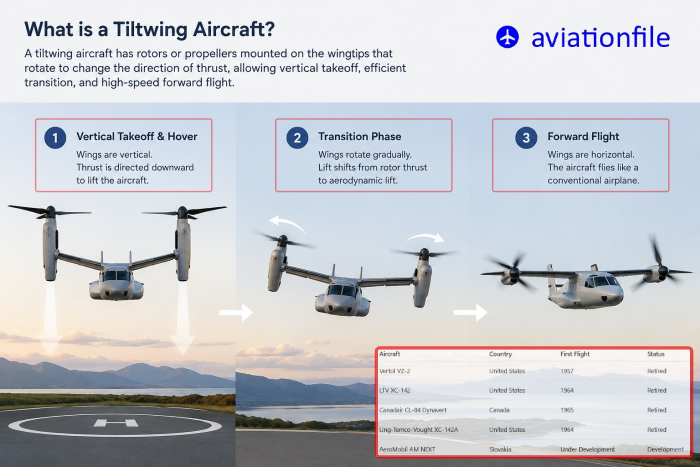
A tiltwing aircraft is a VTOL aircraft whose entire wing rotates between vertical and horizontal positions.
During takeoff and landing, the wing tilts upward so that the propellers or rotors generate vertical thrust, allowing the aircraft to lift off like a helicopter. Once airborne, the wing gradually rotates to a horizontal position, enabling the aircraft to fly like a conventional airplane.
Unlike helicopters, which rely on rotor lift throughout the flight, tiltwing aircraft transition to aerodynamic wing-borne flight during cruise, improving speed and fuel efficiency.
How Does a Tiltwing Aircraft Work?
Tiltwing aircraft operate in three primary flight phases.
Vertical Takeoff and Hover
In hover mode, the wing is positioned nearly vertically. The propellers or rotors direct thrust downward, producing lift that supports the aircraft’s weight. In this configuration, the aircraft behaves similarly to a helicopter.
Transition Phase
The transition from hover to forward flight is one of the most critical phases. As the aircraft gains forward speed, the wing gradually rotates toward a horizontal position. During this process, lift generation shifts from rotor thrust to aerodynamic lift produced by the wing.
Managing this transition smoothly requires sophisticated flight control systems and careful aerodynamic design.
Cruise Flight
Once the wing reaches a horizontal position, the aircraft functions much like a traditional airplane. The wing generates lift efficiently while the propellers provide forward thrust, enabling higher speeds and longer ranges than most helicopters.
Tiltwing vs. Tiltrotor Aircraft
Tiltwing and tiltrotor aircraft are often confused because both use rotating propulsion systems to achieve VTOL capability.
The key difference is what rotates.
| Feature | Tiltwing Aircraft | Tiltrotor Aircraft |
|---|---|---|
| Rotating Component | Entire wing and engines | Rotors or engine nacelles only |
| Hover Performance | Excellent | Excellent |
| Transition Complexity | Higher | Lower |
| Mechanical Complexity | High | Moderate to High |
| Cruise Efficiency | Very Good | Very Good |
| Examples | CL-84 Dynavert, XC-142 | V-22 Osprey, AW609 |
In a tiltrotor aircraft, the wing remains fixed while only the rotors rotate. In a tiltwing aircraft, the entire wing rotates together with the propulsion system.
History of Tiltwing Aircraft
The tiltwing concept emerged during the 1950s and 1960s when aerospace engineers sought aircraft capable of operating from short or unimproved runways. Several manufacturers explored tiltwing technology during the Cold War era. Engineers hoped to develop military transport aircraft capable of operating without traditional runways.
Vertol VZ-2
One of the earliest successful tiltwing demonstrators was the Vertol VZ-2. First flown in 1957, it demonstrated the feasibility of transitioning between vertical and conventional flight.
LTV XC-142
The LTV XC-142 remains one of the most famous tiltwing aircraft ever built. Developed for military transport missions, the aircraft featured four large propellers mounted on a rotating wing. The XC-142 successfully demonstrated VTOL capabilities and high-speed forward flight but faced significant technical challenges and was never placed into production.
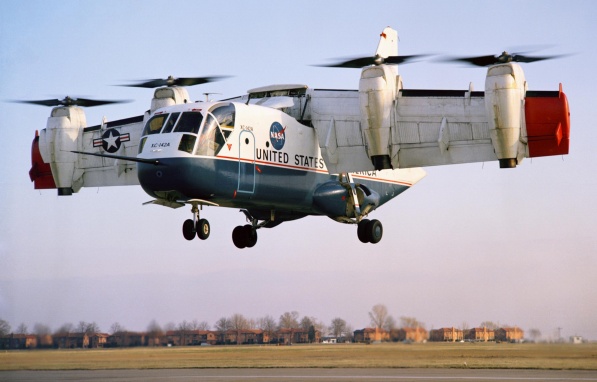
Ling-Temco-Vought_XC-142A
Canadair CL-84 Dynavert
Many aviation historians consider the Canadair CL-84 Dynavert to be the most successful tiltwing aircraft ever developed.
The CL-84 demonstrated excellent hovering performance, short-field capabilities, and reliable transitions between flight modes.
Despite impressive flight testing, changing military requirements and budget limitations prevented large-scale production.
Advantages of Tiltwing Aircraft
Vertical Takeoff and Landing Capability
Tiltwing aircraft can operate without conventional runways, making them suitable for remote locations, ships, and urban environments.
Higher Cruise Speed
Unlike helicopters, tiltwing aircraft can transition to efficient wing-borne flight, allowing significantly higher cruise speeds.
Improved Fuel Efficiency
Because the wing generates lift during cruise, less power is required compared with a helicopter maintaining rotor-borne flight.
Operational Flexibility
Tiltwing aircraft can operate from confined spaces while still providing the range and speed associated with conventional airplanes.
Enhanced Hover Performance
The wing remains immersed in propeller airflow during hover, which can improve low-speed control and stability.
Disadvantages of Tiltwing Aircraft
Mechanical Complexity
Rotating an entire wing structure requires robust mechanisms, increasing maintenance demands and engineering complexity.
Difficult Transition Phase
The transition between hover and forward flight remains one of the most challenging aspects of tiltwing design.
Increased Weight
The structural systems required to rotate the wing add weight, potentially reducing payload capacity.
Certification Challenges
Civil certification of tiltwing aircraft can be difficult due to the unique aerodynamic and operational characteristics involved.
Cost
Research, development, and manufacturing costs are typically higher than those of conventional aircraft.
Modern Tiltwing Aircraft and eVTOL Development
Recent advances in electric propulsion, lightweight materials, and flight control computers have renewed interest in tiltwing designs.
Several modern eVTOL developers are exploring tiltwing configurations for future urban air mobility operations.
These aircraft aim to combine:
- Vertical takeoff and landing
- Reduced noise levels
- Lower emissions
- High cruise efficiency
- Regional transportation capability
Electric propulsion may help overcome some of the reliability and maintenance challenges that affected earlier tiltwing programs.
Potential Applications
Urban Air Mobility
Tiltwing eVTOL aircraft could transport passengers between city centers and airports without requiring traditional runways.
Regional Transportation
The ability to access small landing areas could improve connectivity in remote regions.
Military Operations
Military organizations continue to seek aircraft capable of operating from austere environments while maintaining high speed and long range.
Search and Rescue
Tiltwing aircraft may provide rapid deployment capabilities in disaster relief and emergency response missions.
Offshore Operations
Energy and maritime industries could benefit from VTOL aircraft capable of reaching offshore platforms without large helipads.
Why Tiltwing Aircraft Never Became Mainstream
Despite their impressive capabilities, tiltwing aircraft have historically faced several obstacles:
- High development costs
- Mechanical complexity
- Maintenance challenges
- Flight control limitations of earlier technologies
- Competition from helicopters and tiltrotors
Modern digital flight control systems, fly-by-wire technology, and electric propulsion may help address many of these historical limitations.
The Future of Tiltwing Aviation
The aviation industry’s growing focus on sustainable transportation and urban air mobility has created new opportunities for tiltwing aircraft.
Advances in:
- Battery technology
- Electric motors
- Autonomous flight systems
- Composite materials
- Artificial intelligence-assisted flight controls
could enable a new generation of tiltwing aircraft that are safer, quieter, and more economical than their predecessors.
While it remains uncertain whether tiltwing designs will achieve widespread commercial adoption, they continue to represent one of the most promising VTOL concepts in aerospace engineering.
Conclusion
Tiltwing aircraft represent a unique blend of helicopter versatility and airplane efficiency. By rotating the entire wing between vertical and horizontal positions, these aircraft can perform vertical takeoffs and landings while achieving high-speed, efficient cruise flight.
Although historical programs such as the XC-142 and CL-84 Dynavert never entered large-scale production, the underlying concept remains relevant today. The rise of eVTOL technology and urban air mobility initiatives may ultimately provide the environment needed for tiltwing aircraft to fulfill their long-recognized potential.
As aviation continues to evolve, tiltwing aircraft remain an important example of innovative engineering aimed at overcoming the traditional limitations of flight.