
Let’s think of an aircraft that can fly at long range and fast like a fixed-wing airplane and take off from its position like a helicopter and land without the need for a runway. A tiltrotor is an aircraft designed for that idea.
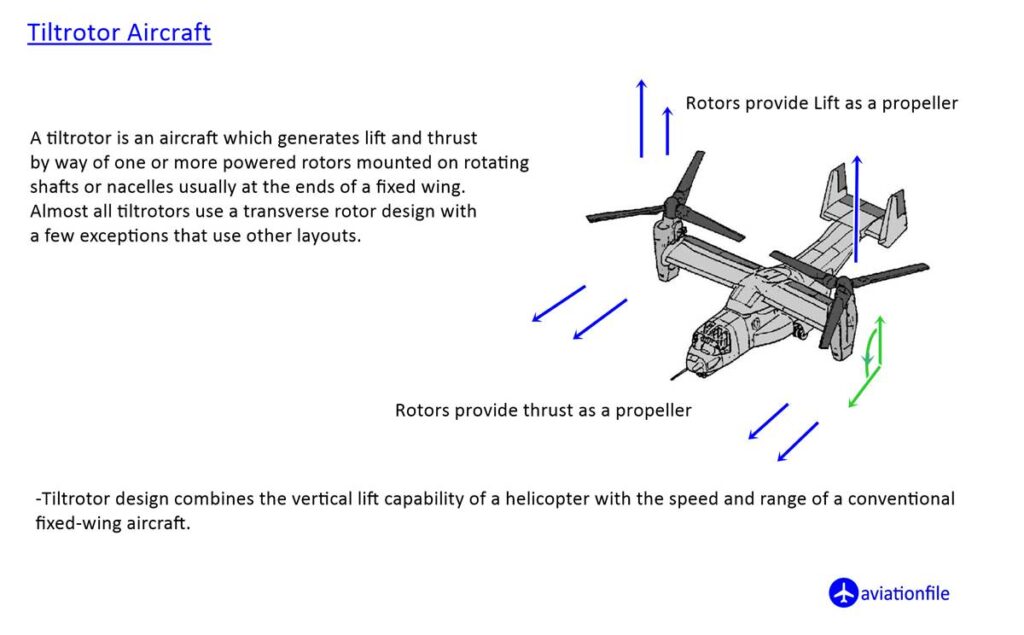
Tilt rotor is an aircraft that moves with the thrust and lifting power created by one or more rotors fixed to the rotary engine cover or basket. Tiltrotors can take off vertically when their rotors are in vertical position. When it moves its rotors to a horizontal position, it can fly fast and long distances like fixed wing aircraft. The rotors can also be used at an angle for the desired maneuver direction.
Let’s examine the Bell Boeing V-22 Osprey aircraft, one of the most popular tiltrotor models.
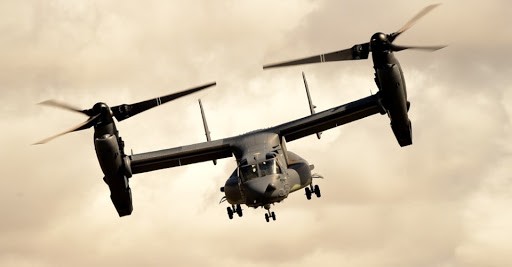
In 1981, Bell teamed up with Boeing Helicopter to develop the V-22 Osprey, which was used by the US Air Force and Marine Corps. The V-22 performed missions such as troop or cargo transport, special operations, amphibious assaults, and search and rescue missions. It also flew at major airshows, including the famous Paris Air Show.
V-22 Osprey – Specifications
| Propulsion | Two Rolls-Royce AE1107C, 6,150 shp (4,586 kW) each |
| Length | Fuselage: 57.3 ft. (17.48.20 m); Stowed: 63.0 ft. (19.20 m) |
| Width | Rotors turning: 84.6 ft. (25.78 m); Stowed: 18.4 ft. (5.61 m) |
| Height | Nacelles vertical: 22.1 ft. (6.73 m); Stabilizer: 17.9 ft. (5.46 m) |
| Rotor Diameter | 38.1 ft (11.6 m) |
| Vertical Takeoff Max Gross Weight | 52,600 lbs. (23,859 kg) |
| Max Cruise Speed | 270 kts (500 km/h) SL |
| Mission Radius | 428 nm – MV-22 Blk C with 24 troops, ramp mounted weapon system, SL STD, 20 min loiter time |
| Cockpit – crew seats | 2 MV / 3 CV |
Italian aerospace company Leonardo and their AW609.
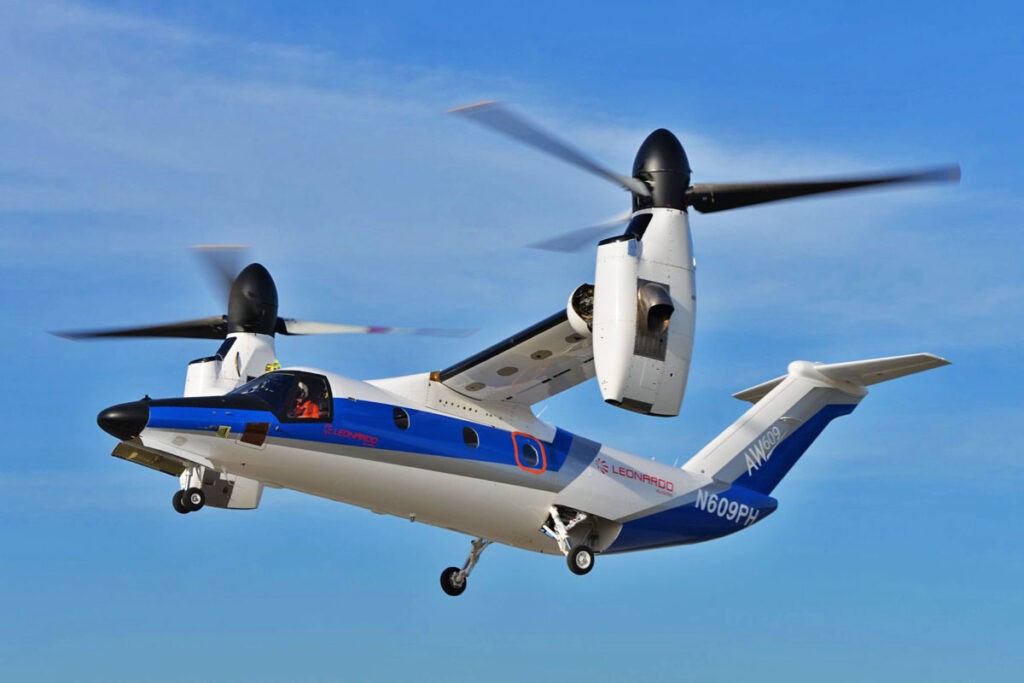
They say that, “The AW609 is a tilt rotor and it answers the need for an aircraft with the speed, range and altitude of a fixed-wing turboprop airplane and the vertical takeoff and landing versatility of a helicopter. This revolutionary combination, along with the comfort of a pressurized cabin in which you can fly above bad weather, makes the AW609 an unrivaled asset.”
Recommended: RAH-66: World’s Most Famous Stealth Helicopter
AW609 Specifications
- MAX GROSS WEIGHT – 8 tonne class 18,000 lb class
- USEFUL LOAD – over 2,721 kg/over 6,000 lbs
- POWERPLANT – 2x Pratt & Whitney Canada PT6C-67A
- LENGTH – 14.1 m (46 ft)*
- HEIGHT VTOL MODE – 5.1 m (16 ft 9 in)*
- WIDTH – 18.3 m (60 ft)*
- CAPACITY – Crew: 2; Passenger 9 standard or – 12 high density (government use)
- MAX CRUISE SPEED – 510 km/h 275 ktas
- HIGE (ISA) – 3,048 m 10,000 ft
- HOGE (ISA) – 1,828 m 6,000 ft
- MAX RANGE – 1,389/1,852 km 700/1,000 nm *with aux. fuel
- SERVICE CEILING (ISA) – 7,620 m 25,000 ft
Tiltrotor vs. Tiltwing
Tiltrotor and tiltwing aircraft may look similar, but they use different mechanisms to transition between vertical and forward flight. In a tiltrotor aircraft, only the rotors or engine nacelles rotate while the wings remain fixed. Examples include the V-22 Osprey and AW609.
In a tiltwing aircraft, the entire wing rotates along with the propellers. Although tiltwing designs can offer excellent VTOL performance, their greater mechanical complexity has limited widespread adoption. As a result, tiltrotors have become the more successful and operationally proven configuration.
| Feature | Tiltrotor | Tiltwing |
|---|---|---|
| What Rotates? | Rotors or nacelles | Entire wing |
| Wing Position | Fixed | Rotates |
| Examples | V-22 Osprey, AW609 | CL-84 Dynavert, XC-142 |
| Operational Status | In active service | Experimental/historical |
| Complexity | High | Very high |
References and further reading:
- Numerical Simulation on Aerodynamic Characteristics of Transition Section of Tilt-Wing Aircraft
- https://www.pivotal.aero/pdfs/introduction_to_tilt_aircraft.pdf
- https://www.boeing.com/defense/military-rotorcraft/v-22-osprey
for more articles click.