
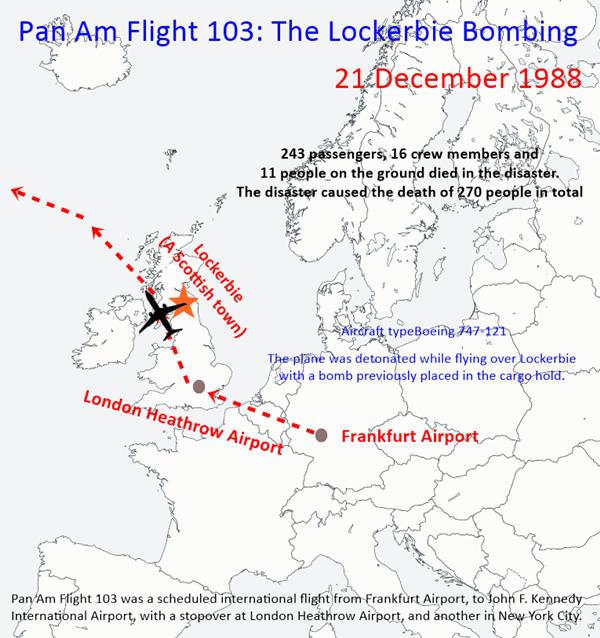
Pan Am Flight 103 was a scheduled international passenger flight from Frankfurt Airport (FRA) in Frankfurt, West Germany, to John F. Kennedy International Airport (JFK) in New York City, with a stopover at London Heathrow Airport (LHR) in London, England and another in New York City. On December 21, 1988, the aircraft, a Boeing 747-121, was destroyed by a bomb 38 minutes after takeoff from Heathrow, killing all 259 people on board and 11 people on the ground in the Scottish town of Lockerbie.
- The bomb was planted in a suitcase in the forward cargo hold of the aircraft.
- The bomb detonated at 7:02 p.m. GMT, while the aircraft was flying over Lockerbie at an altitude of 31,000 feet.
- The aircraft broke apart and crashed to the ground in three pieces.
- All 259 people on board were killed, including 190 Americans and 43 Britons.
- Eleven people on the ground in Lockerbie were also killed.
- The Lockerbie bombing was the deadliest single terrorist attack on British soil.
- It was also the deadliest terrorist attack on an American airliner.
Investigation and the Lockerbie Trial
The investigation into the Lockerbie bombing became one of the largest and most complex criminal investigations of its time. Investigators examined an enormous debris field, reconstructed parts of the Boeing 747, and pursued evidence across numerous countries. In November 1991, U.S. and Scottish authorities charged two Libyan nationals, Abdelbaset al-Megrahi and Lamin Khalifah Fhimah, in connection with the bombing. However, years of diplomatic negotiations followed before Libya surrendered the two suspects for trial in 1999.
The trial was held before a Scottish court sitting at Camp Zeist in the Netherlands. In January 2001, al-Megrahi was convicted of murder and sentenced to life imprisonment, while Fhimah was acquitted. Al-Megrahi was released by the Scottish government on compassionate grounds in August 2009 after being diagnosed with terminal prostate cancer. He returned to Libya and died in 2012.
The Lockerbie case has remained controversial. Al-Megrahi maintained his innocence, and questions about aspects of the evidence and alternative theories concerning responsibility have continued to be debated. Nevertheless, his conviction remained in place following subsequent legal proceedings. The criminal investigation also continued beyond his death, and in 2020 U.S. authorities charged another Libyan national, Abu Agila Masud, alleging that he helped make the bomb used to destroy Pan Am Flight 103.
The Lockerbie Case Continues: Abu Agila Masud
More than three decades after the bombing, the Lockerbie investigation remains active. In December 2020, U.S. authorities charged Libyan national Abu Agila Masud Kheir Al-Marimi, alleging that he helped make the explosive device used to destroy Pan Am Flight 103. Masud was taken into U.S. custody in December 2022 and has pleaded not guilty.
His federal trial in Washington, D.C., is scheduled to begin in August 2026. Prosecutors allege that Masud played a key role in constructing the bomb, while his defense disputes the allegations and has challenged an alleged confession attributed to him. The case represents the latest major chapter in the continuing effort to establish accountability for the Lockerbie bombing.
Legacy
The Lockerbie bombing had a profound impact on the aviation industry and on international security. It led to the implementation of new security measures at airports and on aircraft. It also raised awareness of the threat of terrorism and the need for international cooperation to combat it.
The Lockerbie bombing was a tragic event that resulted in the loss of many innocent lives. It is a reminder of the importance of security and cooperation in the fight against terrorism.
References and Further Reading:
- Wikipedia: Pan Am Flight 103
- BBC News: Lockerbie bombing
- Aviation Safety Network: Pan Am Flight 103
- http://www.aaib.gov.uk/cms_resources.cfm?file=/2-1990%20N739PA%20Append.pdf,
- https://commons.wikimedia.org/w/index.php?curid=30369951