
A bounced landing is a type of landing where an aircraft touches down on the runway, bounces back into the air, and touches down again. This can happen due to several reasons, such as excessive speed or a hard touchdown. Bounced landings can be dangerous, as they can cause structural damage to the aircraft and result in injuries or fatalities.
To recover from a bounced landing, pilots must take immediate action. According to Boldmethod, the recovery procedure involves the following steps:
- Apply maximum power immediately to execute a go-around.
- Once the go-around is initiated, pilots should follow the aircraft manufacturer’s published go-around procedure and applicable operator SOPs for pitch, thrust, flap and landing-gear configuration.
- Retract the landing gear after the aircraft has reached a safe altitude.
- Climb straight ahead to a safe altitude, then make a normal approach and landing.
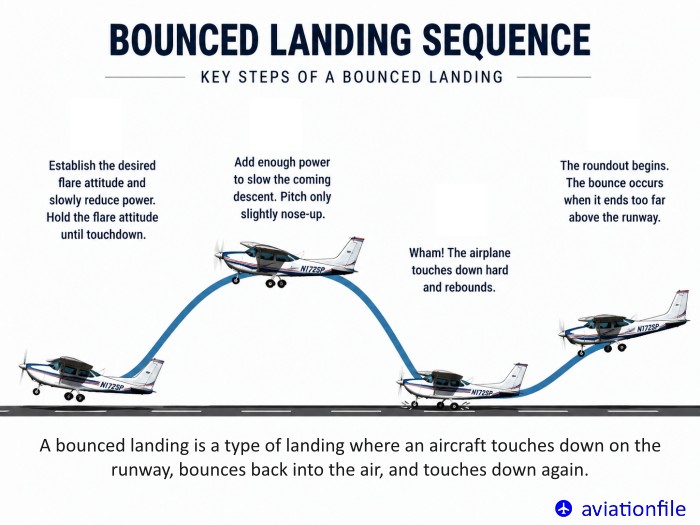
During the recovery, pilots must ensure that they maintain control of the aircraft and avoid overcorrecting, which can lead to loss of control. It is essential to follow the aircraft’s operating manual and standard procedures during the recovery process.
| Situation | General response |
|---|---|
| Very slight bounce | Landing may sometimes be continued with proper pitch and appropriate power |
| Severe/high bounce | Go around immediately |
| Severe porpoising | Go around; don’t attempt to salvage the landing |
| Insufficient runway remaining / uncertainty | Go around |
| Aircraft-specific procedure exists | Follow AFM/FCOM/SOP |
Preventing bounced landings is crucial in aviation. Pilots must ensure that they approach the runway at the correct speed and attitude, and make a smooth touchdown. Proper training, experience, and situational awareness are also essential in avoiding bounced landings.
Bounced Landing vs. Porpoising
A bounced landing can sometimes develop into porpoising, a series of increasingly severe nose-up and nose-down oscillations accompanied by repeated runway contacts. This may occur when the pilot attempts to correct a bounce with excessive or poorly timed pitch inputs. Porpoising can rapidly become dangerous, potentially resulting in a hard nose-wheel impact, landing-gear damage, or loss of aircraft control. If severe porpoising develops, attempting to salvage the landing can make the oscillations worse; a go-around should be initiated in accordance with the aircraft’s approved procedures and operator SOPs.
Do Not Force the Aircraft Back onto the Runway
After a bounced landing, pilots should avoid the instinctive reaction of pushing the nose down to force the aircraft back onto the runway. An excessive or poorly timed nose-down input can lead to a nose-wheel-first touchdown and may initiate or worsen porpoising. Instead, the pilot should maintain appropriate aircraft control and either recover from a minor bounce or initiate a go-around when required, following the aircraft manufacturer’s procedures and applicable operator SOPs.
In conclusion, bounced landings can be dangerous and require immediate action from pilots to recover safely. It is crucial to follow the standard recovery procedure and avoid overcorrecting during the recovery process. Pilots must also take preventive measures to avoid bounced landings by maintaining the correct approach speed and attitude.
References:
- Boldmethod. (n.d.). How To Recover From A Bounced Landing. Retrieved from https://www.boldmethod.com/learn-to-fly/maneuvers/how-to-recover-from-a-bounced-landing/
- Wikipedia. (2022). Bounced landing. Retrieved from https://en.wikipedia.org/wiki/Bounced_landing