
The Krueger flap is a device used in aviation that is designed to improve the lift and control of an aircraft during takeoff and landing. This device is named after its inventor, Werner Krueger (November 23, 1910 – October 21, 2003), who was a German engineer and designer. It is commonly used in modern commercial and military aircraft, and it has proven to be a reliable and effective way to enhance flight performance.
The Kruger flap is a simple yet effective device that is mounted on the leading edge of an aircraft’s wing. It is a hinged plate that can be raised or lowered, depending on the flight conditions. When the Kruger flap is lowered, it increases the wing’s camber, which generates more lift and reduces the aircraft’s stall speed. This makes it easier for the aircraft to take off and land at lower speeds, which can be critical in certain situations, such as during a short runway takeoff or landing.
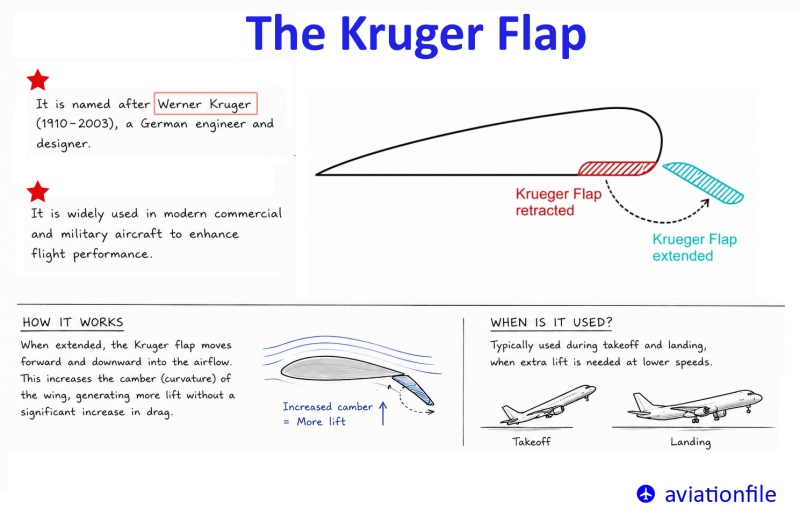
According to Skybrary, an online aviation safety knowledge center, the Kruger flap is particularly useful for aircraft that have high wing loading or that operate at high altitudes. It is also beneficial for aircraft that have limited runway lengths or that need to operate from rough or unimproved surfaces. The Kruger flap can be used in conjunction with other types of flaps, such as slotted or Fowler flaps, to further enhance the aircraft’s lift and control.
Types of Krueger Flaps
Not all Krueger flaps are identical. Over the years, engineers have developed several variations to improve aerodynamic performance and meet different aircraft design requirements.
- Simple Krueger Flap: The original design that rotates forward from the wing’s lower surface, increasing the wing’s leading-edge curvature and lift at low speeds.
- Bullnose Krueger Flap: Features a rounded leading edge that provides smoother airflow and improved stall characteristics compared to the basic design.
- Variable Camber Krueger Flap (VCKF): An advanced design capable of changing its shape during deployment. This allows the flap to optimize airflow for different phases of flight, improving both lift and aerodynamic efficiency.
Recommended: Effects of Flaps on Takeoff
Key Advantages
One of the key advantages of it is its simplicity and reliability. Unlike other types of flaps, such as the split flap or the leading edge flap, the Krueger flap does not require complex mechanisms or actuators. It can be operated manually or hydraulically, depending on the aircraft’s design. This makes it a cost-effective and low-maintenance option for many aircraft manufacturers and operators.
In summary, the Krueger flap is a useful device that can enhance an aircraft’s lift and control during takeoff and landing. It is a simple and reliable solution that has been widely adopted in the aviation industry. The Kruger flap is just one example of the many innovations and advancements that have been made in aviation over the years, and it highlights the importance of continuous improvement and innovation in this critical industry.
References:
- “Kruger Flap.” Skybrary – The Aviation Safety Knowledge Center, https://www.skybrary.aero/index.php/Kruger_Flap.
- “Krueger Flaps.” Boeing, https://www.boeing.com/commercial/aeromagazine/articles/qtr_4_07/article_04_2.html.
- www.aviationfile.com
Featured image source:
By Arpingstone – Photographed by Adrian Pingstone in August 2002 and released to the public domain., Public Domain, https://commons.wikimedia.org/w/index.php?curid=118310