
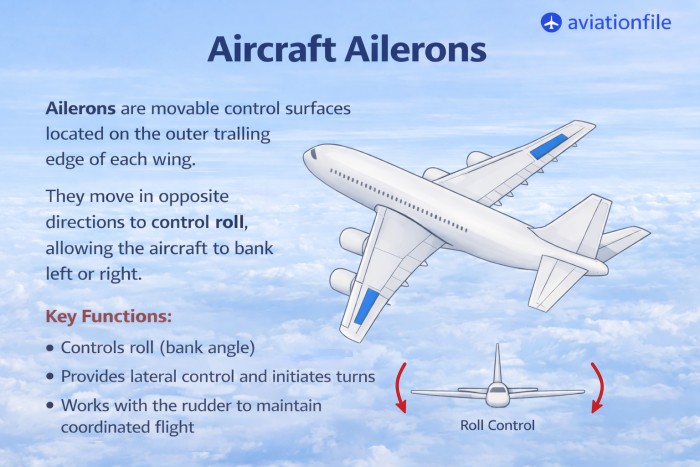
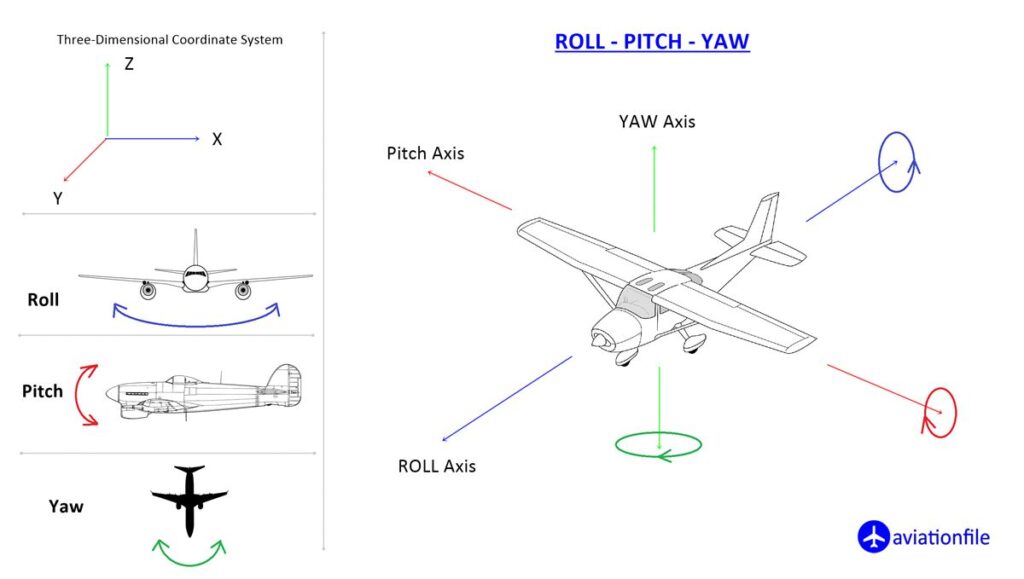
An aileron is a movable flight control surface located on the trailing edge of each wing, usually near the tip. It is primarily responsible for controlling the roll of an aircraft around its longitudinal axis. By changing the lift on each wing, ailerons allow the airplane to tilt one wing up and the other down, initiating a turn or maintaining a bank. (Bank Angle)
Placement of Aileron and Function
Ailerons are installed symmetrically on both wings and operate in opposite directions. When the pilot moves the control stick or yoke to one side, one aileron deflects upward while the other deflects downward. The upward-deflected aileron decreases lift on that wing, while the downward-deflected one increases lift on the opposite wing. This lift difference creates a rolling moment that tilts the airplane.
The Role of Roll in Flight
Rolling allows the aircraft to bank and consequently change direction. When the airplane is banked, the lift vector tilts sideways, providing a horizontal component that turns the airplane. In summary ailerons are the primary and most precise method of roll control.
Aerodynamic Effects of Aileron
When an aileron moves downward, the wing’s camber and lift increase. Conversely, the upward-deflected aileron reduces the camber and lift. This differential in lift between the two wings produces the roll. However, it also introduces adverse yaw—a tendency for the aircraft’s nose to yaw opposite the direction of roll due to differential drag on the wings.
To counter this effect, pilots apply coordinated rudder input. Additionally, aircraft designers employ differential ailerons—where the upward-moving aileron deflects more than the downward-moving one—or Frise ailerons, which extend the leading edge of the upward-moving surface into the airflow beneath the wing, increasing drag on that side to balance the yawing forces.
Types and Configurations
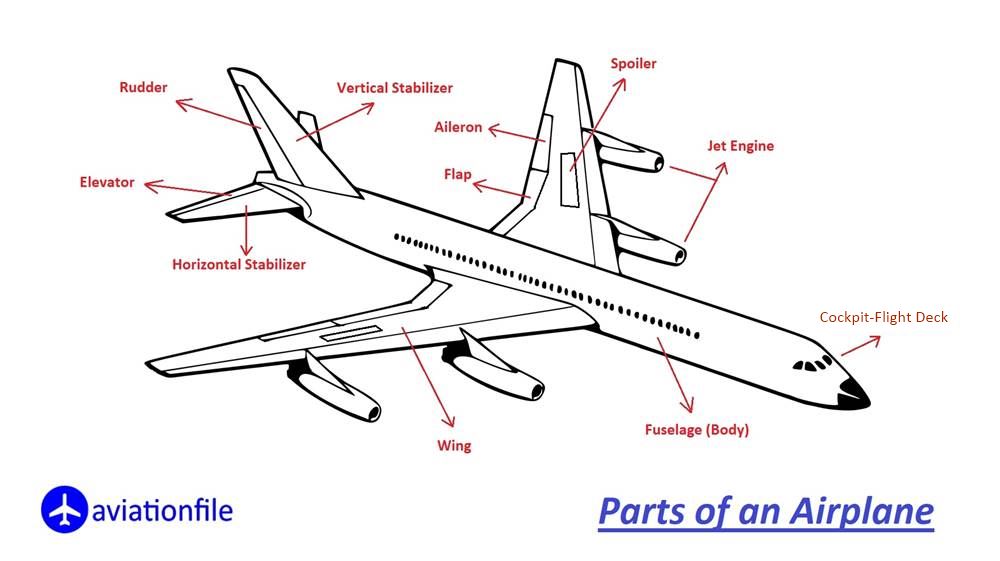
In small aircraft, there is typically one aileron per wing. In larger or faster aircraft, both inboard and outboard ailerons may be installed.
- At low speeds, both sets may operate to provide increased control authority.
- At high speeds, the outboard ailerons are usually locked out to reduce aerodynamic loads and wing twisting, leaving only the inboard ailerons and often roll spoilers to manage roll control.
Some advanced aircraft use flaperons (combining flaps and ailerons) or spoilerons (spoilers acting as roll-assist devices).
Pilot Operation
The pilot controls the ailerons through the yoke or side-stick. Turning the control to the right raises the right aileron and lowers the left, causing a roll to the right. Once the desired bank angle is reached, the pilot neutralizes the control to stop the roll. In steady, level turns, small coordinated inputs from the ailerons and rudder maintain the bank angle and prevent overbanking.
Design Considerations
To improve efficiency and safety, many aircraft incorporate aileron gap seals to prevent airflow leakage between the wing and the aileron, reducing drag and enhancing control responsiveness. The design of ailerons must also account for wing flexibility, aerodynamic balance, and structural load distribution, especially in large transport aircraft.
Summary
Ailerons are essential components of an aircraft’s primary flight control system. They enable precise roll control, making coordinated turns and stable flight possible. Through innovations such as differential and Frise designs, inboard-outboard configurations, and spoiler assistance, modern aileron systems ensure that pilots can safely maneuver aircraft of all sizes and speeds.
References:
https://skybrary.aero/articles/ailerons
https://www.grc.nasa.gov/www/k-12/VirtualAero/BottleRocket/airplane/alr.html