
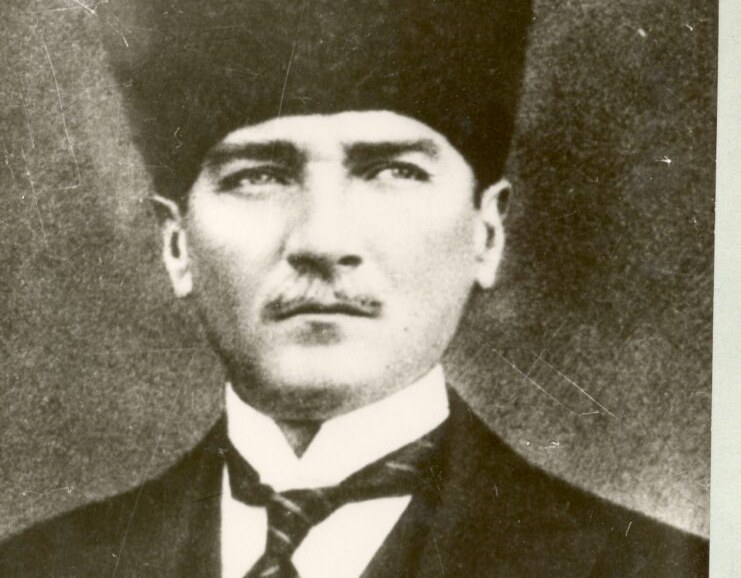
Human flight entered a new era in 1783 with the first successful human-carrying balloon flights. A revolutionary breakthrough followed in 1903 with the invention of the powered airplane. From the Wright brothers’ first flight, which lasted only seconds, aviation developed at a remarkable pace and eventually transformed transportation, communication and warfare. As aircraft began to be used for military purposes, the sky emerged as a new operational dimension alongside land and sea. Against this background, Mustafa Kemal Atatürk’s relationship with aviation offers an important perspective on the development of Turkish aviation.
Mustafa Kemal recognized the emerging importance of aviation at an early stage of its development. In 1910, he attended the Picardie military manoeuvres in France, where he witnessed the growing role of aircraft in military operations. In the years that followed, from the Italo-Turkish War in Tripoli to the Turkish War of Independence, his military experience coincided with a period in which aviation was rapidly becoming an increasingly important element of modern warfare.
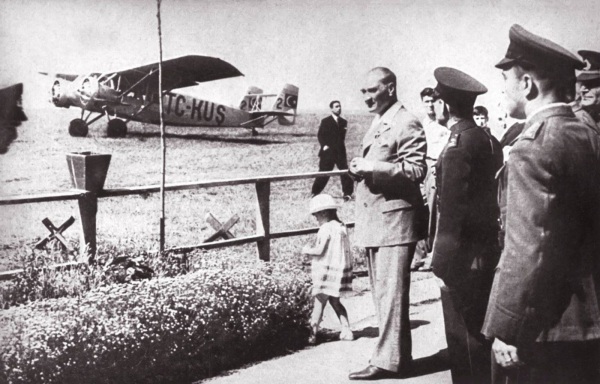
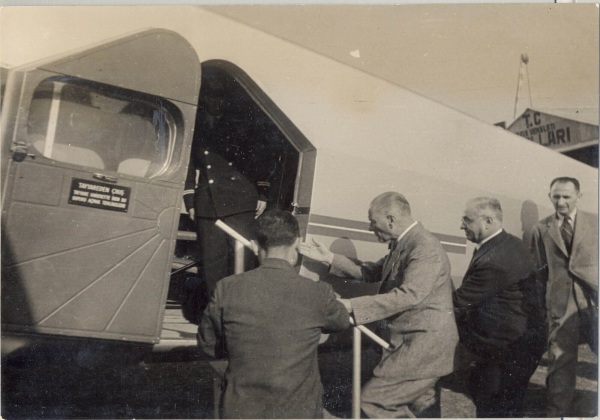
As the founder of the Republic of Turkey, Atatürk strongly supported efforts to develop the country’s aviation capabilities. He closely followed developments in world aviation and encouraged Turkey to build its own aviation institutions, infrastructure, training capacity and aircraft industry. His approach went beyond the military use of aircraft; he regarded aviation as an important field for technological progress, national development and the education of future generations.
“The future is in the skies. Nations that cannot protect their skies can never be sure of their future.”

image source: THK
Mustafa Kemal Atatürk and His Aviation Vision
Atatürk regarded aviation as one of the most important fields for Turkey’s future. His well-known words, “The future is in the skies,” became closely associated with the development of Turkish aviation and reflected the importance he placed on air power, technological progress and the education of future generations. At a time when aviation was still a relatively young and rapidly evolving field, he encouraged Turkey not merely to follow developments abroad but to build its own capabilities.
This vision was particularly evident in his emphasis on young people and aviation. At the opening of Türkkuşu in 1935, Atatürk encouraged Turkish youth to pursue the highest levels of achievement in aviation. He saw the development of skilled pilots, engineers and aviation professionals as an important part of the country’s technological and national progress. His support for aviation therefore extended beyond military requirements to education, civil aviation, air sports and the development of a domestic aviation industry.
Several highly visionary statements concerning future space travel, journeys to other planets and even reaching the Moon have also been attributed to Atatürk in Turkish aviation literature. These statements are often used to illustrate his forward-looking approach to science and aviation. However, the precise wording, dates and original sources of some of these quotations are difficult to establish conclusively. What is clearly documented is that Atatürk consistently supported the advancement of aviation in Turkey and encouraged younger generations to take an active role in its future.
Recommended: Atatürk’s Strategic Revolution: How Turkey Became the First Muslim-Majority Country with Its Own Aviation Industry
Atatürk and Aviation
The first powered flight in 1903 marked the beginning of a new era in transportation and military affairs. As aviation developed, the traditional understanding of national territory increasingly expanded beyond land and sea to include the airspace above them.
The First World War accelerated the development of military aviation. Aircraft evolved from primarily reconnaissance platforms into increasingly important tools for artillery observation, air combat and bombing. Although air power was not by itself decisive in determining the outcome of the war, its growing military importance demonstrated that future strategies would need to consider the air as a distinct operational domain.
In the following years, developments in aviation and the experiences of early aviators were documented in publications across Europe and other parts of the world. Such accounts contributed to the emerging literature on aviation history and helped stimulate public and youth interest in flying. Similar efforts in Turkey sought to develop aviation awareness, encourage young people to become interested in the field and support the country’s emerging aviation culture.
Establishment of the Turkish Aircraft Society
Mustafa Kemal sensed that aviation would develop rapidly and warned those concerned about it. He took the necessary initiatives without delay in order to ensure the development and strengthening of Turkish aviation.
The Turkish Aeronautical Association (THK) was established on February 16, 1925, 16 months after the proclamation of the Turkish Republic, under the name of “Turkish Aircraft Society” by the orders of Atatürk. With the congress decision taken in 1935, the foundation aims of the Association, are as follows:
- Establishing the aviation industry in Turkey,
- To explain the military, economic, social and political importance of aviation,
- To ensure the development of military, civil, sportive and touristic aviation,
- To prepare the necessary tools and equipment for aviation activities,
- It is determined as to train personnel and to create a flying Turkish Youth.
The Aircraft Society has developed in a very short time, as a result of its hard and virtuous work, and gains appreciation, love and trust at the national level; imposes its existence on society.
TOMTAŞ Aircraft and Engine Factory
In 1926, Turkey took a major step toward establishing a domestic aviation industry with the creation of TOMTAŞ (Tayyare ve Motor Türk Anonim Şirketi), a Turkish-German venture involving the German aircraft manufacturer Junkers. The Kayseri Aircraft Factory officially opened on 6 October 1926. In 1927, the facility began maintenance, repair and overhaul work on aircraft including the Junkers A-20, F-13 and G-23, while assembly work was also carried out on A-20 aircraft. However, financial and contractual difficulties brought the original Turkish-German partnership to an end in 1928, and TOMTAŞ was formally dissolved in 1929. Aircraft-related activities at Kayseri subsequently continued under Turkish state control.
Public support also played an important role in the development of Turkish aviation. Historical sources report that during its first decade, the Turkish Aeronautical Association (THK, originally the Turkish Aircraft Society) used public contributions to acquire hundreds of aircraft for the Turkish Air Force, with some historical accounts giving a total of 351 aircraft. In 1929, the organization became a member of the Fédération Aéronautique Internationale (FAI), strengthening Turkey’s participation in international air sports and promoting aviation among young people.
THK also expanded its involvement in aircraft production. Its Akköprü workshop, which had produced and repaired gliders, was converted into a factory at the end of 1940, where serial assembly of British-designed Miles Magister training aircraft began. Meanwhile, the Etimesgut Aircraft Factory was established between 1939 and 1941 and developed into a significant center for Turkish aircraft and glider design and production. Production expanded during the 1940s, including Miles Magister aircraft as well as several indigenous THK-designed gliders and training, ambulance and transport aircraft.
THK later established an aircraft engine factory at Gazi Orman Çiftliği in Ankara, further extending Turkey’s domestic aviation manufacturing capabilities. In 1952, both the aircraft and engine factories were transferred to the state-owned Machinery and Chemical Industry Corporation (MKE). Following this transition, THK increasingly concentrated its activities on aviation education, training and national and international air sports.
Recommended: The story of Turkey’s first aircraft factory TOMTAŞ

image source: rayhaber
First Days of Turkish Airlines
Separately from the Turkish Aeronautical Association, on 20 May 1933, the “State Airlines Administration” was established under the Ministry of National Defense. The initial budget of the organization, headed by Fesa EVRENSEV, one of the first Turkish aviators, is 180 thousand liras. And there are a total of 24 personnel, including seven pilots, eight mechanics, eight officers and a radio operator. In the first fleet; There are 2 King Birds (5 seats), 2 Junkers F-13 (4 seats) and 1 ATH-9 (10 seats). This is how the story of Turkish Airlines, which is one of the world’s leading airlines today, began. The institution, which was opened under the name of Airlines State Enterprise, took the name of Turkish Airlines in 1955.
Atatürk – The future is in the skies
Atatürk’s approach to aviation was not limited to military air power. He regarded aviation as an important component of national development and believed that progress in this field required public support, strong institutions and the active involvement of younger generations. His widely cited words, “The future is in the skies,” came to symbolize this vision and the importance he attached to Turkey’s aviation future.
This approach was also reflected in his support for the Turkish Aircraft Society (Türk Tayyare Cemiyeti), established in 1925. In his public statements during the following years, Atatürk praised the Turkish nation’s contributions to strengthening the country’s air power and emphasized the Society’s role in promoting aviation and encouraging young people to take an interest in flying. These efforts were accompanied by concrete initiatives in aviation education, aircraft manufacturing, institutional development and the expansion of both military and civil aviation.
Atatürk’s contribution to Turkish aviation should therefore be understood not through individual quotations alone, but through the institutions and initiatives developed during his leadership. The establishment of the Turkish Aircraft Society, support for aviation education and air sports, the development of aircraft manufacturing capabilities and the growth of civil aviation all formed part of this broader vision. Together, these initiatives helped lay important foundations for the development of aviation in the Republic of Turkey.
Resources:
- https://www.turkishairlines.com/en-int/press-room/about-us/our-story/index.html
- http://www.ankarabarosu.org.tr/siteler/ankarabarosu/hgdmakale/2013-1/22.pdf
- https://en.chateauversailles.fr/discover/history/key-dates/first-hot-air-balloon-flight
- https://www.thk.org.tr/ataturk_ve_havacilik
- https://ataturkansiklopedisi.gov.tr/detay/918/Atat%C3%BCrk-D%C3%B6neminde-Havac%C4%B1l%C4%B1k-ve-U%C3%A7ak-Sanayii