
In this article, we will examine the factors that affects the runway take-off distance of aircraft on while departing. The takeoff distances required or used by airplanes vary depending on many factors. We may count some of these factors such as meteorological conditions aircraft type, pilot in command, aircraft weight, and more. Let’s take a deeper dive into these titles.
Meteorological conditions
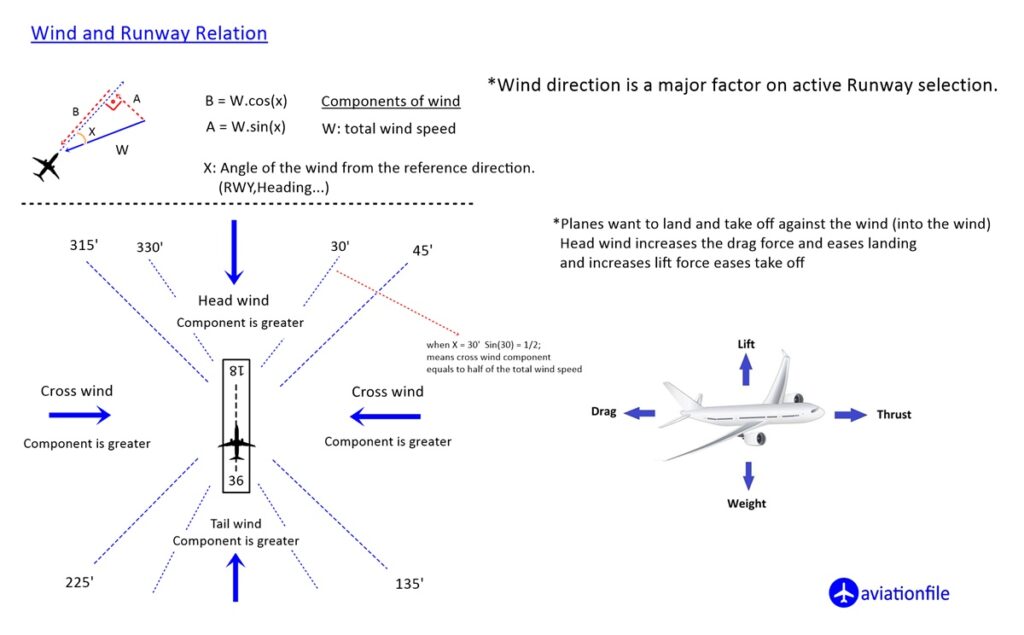
The direction and strength of the wind is an important factor affecting the take-off distances of aircraft. While choosing the active runway used in airports, the direction and strength of the wind are also evaluated as a major factor. Airplanes usually want to take off and land against the wind. The opposite wind (head wind) helps the aircraft to stop at a shorter distance by increasing the drag force on the plane and indirectly the weight force during landing. The opposite wind also increases the lift force during takeoff with the help of the structure of the wings and the parts on the wing. For this reason, the running distance is shortened for take-offs with the opposite wind/head wind. In addition, temperature and pressure are factors that affect the running distance required by aircraft.
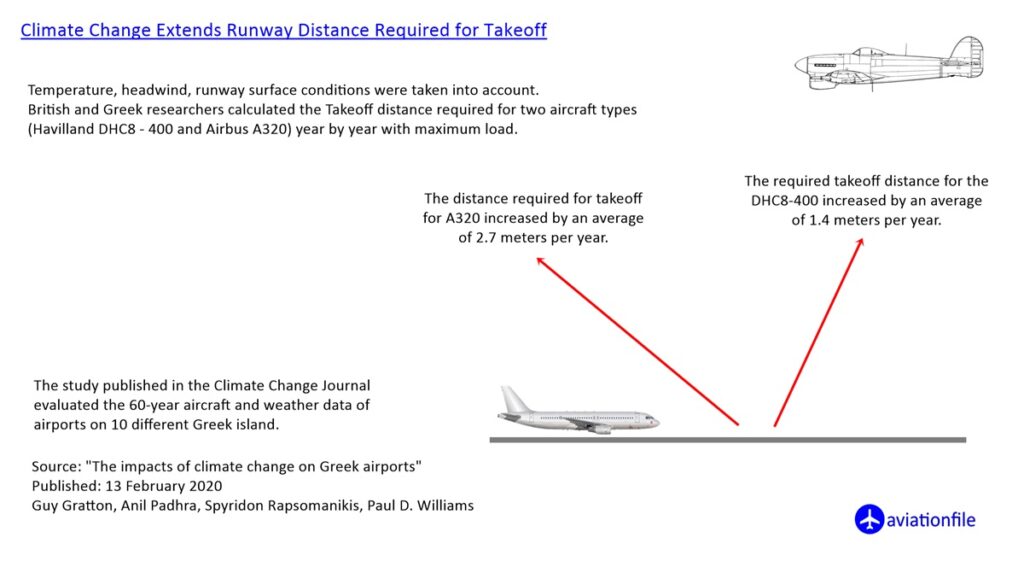
As the weather gets warmer, the runway length required by the aircraft for take-off increases. A study led by Professor Paul Williams from the University of Reading indicated that warm weather and slow wind cause difficulties for planes on takeoff.
Recommended article: https://www.aviationfile.com/runway-and-wind-relation/
Aircraft Type
As you can see from the title, the aircraft type is one of the most important factor determining the running distance required by an airplane. There are huge performance differences between different types.
By its very nature, a military jet is produced for high performance. It accelerates faster and maneuvers more sharply when we compare with a commercial airplane. And it is easy to deduce that the distance required by a heavy category B747 is way too long than a F-16 Fighting Falcon.
Pilotage
Another factor affecting the take-off run distances of aircraft are pilots. Pilots, of course, act in line with the limits and rules. Therefore, the running distances of two different aircrafts of the same type are close to each other under similar conditions. The small distance differences between them are also due to pilot on command.
Aircraft weight
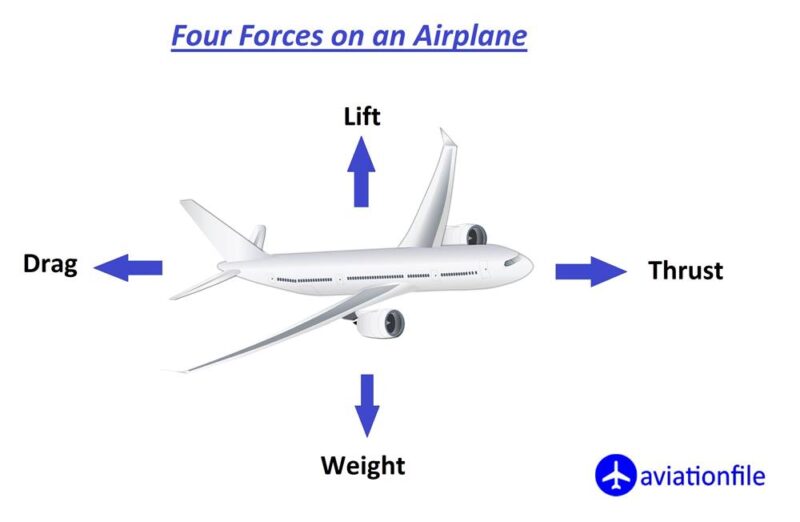
One of the most important factors affecting the take-off distances of aircraft is weight. Let’s remember the basic forces acting on airplanes. Weight, lift, thrust and drag forces are four (4) basic forces acting on the aircraft. In order for an airplane to take off, the thrust force generated by its engines must first overcome the drag force, and then the lift force created by the wings of the aircraft must overcome the weight force. That is, the heavier an airplane, the greater the weight force, and the lift force must increase to overcome. For this, it means that the aircraft needs a longer distance to reach the needed speed for takeoff. In summary, the heavier one than two aircraft of the same type and the same conditions will need a longer distance for take off.
Geography – Height
As you know, as we rise up from the earth, the amount of oxygen per unit area in the atmosphere decreases. For example, when you climb to the top of a high mountain during the day in the same city, you may feel dizzy because of low oxygen level. When you climb to the top of Mount Everest, the amount of oxygen entering your body when you breathe is just less than half of what is at sea level.
Aircraft engines also need oxygen to operate efficiently. In summary, aircraft fuel burns in the combustion sections with the oxygen entering the aircraft engine and creates thrust power. Therefore, since the oxygen level is low at high altitude airports, the running distances required by the aircraft increases. The longest runway in the world is at Qamdo Bamda Airport. It’s altitude (above sea level) is 4,400 m / 14,436 ft.
Runway-Related Factors (Operationally Critical)
In real-world operations, runway characteristics play a major role in determining takeoff performance. An uphill runway increases the takeoff roll by reducing acceleration, while a downhill slope can improve it. Runway condition is equally critical—wet, contaminated, or icy surfaces significantly reduce tire friction and braking effectiveness, increasing both acceleration distance and stopping distance. Additionally, runway surface type (such as asphalt, concrete, or grass) affects rolling resistance and aircraft performance. These factors are always considered in performance calculations and can be limiting even when weather conditions are favorable.
Key Performance Concepts (Operational Perspective)
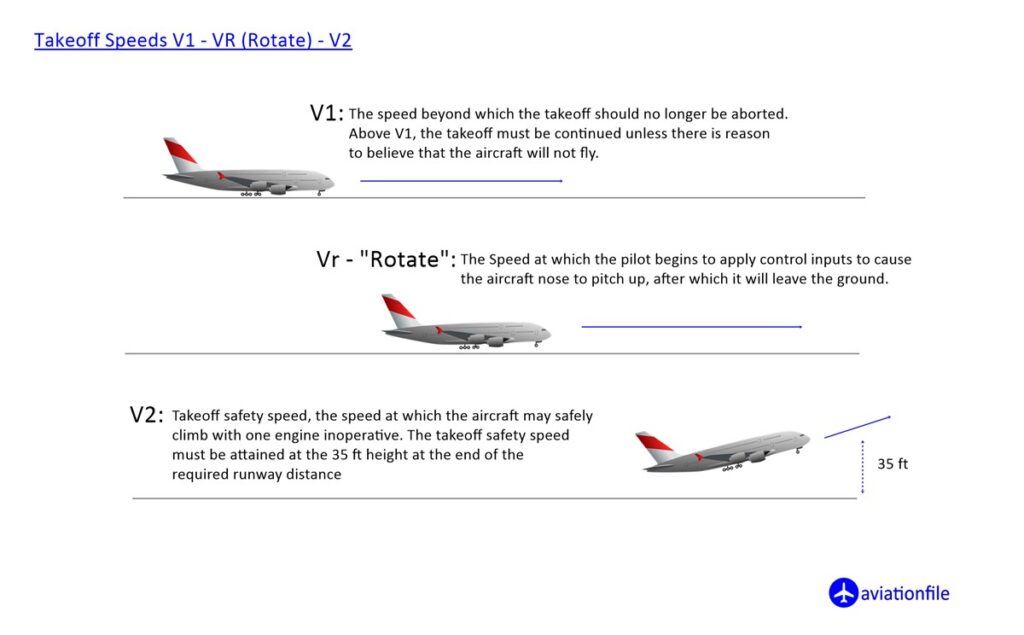
To fully understand takeoff distance, it is essential to consider the performance concepts used in real-world operations. Takeoff is not simply about accelerating to become airborne—it is based on calculated decision points and safety margins. V-speeds play a central role: V1 is the decision speed where the pilot must either continue or reject the takeoff, VR is the rotation speed where the aircraft begins to lift off, and V2 is the safe climb speed maintained after departure, especially in the case of an engine failure.
Another critical concept is balanced field length, which ensures that the runway is long enough for both scenarios—either safely stopping the aircraft after a rejected takeoff or continuing the takeoff after an engine failure at V1. This is directly linked to accelerate-stop distance (the distance required to abort and stop) and accelerate-go distance (the distance required to continue and climb safely). These calculations form the foundation of modern takeoff performance and are essential for both pilots and air traffic controllers to understand operational limitations.
In conclusion, takeoff distance is influenced by a combination of environmental conditions, aircraft characteristics, and operational factors. At its core, any element that affects the four fundamental forces acting on an aircraft—lift, weight, thrust, and drag—will directly impact takeoff performance. By understanding how these forces interact under different conditions, it becomes much easier to interpret why takeoff distance varies and how it is managed in real-world operations.