Point Merge in Air Traffic Management
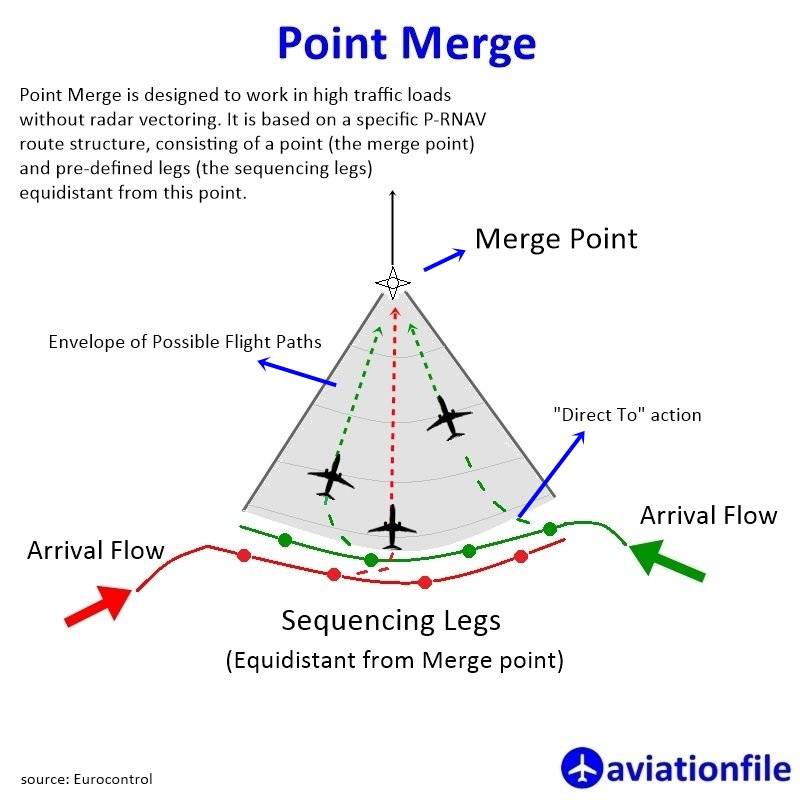
Point merge in air traffic management is a systemized method for sequencing arrival flows developed by the EUROCONTROL Experimental Centre in 2006. It is based on a specific P-RNAV route structure, consisting of a point (the merge point) and pre-defined legs (the sequencing legs) equidistant from this point.
Point merge is designed to work in high traffic loads without radar vectoring. Aircraft are assigned to a specific sequencing leg and fly at a pre-defined speed and altitude. This ensures that they arrive at the merge point in a predictable and spaced manner, making it easier for air traffic controllers to manage the flow of traffic. It is primarily designed for arrival sequencing within terminal maneuvering areas (TMAs).
Point merge offers a number of benefits over traditional vector-based sequencing, including the following:
- Increased capacity: Point merge can increase the capacity of airspace.
- Improved efficiency: Point merge reduces the workload on air traffic controllers and allows them to focus on more complex tasks.
- Reduced environmental impact: Point merge enables aircraft to fly more efficient flight paths, which reduces fuel consumption and emissions.
Point Merge is now operational at over 35 airports around the world, including major hubs such as Istanbul, Shanghai, and Tokyo.
RNAV / PBN Dependency in Point Merge
Point Merge procedures are heavily dependent on RNAV and Performance-Based Navigation (PBN) capabilities. The system is designed around predefined RNAV sequencing legs that allow aircraft to follow highly predictable lateral flight paths with accurate navigation performance. This structured route design helps controllers manage arrival sequencing more efficiently while supporting smoother traffic flows and reducing the need for extensive radar vectoring.
Recommended: What Is an Emergency Landing?
Here is an example of how point merge works:
- Aircraft are assigned to a specific sequencing leg and fly at a pre-defined speed and altitude.
- As aircraft approach the merge point, they begin to turn towards it.
- Aircraft flying on the outside of the sequencing legs turn in more tightly than those flying on the inside.
- All aircraft arrive at the merge point at the same time and altitude, spaced evenly apart.
- Air traffic controllers then clear aircraft for their approach to the runway.
Point merge is a powerful tool that can help to improve the efficiency and safety of air traffic management.
References:
– https://www.researchgate.net/figure/Point-Merge-system-design-with-two-arrival-flows_fig4_256497459
– https://www.eurocontrol.int/concept/point-merge