
Ever wonder how planes glide seamlessly through the air, avoiding each other like celestial dancers? It’s not just air traffic controllers weaving their magic – a crucial team works silently behind the scenes, ensuring every radar blip and communication channel hums flawlessly. Air Traffic Safety Electronics Personnel (ATSEP)
This team, the ATSEP, are the tech wizards of aviation. Air Traffic Safety Electronics Personnel (ATSEP) are aviation technical professionals responsible for the installation, operation, monitoring, maintenance, and technical support of Communication, Navigation, Surveillance, and Air Traffic Management (CNS/ATM) systems. Depending on their roles and organizations, they may also contribute to system design, integration, testing, and development.
Think of them as the IT superheroes of air traffic management.
Craft the tech: From radars that track planes to communication systems that relay instructions, ATSEPs build the invisible infrastructure of air travel.
Keep it running: ATSEP help maintain the reliability, availability, and operational integrity of safety-critical CNS/ATM systems through preventive maintenance, technical monitoring, troubleshooting, and corrective actions.
Safety first: ATSEP contribute to aviation safety by following established technical procedures, performing system checks, supporting safety assessments, and ensuring that CNS/ATM equipment operates within applicable technical and operational requirements. ATSEPs prioritize safety above all else, making sure every system operates flawlessly.
ATSEP Training and Professional Competency
ATSEP professionals require specialized technical knowledge and operational competencies to support the safe functioning of CNS/ATM systems. ICAO Doc 10057 provides international guidance for competency-based training and assessment, covering initial training, unit training, continuation training, and professional development.
In the European regulatory framework, Commission Implementing Regulation (EU) 2017/373 establishes specific requirements for ATSEP training and competence assessment. These include basic training, qualification training, system/equipment rating training, and continuation training. Service providers must also ensure that personnel demonstrate and maintain the competencies required for their assigned duties.
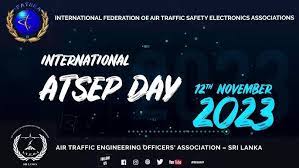
Celebrating the Unsung Heroes: International ATSEP Day
Every year on November 12th, the world celebrates International ATSEP Day, a day to recognize the vital role of ATSEP in ensuring the safety and efficiency of air travel. These tech wizards behind the scenes are the silent guardians of the skies, working tirelessly to maintain the complex electronic systems that keep planes flying and passengers safe.
Further Reading on ATSEP:
- Manual on Air Traffic Safety Electronics Personnel Competency-based Training and Assessment: https://www.skyradar.com/blog/understanding-the-icao-doc-10057-manual-on-atsep-competency-based-training-and-assessment
- https://store.icao.int/en/manual-on-air-traffic-safety-electronics-personnel-atsep-competency-based-training-and-assessment-doc-10057
- Air Traffic Safety Electronics Personnel (ATSEP) – Basic – ICAO Training: https://igat.icao.int/ated/TrainingCatalogue/Browse?TrainingAreaId=2&TrainingSubareaId=8
- Guidelines for the Licensing and Training of ATSEP: https://www.eurocontrol.int/archive_download/all/node/10371
- Federal Aviation Administration (FAA): https://www.faa.gov/jobs/electronics-systems-technicians-fact-sheet
- Civil Aviation Authority (UK): https://www.caa.co.uk/
- https://ifatsea.org/2016/11/12/international-day-of-the-atsep/
image source: https://nats.aero/blog/2021/11/international-atsep-day-2021/