
Many of the fireworks used at large-scale celebrations have canisters that may shoot hundreds of feet into the air. Fireworks usually go up to 300-400 feet high. Of course, there may be special productions and different applications, and fireworks can go even higher. Therefore the chance of colliding with an aircraft is minimal and, for the majority of operations, only really matters during takeoff and landing. (Of course, when we say aircraft, we also need to think of helicopters, low-altitude trainers and VFR aircraft…) It is improbable that a firework will strike a commercial jet airplane and inflict serious harm. Aircrews may become distracted and perplexed by pyrotechnics, though, if they see them at low levels, particularly as they approach a landing. So are Fireworks Dangerous for aircraft?
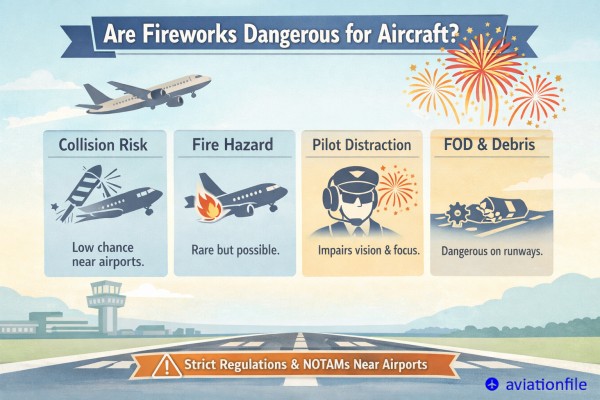
Therefore, even if it’s unusual and not very common, fireworks can be harmful to airplanes. They may be a fire danger, a collision hazard, and a distraction for pilots.
Fireworks and Possible Hazards
- Distraction hazard: Fireworks can be very bright and colorful, and they can easily distract pilots, especially during the take-off and landing phases of flight. This can lead to errors in judgment or flying procedures, which could result in an accident.
- Collision hazard: Fireworks can be launched into the air at high speeds and can reach altitudes of several hundred feet. If an aircraft collides with a firework, it could cause damage to the aircraft or even bring it down.
- Fire hazard: Fireworks can also start fires on the ground or on aircraft. This is a particular risk if fireworks are launched near airports or other areas where there is a lot of fuel and other flammable materials.

For these reasons, it is important to take precautions to avoid fireworks from coming into contact with aircraft. This includes:
- Not launching fireworks near airports or other areas where there is a lot of air traffic.
- Keeping fireworks away from aircraft.
- Being aware of the risks of fireworks and taking steps to avoid them.
In the United States, the Federal Aviation Administration (FAA) prohibits the transportation of fireworks on aircraft. This includes both carry-on and checked baggage. The FAA also requires organizers of fireworks displays to obtain a permit from the FAA and to notify the FAA of the location and time of the display.
Many aviation authorities have different rules regarding fireworks. As a general approach, fireworks activities should be notified to the relevant authority in advance and permission should be obtained. In addition, fireworks activities may be prohibited around airports. In some cases, fireworks activities are announced to airmen through NOTAMs.
Regulations and Airspace Restrictions
Fireworks are strictly regulated in aviation due to their potential impact on flight safety, especially near airports. In most countries, any organized fireworks display within controlled or nearby airspace must be coordinated with aviation authorities in advance.
Typically, this includes:
- Prior notification to the relevant authority (e.g., civil aviation authority or ANSP)
- Issuance of a NOTAM (Notice to Airmen) to inform pilots about the location, altitude, and timing of the display
- Compliance with distance and altitude limitations, especially within a few nautical miles of an airport
In controlled airspace, air traffic controllers may:
- Adjust arrival and departure paths
- Delay or reroute traffic if necessary
- Increase pilot awareness during critical phases like approach and landing
Unauthorized or uncoordinated fireworks near flight paths can pose a safety risk and may lead to legal penalties.
Recommended Article: https://www.aviationfile.com/notam-notice-to-air-mission/
FOD & Ground Risk (ATC Perspective)
Fireworks can generate debris that falls back to the ground, creating Foreign Object Debris (FOD) risks around airports. Residual materials such as fragments, casings, or unexploded components may end up on runways, taxiways, or aprons, posing a hazard to aircraft operations.
This is particularly critical for:
- General Aviation (GA) aircraft
- Aircraft operating with propellers or low engine clearance
From an ATC perspective:
- Runway inspections may be required after nearby firework activity
- Operations can be temporarily delayed or restricted until surfaces are confirmed clear
- Coordination with airport authorities becomes essential to maintain safety
Even small debris can lead to engine ingestion, tire damage, or reduced braking performance, making FOD one of the more practical risks associated with fireworks near aerodromes.
References:
https://skybrary.aero/articles/fireworks-and-aviation-safety
https://www.faa.gov/newsroom/fireworks-dont-fly-0
https://community.infiniteflight.com/t/do-fireworks-pose-a-risk-for-planes/339165