
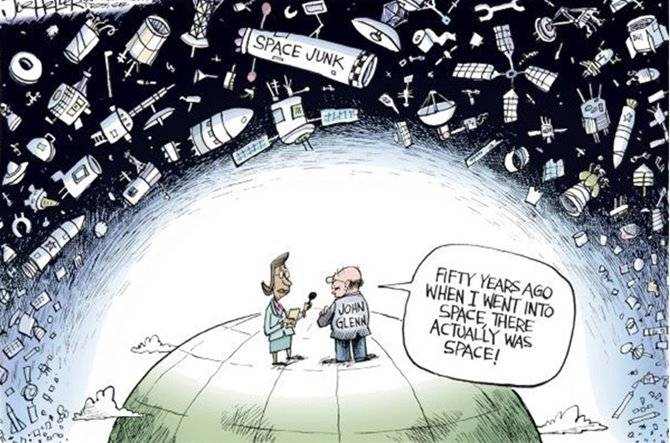
Yes, we are leaving debris in space. This garbage includes defunct satellites, spent rocket stages, and other objects. There are an estimated 29,000 pieces of debris larger than 10 centimeters (4 inches) in orbit around Earth and millions of smaller pieces. This debris can travel at speeds of up to 17,500 miles per hour (28,163 kilometers per hour), and even a small piece of debris can cause significant damage to a spacecraft (2023).
Update (April 2025): According to the European Space Agency’s (ESA) Space Environment Report 2025, there are now more than 50,000 tracked objects larger than 10 cm orbiting Earth, along with an estimated 1.2 million debris fragments between 1 and 10 cm and over 130 million particles larger than 1 mm. These figures highlight the growing challenge of managing space debris and protecting operational spacecraft.
The problem of space garbage is getting worse. Every year, we launch hundreds of new satellites into orbit, and some of these satellites eventually break apart or become defunct. In addition, there are a number of countries that are developing anti-satellite weapons, which could also create a lot of debris.
There are a number of things that can be done to mitigate the problem of space garbage. One is to develop better ways to track and remove debris from orbit. Another is to design satellites that are more resistant to damage from debris. And finally, we need to work together internationally to reduce the amount of garbage that we launch into space.
Here are some of the things that are being done to address the problem of space debris:
- The European Space Agency (ESA) is developing a system called ClearSpace-1 to remove a defunct satellite from orbit.
- The Japanese Space Agency (JAXA) is developing a system called EnMAP to map the distribution of space debris.
- The United States Space Force is developing a system called Space Fence to track space debris.
- A number of countries are working on international treaties to reduce the amount of space debris that is created.
It is important to address the problem of space debris because it poses a threat to spacecraft and astronauts. It is also a hazard to future space exploration. By working together, we can reduce the amount of space garbage and protect our space environment.
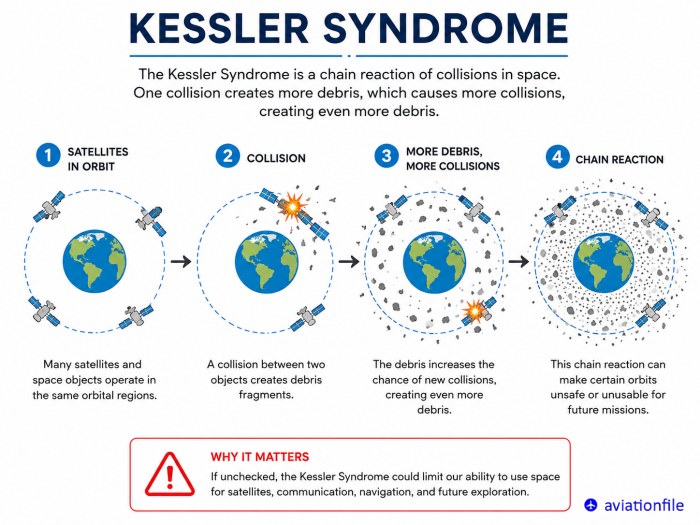
What Is the Kessler Syndrome?
One of the biggest long-term concerns surrounding space debris is the Kessler Syndrome. This theory suggests that as the number of objects in orbit increases, collisions could create even more debris, triggering a chain reaction of further collisions. If left unchecked, this cascading effect could make certain orbital regions increasingly hazardous for satellites and future space missions.
Recommended: Space Tourism: Is a New Era of Travel Beginning?
References:
- https://www.esa.int/Enabling_Support/Space_Engineering_Technology/The_Kessler_Effect_and_how_to_stop_it
- https://www.aerotime.aero/articles/mission-to-remove-space-debris-struck
- https://www.nhm.ac.uk/discover/what-is-space-junk-and-why-is-it-a-problem.html
- https://www.planetary.org/articles/space-trash
- image source: https://www.themarketforideas.com/space-debris-visualizing-the-risk-and-informing-stakeholders-a190/
- aviationfile articles.