
The location of an airport plays a critical role in its operational efficiency, accessibility, and impact on the surrounding community. Determining the right site involves careful consideration of multiple factors and adherence to international standards set by organizations like the International Civil Aviation Organization (ICAO). Here, we’ll explore the systematic process of selecting airport locations and the key elements that influence these decisions.
1. Assessing Space Requirements
The first step in determining an airport’s location is identifying the land area required. This includes space for:
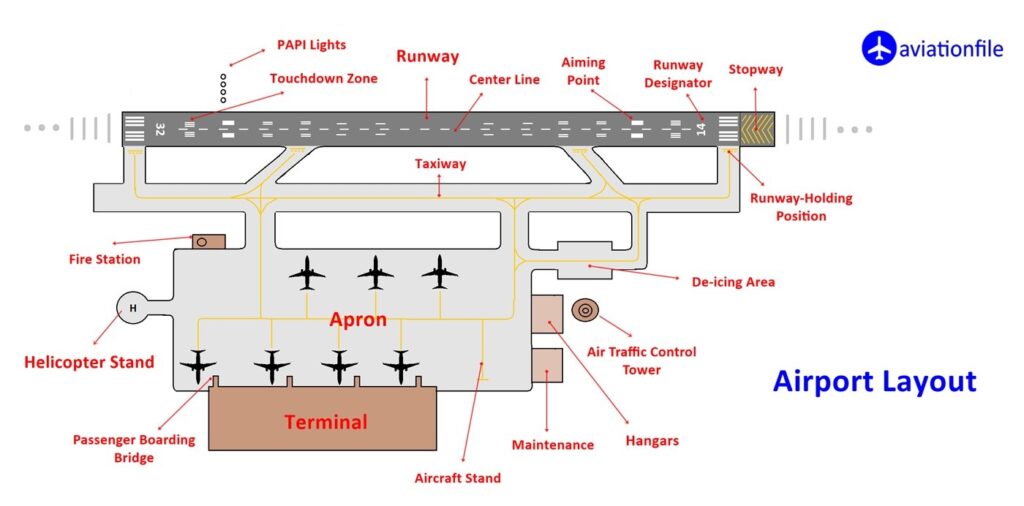
- Runways: Length, number, and orientation are crucial, especially to align with prevailing wind patterns.
- Facilities: Terminals, hangars, parking, and other infrastructure.
- Future Expansion: Adequate space for future growth ensures the airport remains viable as demand increases.
2. Key Factors Influencing Location
Several factors influence the decision-making process:
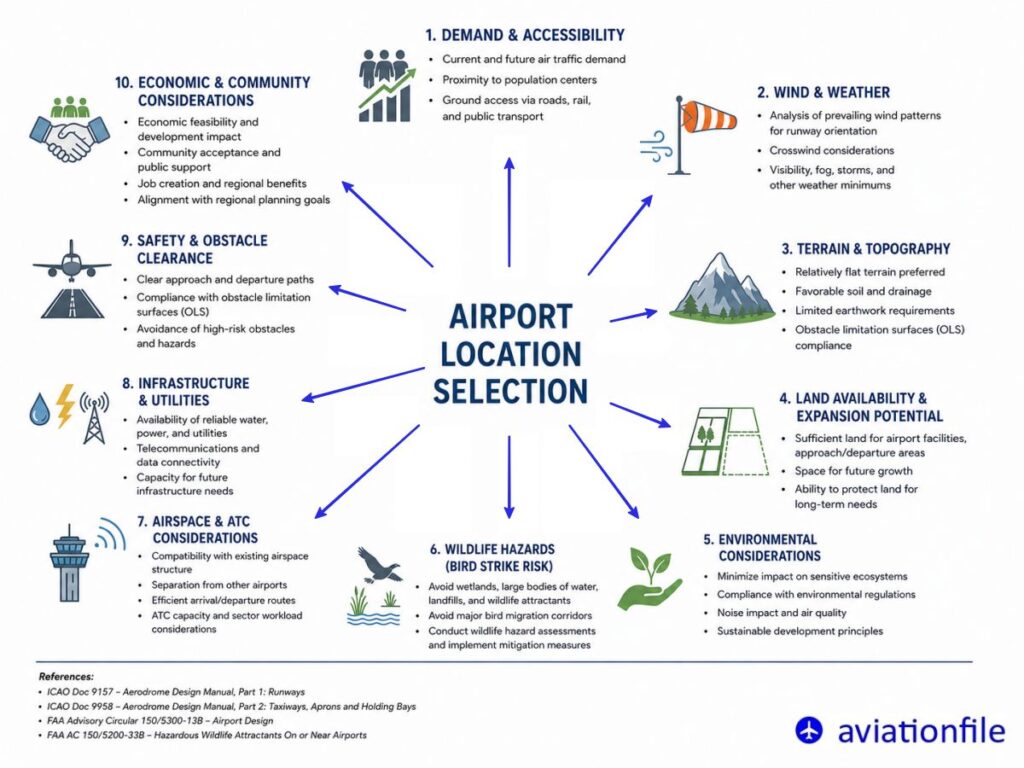
- Aviation Activities: Current and projected air traffic, type of aircraft, and airline operations.
- Environmental Considerations: Assessing the impact on local ecosystems, air quality, and noise levels.
- Topography and Terrain: Flat, stable land minimizes construction challenges and costs.
- Transportation Connectivity: Proximity to highways, railroads, and public transport enhances accessibility.
- Weather and Atmospheric Conditions: Wind patterns, fog, and other weather conditions significantly impact flight operations.
- Existing Infrastructure: Distance from other airports to avoid airspace conflicts and redundancy.
3. Identifying and Analyzing Potential Sites
Planners typically start with a broad review of possible locations, eliminating areas unsuitable due to:
- Obstacles like mountains or tall structures.
- Restricted airspace.
- Inadequate room for expansion or future needs.
4. Conducting Ground and Operational Assessments
The next step is a detailed analysis of shortlisted sites, considering:
- Airspace Efficiency: Ensuring safe and efficient flight operations.
- Proximity to Demand Centers: Closeness to cities or business hubs for passenger convenience.
- Noise and Environmental Impact: Minimizing disruption to residential areas.
- Construction Feasibility: Evaluating soil quality, drainage, and availability of construction materials.
- Cost Analysis: Balancing operational efficiency with budget constraints.
5. Performing Environmental Studies
Environmental impact assessments are mandatory to evaluate:
- Air and water quality.
- Noise pollution levels.
- Effects on local wildlife and ecosystems.
- Social and demographic trends, such as population growth.
Wildlife Hazards and Bird Strike Risk
Environmental considerations in airport planning are not limited to noise or emissions. Wildlife hazards — especially bird strike risk — are also important factors when determining airport locations. Airports generally try to avoid areas near wetlands, large bodies of water, landfill sites, and major bird migration corridors because these environments attract large numbers of birds and wildlife. Bird strikes can pose serious safety risks to aircraft, particularly during takeoff and landing phases when aircraft operate at lower altitudes and have limited recovery time.
For this reason, airport planners and aviation authorities conduct wildlife hazard assessments before approving new airport sites. Even after construction, airports continuously monitor wildlife activity and implement bird control measures to reduce operational risk.
6. Comparing Alternatives
Based on the gathered data, planners rank potential sites by weighing operational, environmental, and economic factors. This process often involves input from government agencies, industry stakeholders, and the public.
7. Final Site Selection and Reporting
The final stage includes:
- Documenting the findings and rankings.
- Presenting recommendations for the selected site.
- Outlining next steps, including acquiring land and initiating construction.
Airspace and Air Traffic Control Considerations
Airport locations are also influenced by surrounding airspace structure. Planners must evaluate nearby airports, military zones, terrain restrictions, and expected arrival/departure flows. Poorly positioned airports can create complex air traffic control challenges, increase controller workload, and reduce overall airspace efficiency.
Why Proper Airport Site Selection Matters
Choosing the right location for an airport impacts:
- Operational Efficiency: Ensuring smooth flight operations and minimal delays.
- Passenger Experience: Providing convenient access and minimizing travel time.
- Community Relations: Balancing economic benefits with environmental and social considerations.
Global Best Practices in Airport Location Planning
International guidelines emphasize a comprehensive approach:
- The International Transport Forum suggests starting with a needs assessment, followed by evaluating potential sites against economic, social, and environmental criteria.
- The Geography of Transport Systems highlights the importance of balancing benefits (e.g., proximity to urban centers) with externalities like noise and land use conflicts.
Conclusion
Determining the location of an airport is a complex, multi-faceted process that requires balancing operational needs with environmental and community considerations. By following established guidelines and incorporating advanced planning techniques, stakeholders can ensure that new airports are strategically positioned to serve their regions effectively for decades to come.
Refernces and Further Reading:
- ICAO. Aerodrome Design Manual, Part 1: Runways (Doc 9157).
- ICAO. Aerodrome Design Manual, Part 2: Taxiways, Aprons and Holding Bays (Doc 9157).
- FAA Advisory Circular AC 150/5300-13B: Airport Design.
- FAA Advisory Circular AC 150/5200-33B: Hazardous Wildlife Attractants On or Near Airports.
For more articles click.