
Unmanned Aerial Vehicles (UAVs) have become increasingly important in modern security, surveillance, and monitoring operations. Equipped with advanced cameras, sensors, and communication systems, UAVs can support patrol missions by providing aerial situational awareness, collecting real-time information, and monitoring areas that may be difficult, dangerous, or costly to access using conventional methods. Their applications extend across border security, law enforcement, critical infrastructure protection, environmental monitoring, and emergency response. However, the effectiveness of UAV patrol missions depends on factors such as flight endurance, weather conditions, sensor capabilities, airspace restrictions, and regulatory compliance. This article explores the operational principles, key advantages, practical applications, and limitations of UAV patrol missions, examining how unmanned aviation technology is transforming surveillance and security operations while introducing new technical and safety considerations.

The Importance of UAV Patrol Missions
- 1.1 Enhancing Surveillance Capabilities
- 1.2 Rapid Response and Real-time Monitoring
- 1.3 Cost-effective and Resource-efficient Solution
Applications of UAV Patrol Missions
- 2.1 Law Enforcement and Public Safety
- 2.2 Border Security and Surveillance
- 2.3 Industrial Inspections and Monitoring
- 2.4 Environmental Conservation and Wildlife Protection
Key Advantages of UAV Patrol Missions
- 3.1 High Precision and Accuracy
- 3.2 Improved Situational Awareness
- 3.3 Reduced Risk to Human Lives
- 3.4 Enhanced Data Collection and Analysis
Technology Behind UAV Patrol Missions
- 4.1 Advanced UAV Platforms and Payloads
- 4.2 Remote Sensing and Imaging Technologies
- 4.3 Artificial Intelligence and Machine Learning Integration
Challenges and Future Perspectives
5.1 Regulatory Frameworks and Safety Considerations
5.2 Cybersecurity Concerns and Countermeasures
5.3 Integration with Existing Infrastructure
5.4 Advancements in UAV Technology
Operational Limitations and Airspace Integration
Despite their operational advantages, UAV patrol missions are subject to important technical and regulatory limitations. Flight endurance, adverse weather, communication reliability, GNSS interference, and sensor performance can affect mission effectiveness.
Beyond Visual Line of Sight (BVLOS) operations introduce additional safety considerations, particularly when unmanned aircraft share airspace with conventional aviation. Depending on the jurisdiction and operational category, operators may need specific authorisations, airspace coordination, and documented risk mitigation measures.
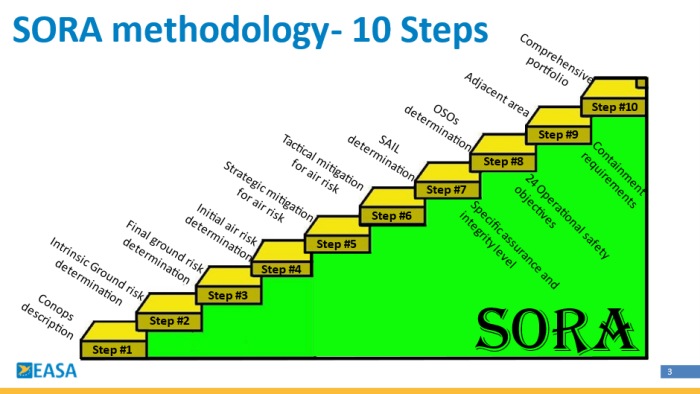
In Europe, the Specific Operations Risk Assessment (SORA) methodology provides a structured approach to assessing ground and air risks associated with certain UAV operations. The integration of UAVs into existing airspace therefore requires not only advanced technology but also appropriate procedures, personnel training, and regulatory compliance.
UAV Patrol Missions have emerged as a game-changer in the domains of security and efficiency. With their ability to provide real-time monitoring, enhance surveillance capabilities, and minimize risks to human lives, these missions have gained prominence across various industries. As technology continues to evolve, UAVs are expected to play an even more significant role in safeguarding our societies. By overcoming challenges and leveraging the potential of UAV technology, we can ensure a safer and more efficient future.
References and Further Reading:
- 1. AL-Dosari, K., Hunaiti, Z., & Balachandran, W. (2023). “Systematic Review on Civilian Drones in Safety and Security Applications.” Drones, 7(3), 210. https://doi.org/10.3390/drones7030210
- 2. International Civil Aviation Organization (ICAO). (2015). Manual on Remotely Piloted Aircraft Systems (RPAS) (Doc 10019, 1st ed.). ICAO. https://store.icao.int/en/manual-on-remotely-piloted-aircraft-systems-rpas-doc-10019
- 3. European Union Aviation Safety Agency (EASA). (2026). Easy Access Rules for Unmanned Aircraft Systems – Revision from June 2026. https://www.easa.europa.eu/en/document-library/easy-access-rules/easy-access-rules-unmanned-aircraft-systems
- 4. Federal Aviation Administration (FAA). (n.d.). Operate a Drone, Start a Drone Program. https://www.faa.gov/uas/public_safety_gov/drone_program
- 5. Strategies for Optimized UAV Surveillance in Various Tasks and Scenarios: A Review. (2024). Drones, 8(5), 193. https://doi.org/10.3390/drones8050193