
When there are great players in any industry, success can become a difficult thing to achieve. However, in the aviation industry there are always challenges to overcome and adversities to push through. Just like individuals who want to have a career around this great passion, companies need to do their best as well. One of these companies is Embraer, which was founded on the 19th of August 1969 in São Paulo, Brazil. Here on this blog post we will be discussing the history of Embraer S.A. and learning more about this multinational aerospace manufacturer serving worldwide.
The Founding And Early Growth Of Embraer
As the aviation industry was growing in the 40s and the 50s, Brazil wanted to become involved in this promising field. Although the early planning for this project started one or two decades before, Embrear was founded in 1969 after the 1964 Brazilian coup. The word Embraer comes from “Empresa Brasileira de Aeronáutica” and it means Brazilian Aeronautics Company in Portuguese. Following its founding, Embraer started out its production with Embraer EMB 110 Bandeirante, a small passanger plane.
During its early days, the company was growing at a slow but steady pace. The company initially focused largely on Brazil’s domestic requirements, Embraer soon began expanding into international markets. Also, Embreaer produced military aircraft in its early period. But another small plane that could carry up to 30 (EMB-120) passangers was built by Embraer and it started the journey which made the company a global player.
The EMB-120 Brasilia
Another important milestone came with the EMB-120 Brasilia, a 30-seat twin-turboprop regional airliner developed by Embraer in the early 1980s. The Brasilia made its first flight in 1983 and entered commercial service in 1985. It became an important international success for Embraer, particularly in the regional airline market, and helped strengthen the company’s presence outside Brazil. Its success also provided valuable experience that would later contribute to Embraer’s development as one of the world’s leading regional aircraft manufacturers.
Embraer’s Move Towards Success
Even though the early growth of Embraer seemed quite promising, the future didn’t look bright for the company some time later. Embraer was not doing well as a corporation solely owned by the Brazilian government and some privatization efforts started for the company during the 90s. Some mistakes made in the past put the company at risk of bankruptcy. The privatization efforts made Embraer much more dynamic with less bureaucracy to deal with.
Following its privatization in 1994, Embraer entered a new period of growth, focusing increasingly on commercial aviation while also expanding into the business jet market. One of the key products behind the company’s recovery was the ERJ 145, whose development had begun before privatization. The program was launched in 1989, and after several design changes, the aircraft made its first flight in 1995 and entered commercial service in 1997. The success of the ERJ family, which later included the ERJ 135 and ERJ 140, helped establish Embraer as a major player in the global regional jet market.
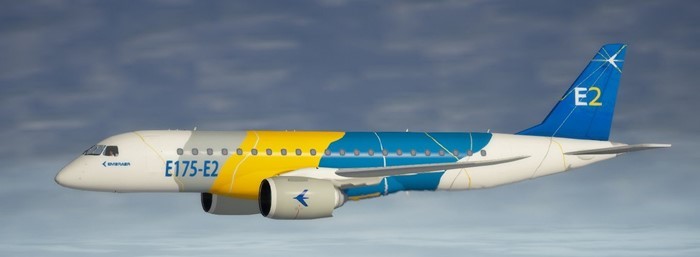
Building on this success, Embraer developed the E-Jet family, consisting of the E170, E175, E190 and E195. Introduced into commercial service in 2004, the E-Jets became one of Embraer’s most successful aircraft programs and significantly expanded the company’s presence in the international airline market. Embraer later introduced the E-Jets E2 family, featuring new-generation engines, redesigned wings and other efficiency improvements. Together, the ERJ, E-Jet and E2 programs played a central role in transforming Embraer from a struggling aircraft manufacturer in the early 1990s into one of the world’s leading commercial aircraft manufacturers.
Today And Tomorrow For Embraer
Today, Embraer is one of the world’s leading aerospace manufacturers, with operations spanning commercial aviation, executive jets, defense and security, and services and support. The company employs more than 23,000 people worldwide and has established a strong international presence with customers and operations across numerous countries.
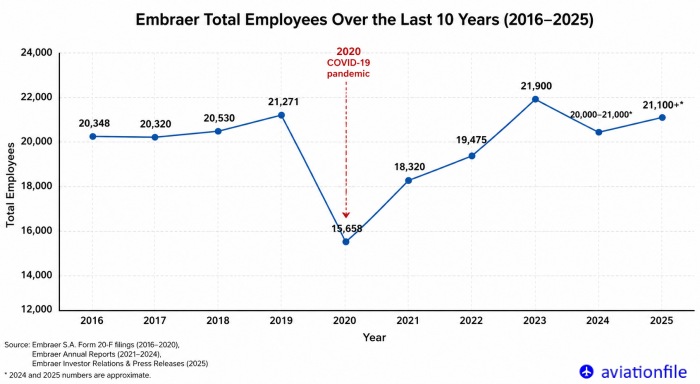
One of the most significant events in Embraer’s recent history was its proposed partnership with Boeing. Announced in 2018, the agreement would have transferred control of Embraer’s commercial aviation business to a new joint venture majority-owned by Boeing. However, the deal was terminated in April 2020 after Boeing stated that certain conditions of the agreement had not been satisfied, a position disputed by Embraer.
In the years that followed, Embraer demonstrated a strong recovery and continued to expand its position in the global aerospace industry. The E-Jets E2 family remains central to its commercial aviation business, while the Phenom and Praetor families have strengthened its position in executive aviation. In the defense sector, the C-390 Millennium and A-29 Super Tucano have attracted customers around the world. By mid-2026, Embraer’s order backlog had reached a record US$34.5 billion, reflecting strong demand across its businesses. More than five decades after its foundation, Embraer remains an important global aerospace company and continues to invest in new aircraft, technologies and international expansion.
Resources
- Anon. (n.d.), Embraer, Wikipedia, Retrieved 19 October 2021
< https://en.wikipedia.org/wiki/Embraer > - Embraer Editor (n.d.), About Us, Embraer, Retrieved 19 October 2021
< https://www.embraercommercialaviation.com/about-us/ > - Justin Hayward (15 October 2020), The Story Of Embraer, Simple Flying, Retrieved 19 October 2021
< https://simpleflying.com/the-story-of-embraer/ > - https://www.embraer.com/media-center/en/?mediatype=NEWS&detail=27143-Embraer-reports-65-aircraft-delivered-in-the-second-quarter%2C-up-48%25-quarter-over-quarter