
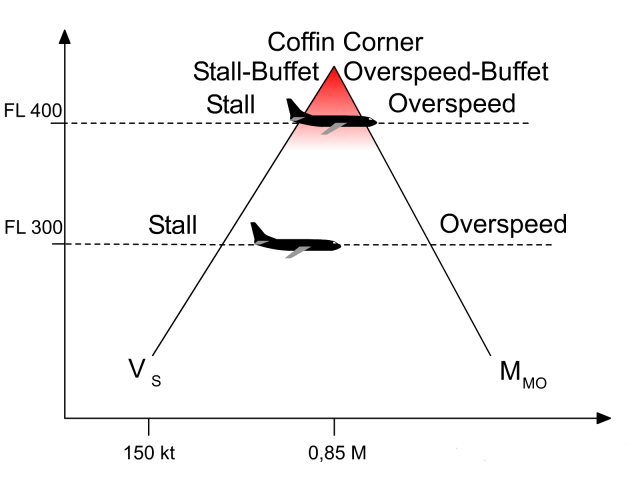
At high altitudes, aircraft operate within increasingly narrow aerodynamic limits. As altitude increases, the difference between low-speed and high-speed buffet boundaries decreases. This critical region of the flight envelope is known as coffin corner, also called Q-corner.
Understanding this phenomenon is particularly important for high-altitude jet operations, where maintaining adequate speed margins is essential for flight safety.
What Is Coffin Corner?
Coffin corner occurs when the low-speed buffet boundary and high-speed Mach buffet boundary approach each other near an aircraft’s aerodynamic ceiling. At the lower boundary, an aircraft may experience buffet associated with a high angle of attack, potentially leading toward a stall. At the upper boundary, compressibility effects and shock-wave-induced airflow separation may cause Mach buffet and handling difficulties. As these boundaries converge, the available operating speed range becomes extremely limited.
Understanding Stall Speed: The Minimum Speed to Keep You Flying Safely
Why Does Coffin Corner Occur?
At high altitudes, reduced air density requires an aircraft to maintain an appropriate combination of true airspeed and angle of attack to generate sufficient lift. Meanwhile, high-speed Mach limitations restrict its upper operating speed. As altitude increases, these aerodynamic boundaries move closer together, narrowing the safe operating envelope. Aircraft weight and load factor also affect the available buffet margin. Heavier aircraft, turbulence, and maneuvering can further reduce the margin between these limits.
Why Is Coffin Corner Dangerous?
The primary danger is the limited margin for changes in airspeed and aerodynamic loading.
- Flying too slowly: May cause low-speed buffet and potentially an aerodynamic stall.
- Flying too fast: May produce high-speed Mach buffet, airflow separation, and handling difficulties.
- Turbulence or maneuvering: Increased load factor can further reduce the available speed margin.
Coffin corner does not automatically cause a stall or loss of control, but operating near these boundaries increases aerodynamic risk.
How Do Pilots Avoid Coffin Corner?
Pilots manage the risk by maintaining adequate buffet margins and following aircraft-specific performance limitations.
Key precautions include:
- Selecting an appropriate cruising altitude based on aircraft weight and performance.
- Following approved airspeed, Mach number, and altitude limitations.
- Maintaining sufficient margins for turbulence and maneuvering.
- Using manufacturer performance data and approved operating procedures.
- Monitoring airspeed, Mach number, and aircraft performance.
Modern aircraft systems assist pilots in monitoring these limitations but cannot eliminate the underlying aerodynamic constraints.
Conclusion
Coffin corner describes a high-altitude condition in which the margin between low-speed and high-speed aerodynamic boundaries becomes very narrow. Although modern aircraft technology and pilot training help manage these risks, understanding the phenomenon remains essential for safe high-altitude flight.
The key principle is simple: at high altitude, both flying too slowly and flying too fast can become dangerous, with very little margin between them.
References: and Further Reading:
- Federal Aviation Administration (FAA). Airplane Flying Handbook, FAA-H-8083-3C, Chapter 16: High-Altitude Considerations. https://www.faa.gov/sites/faa.gov/files/regulations_policies/handbooks_manuals/aviation/airplane_handbook/17_afh_ch16.pdf
- Federal Aviation Administration (FAA). Advisory Circular AC 61-107B, Change 1: Aircraft Operations at Altitudes Above 25,000 Feet Mean Sea Level or Mach Numbers Greater Than .75. https://www.faa.gov/documentLibrary/media/Advisory_Circular/AC_61-107B_CHG_1.pdf
- Federal Aviation Administration (FAA). High Altitude Aerodynamics – Principles. https://www.faa.gov/sites/faa.gov/files/pilots/training/Appendix_3-E_HighAltOperations.pdf
Coffin corner image source: By https://de.wikipedia.org/wiki/User:RosarioVanTulpe – File:CoffinCorner.png, Public Domain, https://commons.wikimedia.org/w/index.php?curid=87376786