
An intersection takeoff is a departure from another lineup position instead of the runway end, without using the entire lenght of runway. You can see the figure below.
Before going further we must point that certain Phraseology must be used between the pilot and ATC communication while performing a interfection Take-off. Pilot must be informed about the available reduced take-off run distance. For further reading about Phraseology visit related article.
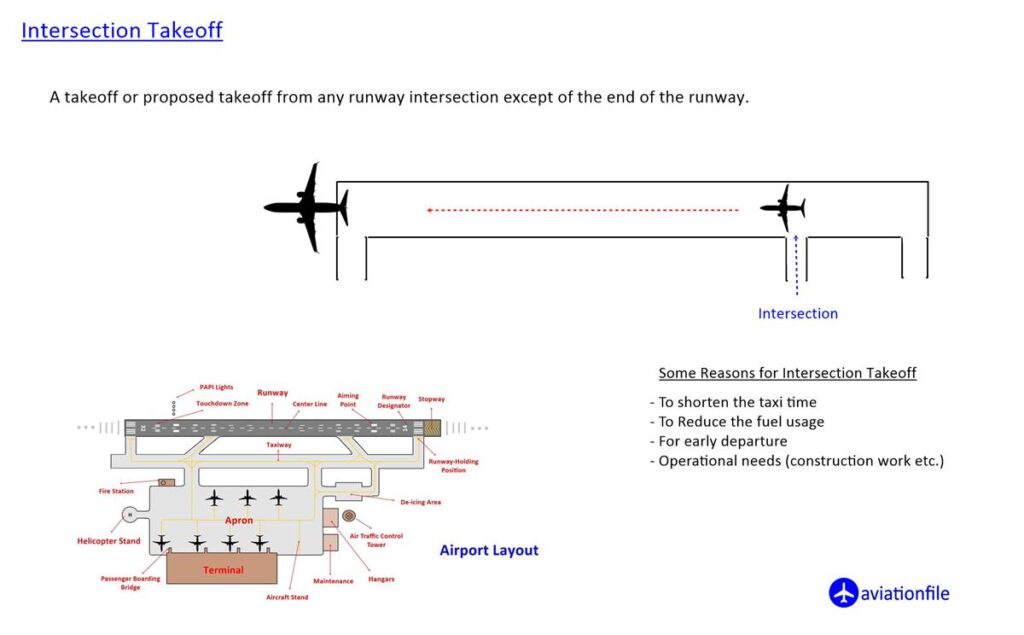
In airport operations, intersection takeoff is applied for many reasons. It can be conduct after the approval of the Air Traffic controller – ATC in charge. And pilot may request it for many reasons. Let’s look to some.
- It can be applied to speed up aircraft traffic.
- Can be requested by the pilot of the plane to reduce the taxi time.
- It may be necessary, due to the maintenance work on taxiway/runway.
- Light category aircraft and business jets generally need shorter distances for take-off than airliner aircraft. It can be requested by the pilots of this type of aircraft.
By shortening taxi distance in suitable operational circumstances, intersection departures can reduce taxi time and may consequently reduce ground fuel burn and associated emissions. Besides, the intersection takeoff implementation also carries some risks. For example, because an intersection departure reduces the runway distance available, flight crews must carefully consider takeoff performance, including accelerate-stop requirements and applicable declared distances, before accepting the departure.
Intersection Takeoffs in Busy Airports: Enhancing Efficiency Without Compromising Safety
Intersection takeoffs play a crucial role in maintaining operational efficiency at some of the busiest airports in the world, including Hartsfield-Jackson Atlanta International Airport (ATL) and London Heathrow Airport (LHR). These hubs, renowned for their high aircraft movements and limited runway availability, use intersection takeoffs to optimize their capacity while maintaining stringent safety standards.
Examples of Major Airports Using Intersection Takeoffs
- Hartsfield-Jackson Atlanta International Airport (ATL): As the world’s busiest airport by passenger volume and aircraft movements, ATL often employs intersection takeoffs to streamline departures. With five parallel runways operating simultaneously, intersection takeoffs allow controllers to expedite departures by reducing taxi times for aircraft already positioned near intersections. This practice ensures a smooth flow of traffic, especially during peak hours, and reduces the risk of bottlenecks on the taxiways.
- London Heathrow Airport (LHR): LHR faces constant pressure to maximize runway utilization. Intersection takeoffs are a common tool in Heathrow’s operational strategy, particularly for short-haul flights and smaller aircraft. By utilizing multiple intersections along its dual runways, Heathrow minimizes delays and maintains its high throughput, even under tight scheduling constraints.
Operational and Safety Considerations
An intersection departure reduces the take-off run available compared with a full-length departure. Therefore, flight crews must ensure that the available TORA and other applicable declared distances are sufficient for the aircraft’s calculated take-off performance under the prevailing conditions. The final decision to accept an intersection departure remains with the flight crew.
At some aerodromes, signs near designated intersection take-off positions indicate the remaining TORA, providing an additional safety layer. ATC may also provide the available TORA using standard phraseology when required.
Wake turbulence is another important consideration. Departures from different points along the same runway can affect the application of wake turbulence separation, particularly when a following aircraft begins its take-off roll from an intersection. Appropriate wake turbulence procedures and separation minima must therefore be applied.
Balancing Efficiency and Safety
While intersection takeoffs improve efficiency, busy airports like ATL and LHR take several measures to ensure safety remains the top priority:
- Precise Coordination Between ATC and Pilots: Controllers at these airports undergo rigorous training to manage intersection takeoffs. They ensure that pilots receive clear instructions about the remaining runway length, wind conditions, and any obstacles along the departure path.
- Runway Performance Calculations: Airports enforce strict protocols requiring pilots to calculate accurate takeoff performance metrics, including Takeoff Distance Available (TODA) and Accelerate-Stop Distance Available (ASDA), before accepting an intersection departure.
- Advanced Traffic Management Systems: Both ATL and LHR leverage cutting-edge air traffic control technologies to monitor runway usage in real time. These systems prevent conflicts and optimize the sequencing of departures, ensuring no safety compromises during high traffic periods.
- Regular Safety Audits: Airports conduct frequent safety audits to review the risks associated with intersection takeoffs and implement best practices. These audits help identify areas for improvement and keep procedures aligned with evolving aviation safety standards.