
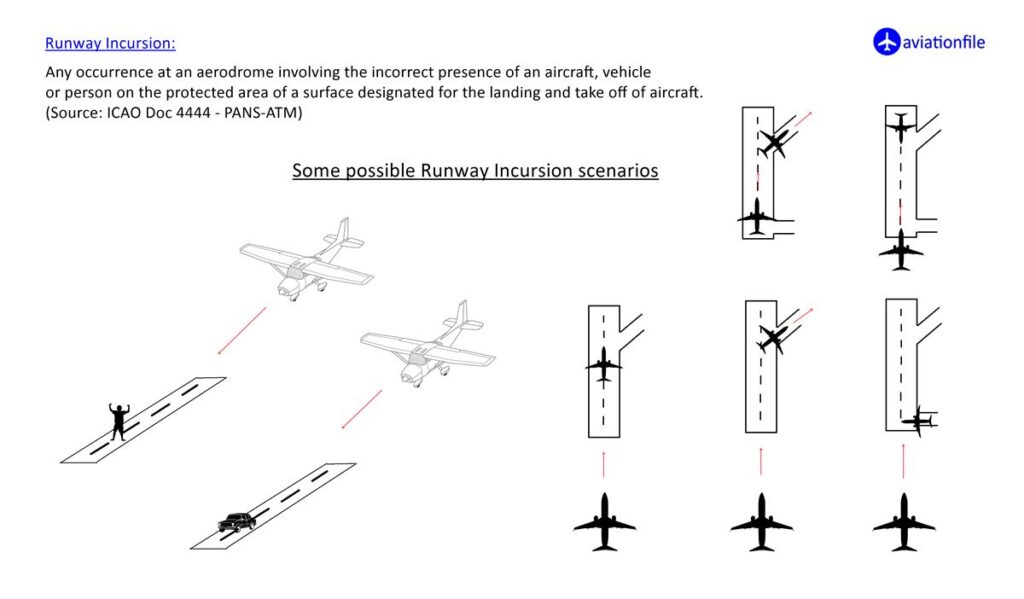
Runway incursions are serious aviation safety hazards that can lead to dangerous incidents or catastrophic accidents. They occur when an aircraft, vehicle, or person is incorrectly present in a protected runway area. Contributing factors include communication errors, reduced visibility, complex airport layouts, and loss of situational awareness.
Air traffic controllers play a vital role in preventing runway incursions by issuing clear instructions, monitoring aircraft and vehicle movements, and coordinating runway operations. Effective communication, accurate readback/hearback procedures, and the appropriate use of surveillance technologies are essential to minimizing these risks. The following sections highlight the key responsibilities and preventive measures undertaken by air traffic controllers to enhance runway safety.
Clear Communication:
Clear and effective communication is one of the most important factors in preventing runway incursions. Air traffic controllers must use standardized ICAO phraseology, issue precise and unambiguous instructions, and avoid unnecessary or confusing transmissions. Particular attention should be given to runway entry, crossing, and holding instructions, where misunderstandings can have serious consequences. Accurate readback/hearback procedures are essential to ensure that pilots and vehicle operators correctly understand safety-critical instructions. Controllers should immediately correct incorrect readbacks and maintain effective communication, especially during high-traffic periods and low-visibility operations.
- Use concise and unambiguous instructions when directing pilots.
- Confirm understanding with pilots to avoid misinterpretations.
- Maintain constant communication to track aircraft movements.
- Emphasize runway use and taxi instructions.
Heightened Awareness:
Maintaining a high level of situational awareness is essential for air traffic controllers to prevent runway incursions. Controllers must continuously monitor aircraft and vehicle movements, anticipate potential conflicts, and remain alert to changing operational conditions. Particular attention is required during peak traffic periods, low-visibility operations, and activities near runway intersections or designated hotspots. Effective visual observation, the appropriate use of available surveillance systems, and proactive coordination help controllers identify potential hazards early and take timely action to maintain runway safety.
- Actively monitor aircraft positions on radar and visually.
- Anticipate potential conflicts and take corrective action promptly.
- Be aware of weather conditions and low visibility situations.
- Utilize available technology, like ground radar and runway incursion detection systems.
Proactive Approach:
A proactive approach to runway safety involves identifying potential risks and taking preventive action before hazardous situations develop. Air traffic controllers should anticipate possible conflicts, assess changing traffic conditions, and apply appropriate safety measures to minimize runway incursion risks. Early coordination, timely intervention, and effective workload management are particularly important during complex ground operations. By recognizing potential threats and addressing them before they escalate, controllers can significantly contribute to safer and more efficient runway operations.
- Issue timely warnings to pilots if they deviate from instructions.
- Coordinate with other controllers to ensure smooth flow of traffic.
- Prioritize safety over expeditious operations.
- Report and analyze past incidents to identify potential weaknesses and improve procedures.
Continuous Improvement:
Continuous improvement is essential for maintaining and enhancing runway safety in an increasingly complex aviation environment. Air traffic controllers must regularly update their knowledge, strengthen operational skills, and adapt to evolving procedures and technologies. Recurrent training, simulation exercises, and the analysis of runway incursion incidents help identify safety risks and improve preventive measures. Furthermore, a strong safety reporting culture and the sharing of lessons learned encourage proactive risk management and support the ongoing reduction of runway incursion risks.
- Regularly participate in training and update knowledge on best practices.
- Embrace new technologies and adapt to evolving regulations.
- Share information and experiences with other controllers.
- Advocate for safety-enhancing measures within the air traffic control system.
By prioritizing clear communication, heightened awareness, and a proactive approach, air traffic controllers can significantly contribute to preventing runway incursions and ensuring the safety of everyone involved in air travel.
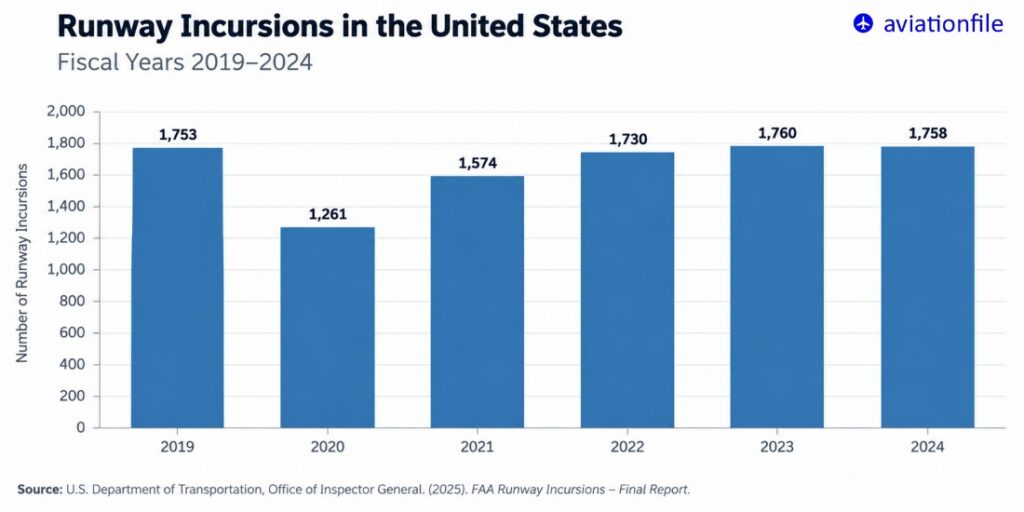
Figure: Runway Incursions in the United States (2019–2024). The chart presents the annual number of runway incursions reported by the Federal Aviation Administration (FAA) across U.S. airports during fiscal years 2019–2024. The data represent nationwide FAA-reported incidents rather than incidents limited to the 30 busiest U.S. airports (Core 30). The figures include runway incursions of varying severity and should not be interpreted as the number of accidents or collisions. The decline observed in 2020 should be considered in the context of reduced air traffic during the COVID-19 pandemic. Since the chart shows absolute incident counts rather than rates adjusted for aircraft movements, changes in these figures do not necessarily indicate equivalent changes in runway safety performance.
Source: U.S. Department of Transportation, Office of Inspector General (2025), FAA Runway Incursions – Final Report, Figure 1.
Further Reading and References:
- SE046: Air Traffic Control Runway Incursion Training: https://www.skybrary.aero/operational-issues/runway-incursion
- European Action Plan for the Prevention of Runway Incursions: https://www.icao.int/safety/RunwaySafety/GRSS2011/Documentation/Docs/European%20APPRI_finaweb.pdf
- Manual on the Prevention of Runway Incursions – ICAO: https://www.icao.int/safety/runwaysafety/documents%20and%20toolkits/icao_manual_prev_ri.pdf
- RUNWAY INCURSION PREVENTION PROGRAM – ICAO: https://www.icao.int/safety/runwaysafety/documents%20and%20toolkits/icao_manual_prev_ri.pdf
- European Air Traffic Controllers Assert Influence to Prevent Runway Incursions: https://skybrary.aero/articles/runway-incursion