
Standard/ Aeronautical phraseology is a set of communication rules for simplified English language communication between an air traffic controller and the pilots of an aircraft. In the majority of countries, the standard phraseology in use is based on standards developed by the ICAO. Standard phraseology is one of the most important factors in the communication process in aviation. It enables fast, effective, and safe communication despite cultural and language differences. It also minimizes the risk of potential misunderstanding.
Standard phraseology reduces the risk that a message will be misunderstood and aids the read-back/hear-back process so that any error is quickly detected. The use of nonstandard phraseology may cause misunderstandings due to its nature. For this reason, the use of non-standard phraseology can lead to the reasons for many problems and accidents in aviation.
ICAO standardized phraseology should always be used whenever applicable. However, aviation cannot anticipate every possible situation. During unusual, abnormal, or emergency circumstances where no standard phraseology exists, pilots and controllers may use clear and concise plain language to ensure safe and effective communication.
In addition to all these, non-standard phraseology can have a positive effect if it is implemented carefully to find a solution to a specific situation. However, it should be considered that the use of non-standard phraseology may cause conflicts between ATC and pilot. In order to avoid this, necessary care should be taken.
International standards of phraseology are laid down in
- ICAO Annex 10 Volume II Chapter 5
- ICAO Doc 4444 Chapter 12
- ICAO Doc 9432 – Manual of Radiotelephony
Many national authorities also publish radiotelephony manuals that amplify ICAO provisions. Moreover, in some cases modify them to suit local conditions.
ICAO Language Proficiency
Standard phraseology alone cannot cover every operational situation. For this reason, ICAO also requires pilots and air traffic controllers involved in international operations to demonstrate English language proficiency. The combination of standardized phraseology and plain-language communication helps maintain safety during both routine and unexpected situations.
Recent ICAO Phraseology Updates
ICAO periodically revises standard phraseology to improve clarity and reduce misunderstandings. Recent updates include harmonized phraseology for SID and STAR procedures, clearer wording for cancelling speed or altitude restrictions, and standardized instructions for modifying lateral flight paths. These revisions help ensure greater consistency between pilots and air traffic controllers worldwide.
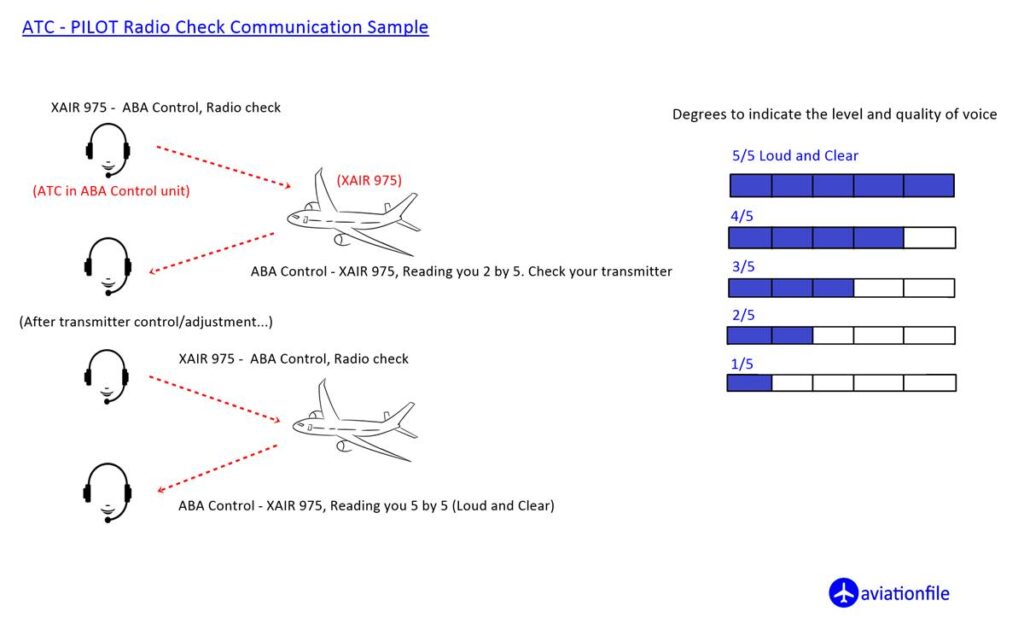
A radio check is performed to mutually confirm the quality of R/T communication between ATC and pilot. You can see it in the figure below.
Recommended: Controller Pilot Data Link Communication (CPDLC)
Standard aeronautical phraseology is much more than a collection of standard words. It is an internationally recognized safety tool that enables pilots and air traffic controllers to communicate quickly, accurately, and unambiguously. Consistent use of ICAO phraseology, combined with effective plain-language communication when necessary, continues to play a critical role in preventing misunderstandings and enhancing global aviation safety.