
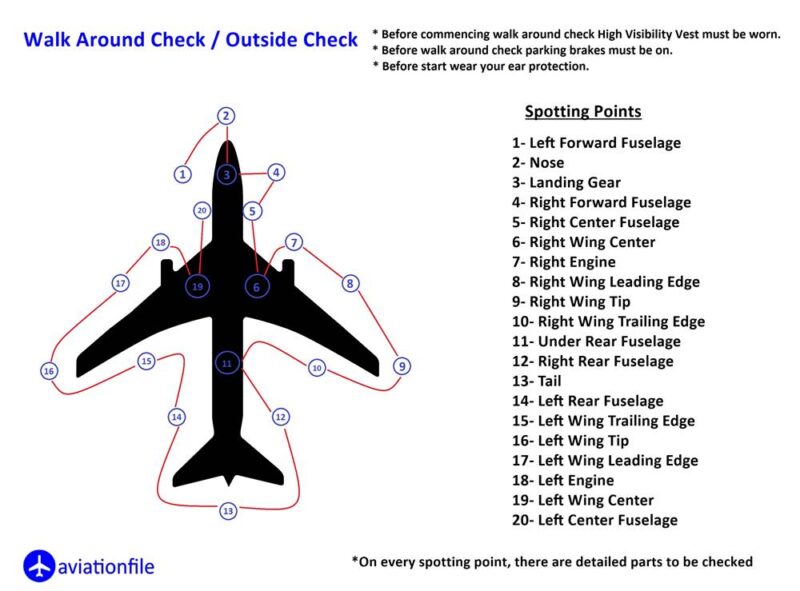
Aircraft are subjected to a number of control procedures after landing or before taking off from the airport. One of these procedures is Walk around Check / Outside Check. A walk-around check is a preflight process.
In this procedure, situations that may prevent the next flight, such as whether there is a visible error, defect, wear, fracture, blockage, or damage, are detected. Usually this check is done visually by a professional walking around the plane. Or, thanks to the developing technology, these controls can be made with the help of specialized drones.
This can be done by the line maintenance personnel or by the pilot of the aircraft.
The purpose of Walk around Check / Outside Check is to determine whether there is a malfunction in the current state of the aircraft that may cause problems to the next flight. A malfunction detected during walk around check is resolved, thus increasing flight safety.
Every Aircraft Has Its Own Walk-Around Procedure
While the purpose of a walk-around inspection is the same across all aircraft—to identify visible issues before flight—there is no single inspection sequence that applies to every airplane. Each aircraft type has a manufacturer-approved preflight inspection checklist tailored to its specific design, systems, and operational requirements. For example, the walk-around procedures for a Boeing 737, Airbus A320, Cessna 172, and Diamond DA40 differ in both the inspection route and the items that must be checked. Pilots are trained to follow the checklist provided in the aircraft’s official flight manual or operating handbook, ensuring that all required inspection points are completed consistently and correctly.
Why Pilots Physically Check Certain Components
Although a walk-around inspection is primarily a visual examination, some items require a physical check to confirm they are secure and functioning as expected. Depending on the aircraft type, pilots may verify that fuel caps are properly fastened, remove pitot tube covers before flight, check oil quantity, inspect fuel drains for contamination on many general aviation aircraft, and gently examine components such as hinges or static wicks for signs of damage or looseness. Tires are also assessed not only for visible damage but for proper inflation based on their appearance and condition. These hands-on checks help identify issues that may not be obvious through visual observation alone, adding an extra layer of safety before departure.
Walk-Around Inspections in General Aviation vs. Commercial Airlines
Although the purpose of every walk-around inspection is to verify that the aircraft is ready for flight, the inspection itself can vary significantly between general aviation and commercial airline operations. In general aviation, pilots typically perform a more hands-on inspection because they are often directly responsible for assessing the aircraft’s condition before departure. This may include checking the oil quantity, sampling fuel for water or other contaminants, verifying the movement of control surfaces, and ensuring fuel caps and drains are secure.
In contrast, airline pilots primarily conduct an external visual inspection focused on identifying obvious abnormalities such as fuselage damage, fluid leaks, tire condition, landing gear integrity, engine fan blade damage, loose access panels, antennas, static ports, lights, and the engine inlet. Commercial aircraft also undergo regular inspections and maintenance by certified maintenance personnel, but the flight crew’s walk-around remains an essential final safety check to identify any visible issues that may have developed since the aircraft was last serviced or operated.
Walk around check is an extremely important procedure for flight safety. For example, a hydraulic leak or physical damage on the landing gear may cause an accident on the runway during the next landing or during take-off. Or a leak or crack in the aircraft wing may lead to serious incidents during flight.
References and Further Reading:
- https://www.easa.europa.eu/en/faq/48482?
- https://www.faa.gov/regulations_policies/advisory_circulars/index.cfm/go/document.information/documentID/1036892?
- https://nbaa.org/news/business-aviation-insider/2025-11/maintenance-tips-for-preflight-walk-around-inspections/
- https://asrs.arc.nasa.gov/publications/callback/cb_521.html
For more articles click.