
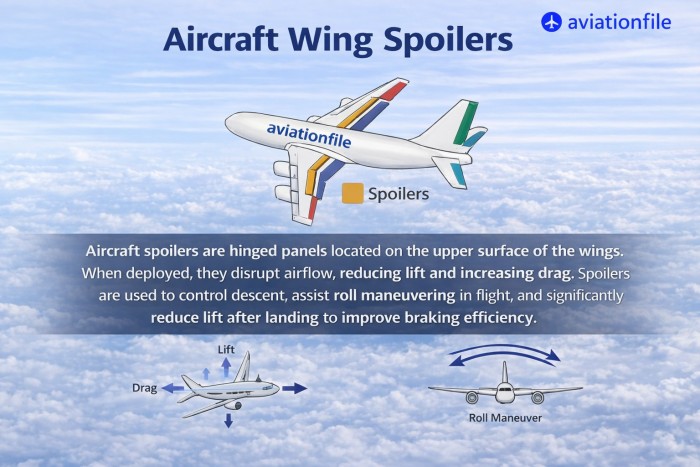
Airplane spoilers are among the most essential yet often misunderstood flight control surfaces on an aircraft. Commonly mistaken for air brakes or speedbrakes, spoilers are aerodynamic devices that play multiple roles during flight and ground operations. Their main function is to reduce lift and increase drag (Four Forces of Flight), helping pilots manage descent rates, control roll, and ensure efficient braking after landing.
What Is a Spoiler?
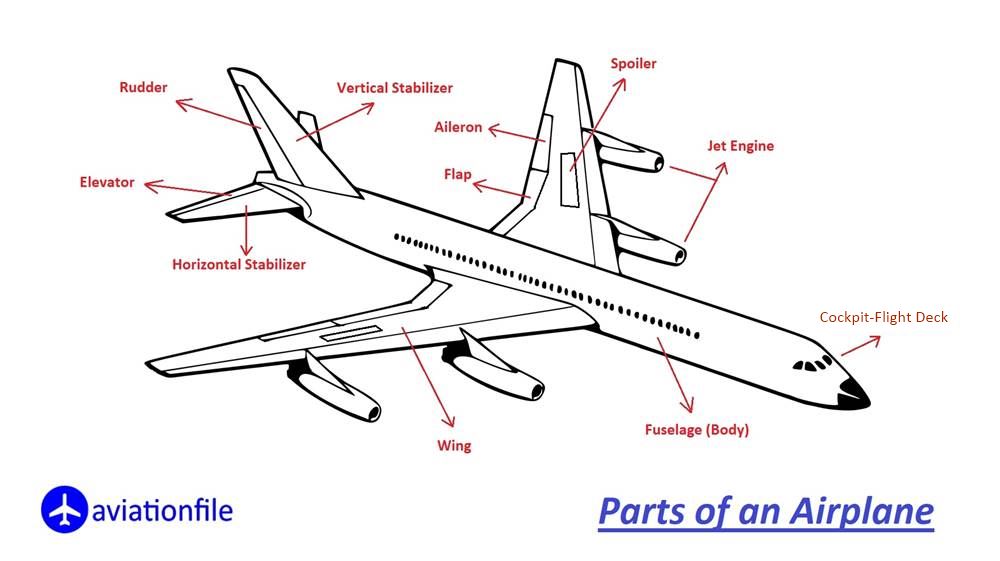
A spoiler is a movable panel located on the upper surface of the wing. When deployed, it disrupts the smooth airflow over the wing, decreasing lift while increasing drag. This effect allows the aircraft to descend more rapidly without accelerating excessively.
Unlike air brakes—which primarily increase drag without significantly affecting lift—spoilers directly impact lift production. This makes them critical in both aerodynamic control and landing performance.
Why Spoilers Are Used
Spoilers serve several important purposes during various phases of flight:
- Descent Control:
By deploying spoilers symmetrically on both wings, pilots can increase the descent rate without gaining excessive airspeed. - Roll Control:
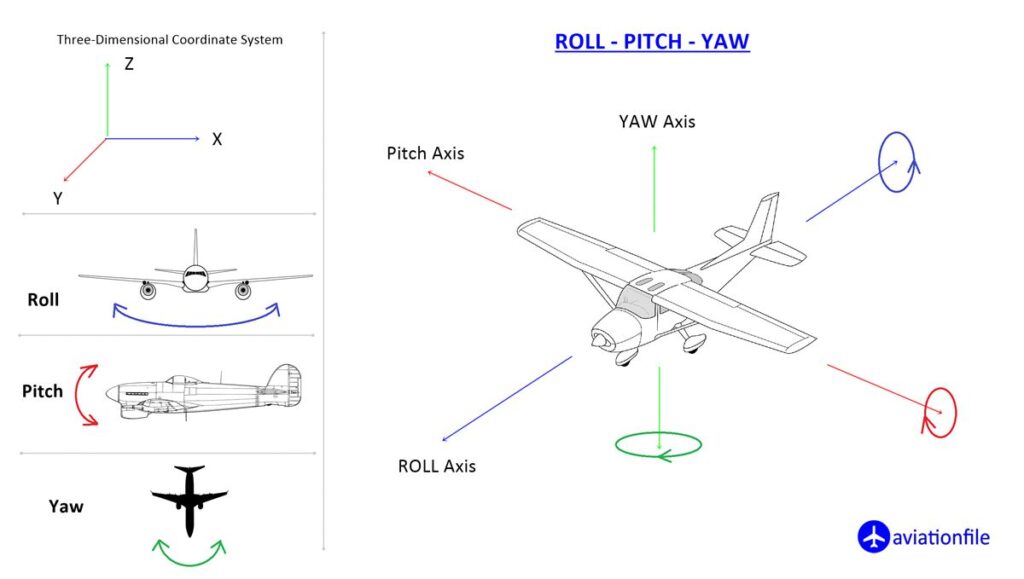
Some aircraft use spoilers asymmetrically to assist ailerons in rolling the aircraft. These are known as spoilerons. They help reduce adverse yaw and improve roll response, especially at higher speeds. (Understanding Roll, Pitch, and Yaw: The Three Axes of Flight) - Ground Lift Dumping:
Upon landing or during a rejected takeoff, spoilers deploy fully to “dump” the remaining lift. This transfers the aircraft’s weight onto the wheels, enhancing braking performance and reducing stopping distance.
Types of Spoilers
While they may look similar in design, spoilers are categorized by their operational role:
| Type | Description | Primary Use |
|---|---|---|
| Roll Spoilers (Spoilerons) | Deployed on one wing to assist or replace aileron control during turns. | Roll control during flight |
| Flight Spoilers / Speedbrakes | Deployed symmetrically to increase drag and reduce lift for descent or speed reduction. | Altitude and speed management |
| Ground Spoilers / Lift Dumpers | Deployed fully on touchdown to destroy lift and maximize wheel braking efficiency. | Landing and rejected takeoff braking |
Modern airliners often integrate all three functions into the same spoiler panels, with computer-controlled deployment logic determining the angle and timing based on flight conditions.
How Spoilers Work
When activated, spoilers rise into the airflow, disturbing the laminar flow across the upper wing surface. This results in a sharp reduction of the wing’s local lift coefficient and an increase in drag.
During flight, spoiler deflection angles are limited to avoid stall or instability. On the ground, however, they can deploy to full range for maximum lift dumping.
Deployment is typically governed by automatic systems:
- In flight, the pilot manually controls spoiler use for descent or roll.
- During landing, the ground spoilers are usually armed before touchdown and automatically deploy when sensors detect weight on the wheels or reverse thrust activation.
Speedbrake vs. Spoiler — What’s the Difference?
Though often used interchangeably, the difference lies in purpose:
- A spoiler reduces both lift and speed by disturbing airflow over the wing.
- A speedbrake primarily increases drag to slow the aircraft, without significantly affecting lift.
Some aircraft have dedicated fuselage-mounted speedbrakes, while others combine both functions within the same wing panels.
Spoiler Operation During Landing
The spoiler system is crucial for safe and efficient landings. Here’s what happens step-by-step:
- Before Touchdown: Pilots arm the spoilers.
- At Touchdown: Automatic deployment occurs when weight-on-wheels is detected, thrust levers are at idle, or reversers are engaged.
- Lift Dumping: Lift is destroyed, increasing tyre contact and brake efficiency.
- Braking & Reverse Thrust: The combined drag and braking effect reduce landing roll distance.
- Stowage: Spoilers retract once the aircraft slows to taxi speed.
A failure of spoiler deployment can result in longer landing rolls or even runway overruns, underscoring their importance in flight safety.
Maintenance and Safety Considerations
Regular maintenance of spoiler actuators, linkages, and sensors is essential. Malfunctioning spoilers can lead to asymmetric lift reduction or degraded braking performance.
Routine checks during inspections ensure that spoiler arming, deployment logic, and retraction systems function properly.
Key Takeaways
- Spoilers are aerodynamic surfaces designed to reduce lift and increase drag.
- They perform multiple roles: roll control, descent management, and lift dumping on landing.
- Proper arming and deployment are critical for safe landing performance.
- Spoiler terminology can vary—what matters most is understanding their aerodynamic purpose and phase-of-flight function.
Conclusion
From subtle flight adjustments to critical landing performance, spoilers are indispensable components of modern aircraft. Their ability to control lift, drag, and roll makes them vital for both efficiency and safety. Understanding how spoilers work not only enhances a pilot’s technical knowledge but also provides insight into one of aviation’s most effective aerodynamic tools.
References and Further Reading:
- SKYbrary Aviation Safety – Spoilers and Speedbrakes
https://skybrary.aero/articles/spoilers-and-speedbrakes - Wikipedia – Spoiler (Aeronautics)
https://en.wikipedia.org/wiki/Spoiler_(aeronautics) - Wikipedia – Spoileron
https://en.wikipedia.org/wiki/Spoileron - Aviation Stack Exchange – Difference Between Air Brakes, Spoilers, and Lift Dumpers
https://aviation.stackexchange.com/questions/22590/what-are-the-differences-between-air-brakes-spoilers-and-lift-dumpers