
Continuous Climb Operations (CCO) and Continuous Descent Operations (CDO) are advanced flight techniques designed to optimize aircraft vertical profiles by minimizing level-offs during climb and descent. Enabled by modern airspace design, performance-based navigation (PBN) procedures, and close coordination with air traffic control, these operations allow aircraft to climb and descend in a more continuous, efficient, and environmentally sustainable manner. By reducing unnecessary thrust changes and maintaining optimal flight paths, CCO and CDO contribute significantly to lower fuel consumption, reduced emissions, and decreased noise impact around airports.
Recommended: https://www.aviationfile.com/what-is-free-route-airspace-fra/
Benefits of CCO & CDO
- Reduced pilot and air traffic controller workload, achieved through fewer radio transmissions and decreased need for tactical ATC interventions.
- Lower fuel consumption, enabled by maintaining optimal engine thrust settings throughout continuous climb and descent profiles.
- Operational cost savings, driven by improved fuel efficiency and optimized flight trajectories.
- Reduced CO₂ emissions, contributing to more environmentally sustainable aviation operations.
- Lower noise impact, particularly in terminal areas, due to smoother and more predictable descent profiles.
- More efficient airspace utilization, supporting improved traffic flow and overall system performance.
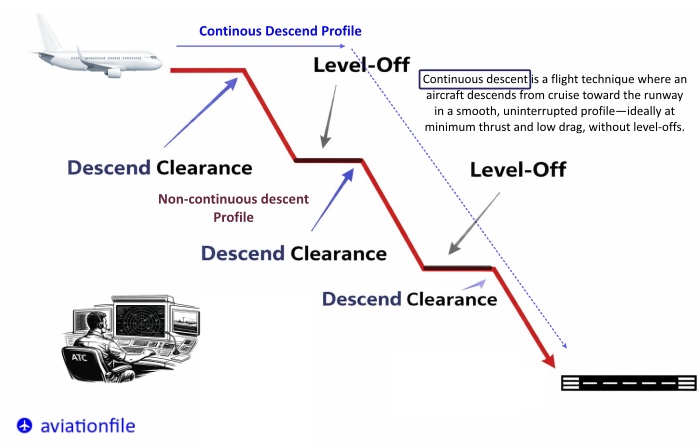
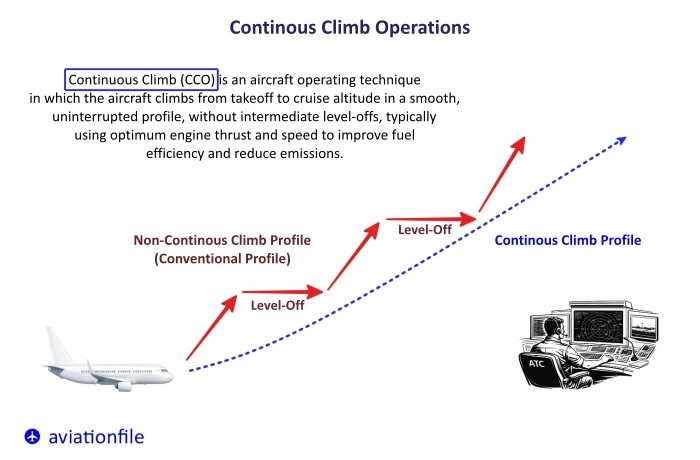
By removing level-offs which require high thrust in order to maintain a level flight in low altitudes on the approach phase, environmental and financial savings can be achieved with the help of continuous operations. (Level-offs are temporary periods during climb or descent when an aircraft stops changing altitude and flies at a constant flight level, usually due to air traffic control instructions or operational constraints.)
What’s the buzz?
CCO & CDO are innovative flight techniques optimizing your climb and descent, slashing fuel burn and emissions. Think less level flight and more continuous gliding towards your destination.
Climb smarter, descend smoother:
- CCO: Power up with optimal engine thrust and speeds, reaching cruising altitude efficiently. No more wasteful step climbs!
- CDO: Dive into fuel-saving descents, minimizing time at lower altitudes where engines guzzle gas. Think steady, controlled drops.
Ready to take off?
CCO & CDO require collaborative effort: airlines, air traffic control, and airspace design all working together. But the rewards are worth the ride – a win-win for airlines, the environment, and passengers.
“Continuous” Does Not Mean Fully Uninterrupted
In operational reality, the term “continuous” in Continuous Climb Operations (CCO) and Continuous Descent Operations (CDO) does not imply a perfectly uninterrupted vertical profile. According to EUROCONTROL and International Civil Aviation Organization guidance, these procedures are designed to be performed “to the greatest extent possible.”
In practice, temporary level-offs or deviations may still occur due to factors such as traffic sequencing, separation requirements, airspace constraints, or weather conditions. Air traffic control may need to intervene to maintain safe and efficient traffic flow, particularly in high-density terminal areas.
Therefore, describing CCO or CDO as operations with no level-offs at all is technically misleading. Instead, they should be understood as optimized profiles that aim to minimize interruptions rather than eliminate them entirely.
ATC Role in CCO/CDO
Continuous Climb and Descent Operations are not pilot-only techniques; they depend on effective air traffic control (ATC) facilitation, as well as compatible airspace and procedure design. As highlighted by EUROCONTROL and International Civil Aviation Organization, these operations are enabled through close coordination between pilots, ATC, and airspace structures.
Focusing solely on pilot actions overlooks this critical operational dimension and provides an incomplete understanding of how CCO/CDO are actually implemented.
In conclusion, CCO and CDO are key techniques for improving efficiency, reducing fuel burn, emissions, and noise in modern aviation. However, their effectiveness depends on airspace design, procedures, and ATC coordination, not just pilot actions. Rather than perfectly uninterrupted profiles, they should be seen as optimized operations that minimize level-offs as much as possible while maintaining safety and traffic flow.
References and Further Reading
- EUROCONTROL CCO/CDO: https://www.eurocontrol.int/concept/continuous-climb-and-descent-operations
- ICAO MID CCO/CDO Workshop: https://www.icao.int/MID/Documents/2022/CCO-CDO%20Workshop/PPT%201.1%20-%20CCO%20CDO%20overview.pdf
- SKYbrary CCO: https://skybrary.aero/articles/continuous-climb-operations-cco
Content editor: https://www.linkedin.com/in/sermetozturk