
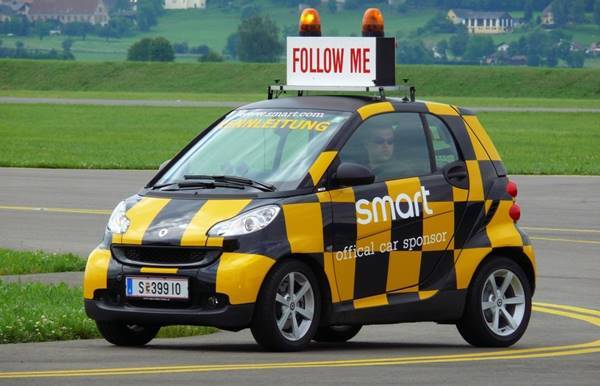
Follow-me vehicles are integral to airport operations, providing vital assistance in guiding aircraft safely to gates, taxiways, and runways. These specially marked vehicles, often equipped with lights and signage, play a crucial role in improving airport safety, efficiency, and sustainability. Let’s explore how follow-me vehicles contribute to smoother airport functions.
Enhancing Safety
Follow-me vehicles ensure that planes safely navigate busy or unfamiliar airports. Pilots rely on these vehicles, especially when facing complex airport layouts, poor weather conditions, or low visibility. By providing a clear visual guide, follow-me vehicles help prevent runway incursions and misrouting incidents. According to Skybrary, they are often used in low visibility procedures to ensure pilots follow safe paths, especially at large, complicated airports (Skybrary).
Improving Operational Efficiency
Airports handle thousands of flights daily, and follow-me vehicles contribute significantly to maintaining timely operations. By guiding aircraft through optimal taxi routes, they reduce congestion and help avoid delays. This improvement in efficiency benefits both airlines and passengers. For instance, International Airport Review highlights how these vehicles help pilots unfamiliar with a location, ensuring they navigate without errors, which keeps the flow of ground traffic steady and smooth (International Airport Review).
Reducing Fuel Consumption and Environmental Impact
Where follow-me guidance helps avoid wrong turns, unnecessary stops or route uncertainty, it may also indirectly reduce additional taxi time and associated fuel burn. However, this is a secondary operational benefit rather than the primary purpose of follow-me services. (Airport Technology) (IATA).
Recommended: Average Taxi Time of Airports
Enhancing Communication
In addition to providing visual guidance, follow-me vehicles can serve as an additional means of directing aircraft when conventional communication is limited or unavailable. For example, local contingency procedures may use follow-me guidance in the event of radio communication difficulties. By providing pilots with clear visual guidance along the designated route, these vehicles can support safe aircraft movement without relying exclusively on verbal instructions. (Skybrary).
Coordination Between Follow-Me Vehicles, Aerodrome Operations and ATC
Air Traffic Control (ATC) plays a pivotal role in coordinating follow-me vehicle operations, ensuring that aircraft are safely guided across complex airport layouts. ATC is responsible for instructing the follow-me vehicle when to assist an aircraft, particularly in low visibility conditions or when guiding unfamiliar pilots. The vehicle operators maintain constant communication with ATC to avoid conflicts with other aircraft and ground vehicles. ATC provides clearance for follow-me vehicles to enter active taxiways and runways, ensuring that the vehicle’s movements align with the broader air traffic flow (Skybrary) (IATA).
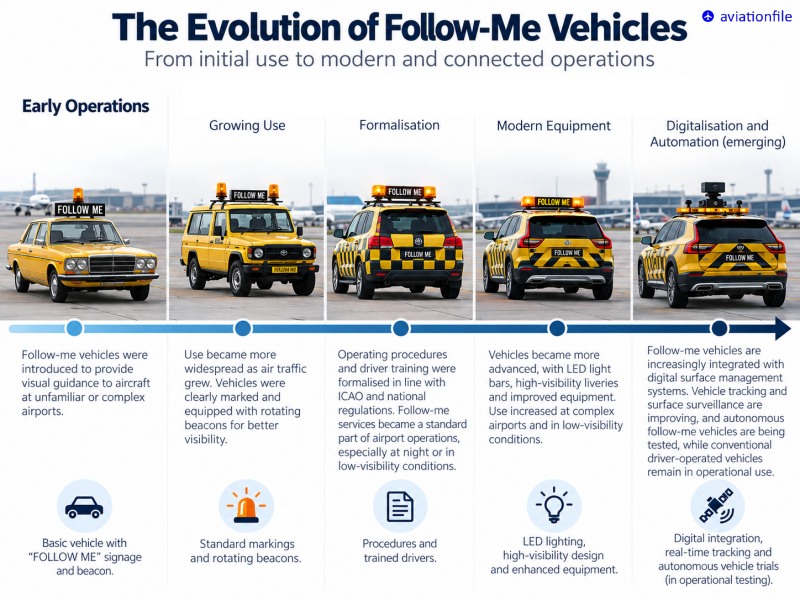
The Future of Follow-Me Vehicles: Automation and Digitalisation (2026)
Airport ground operations are gradually moving toward greater automation. Recent research has explored unmanned Follow-Me vehicles, while airports are increasingly testing autonomous electric vehicles for functions such as crew transport, cargo movement and aircraft towing. At the same time, European research initiatives such as SESAR’s ASTAIR project have examined how autonomous and manually operated vehicles could be integrated into a common digital surface-management environment.
For now, conventional Follow-Me vehicles and trained drivers remain an important part of airport operations. However, advances in autonomous driving, digital surface management and vehicle-to-infrastructure connectivity may gradually transform how visual aircraft guidance is provided at future airports.
Conclusion
Follow-me vehicles are an essential tool in modern airports. By improving safety, boosting operational efficiency, reducing environmental impact, and enhancing communication, these vehicles ensure a smoother and safer airport experience. Their contribution to reducing fuel consumption and emissions further underscores their role in supporting the aviation industry’s sustainability goals.
By investing in these systems, airports can streamline operations, cut costs, and contribute to global sustainability efforts—all while ensuring the safety of aircraft, crew, and passengers.
References
- ICAO. (2020). PANS–Aerodromes (Doc 9981), 3rd ed. International Civil Aviation Organization.
- ICAO. Annex 14, Volume I – Aerodrome Design and Operations. International Civil Aviation Organization.
- EASA. (2026). Easy Access Rules for Aerodromes (Regulation (EU) No 139/2014).
- EASA. (2026). ADR.OPS.D.080 – Training and Proficiency of Marshallers and Follow-Me Drivers.
- FAA. (2015). AC 150/5210-20A – Ground Vehicle Operations on Airports. Federal Aviation Administration.
- FAA. (2010). AC 150/5210-5D – Painting, Marking, and Lighting of Vehicles Used on an Airport.
- https://www.faa.gov/airports/new_entrants/agvs_on_airports
- https://www.sesarju.eu/projects/ASTAIR